
A parks department wants CLAUDE.md and tool schemas managed like other IT assets. How should they classify them?
Select an answer to reveal the explanation.
Short Explanation
CLAUDE.md isn't scrap paper—it's knobs and dials. Track it like any other CMDB configuration item.
Full Explanation
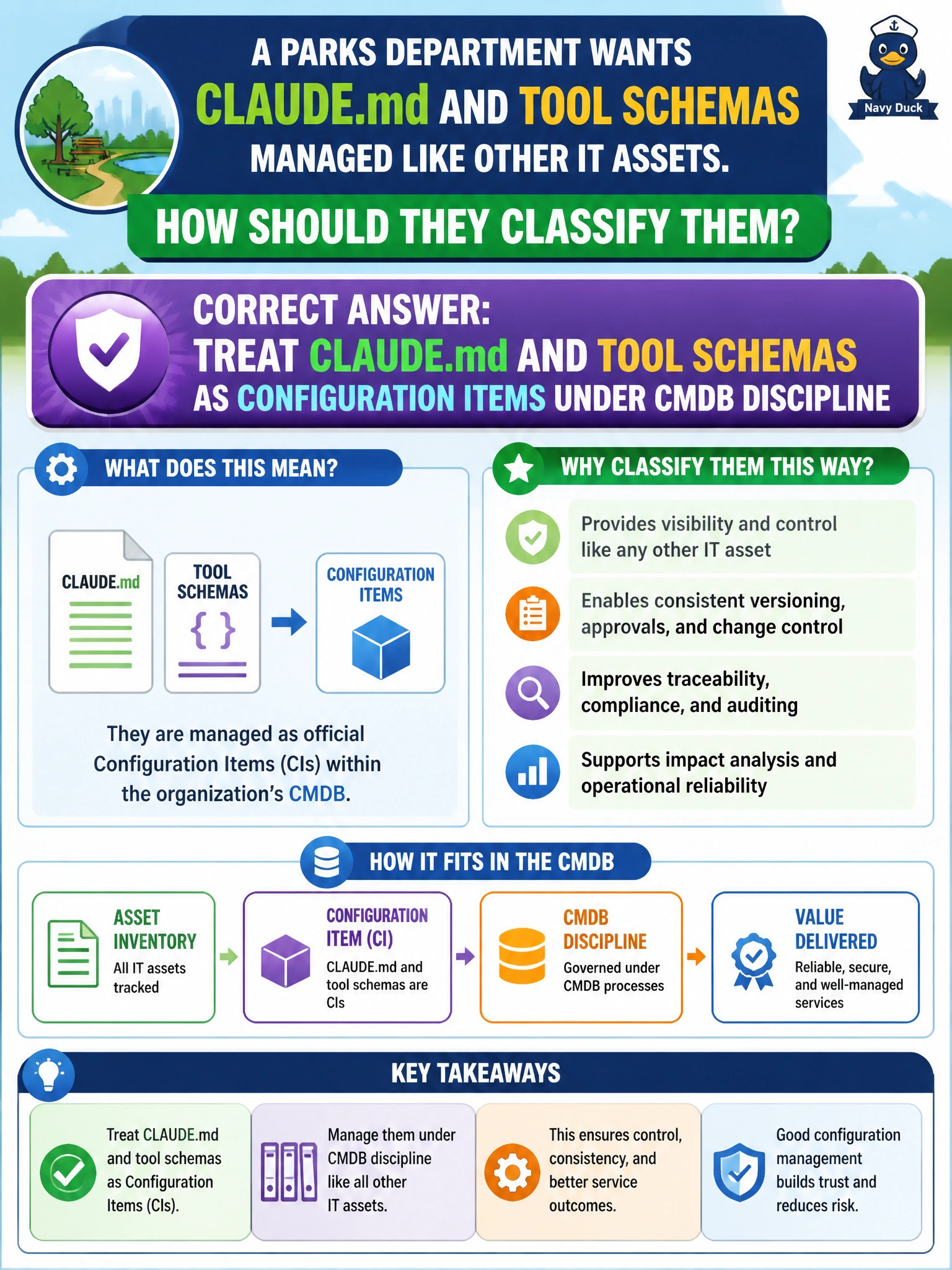
Parks departments that rely on CLAUDE.md and tool schemas to steer agents must manage those files as IT configuration, not disposable notes. Treating CLAUDE.md and tool schemas as configuration items under CMDB discipline is correct because they encode behavioral policy, tool contracts, and operational constraints that change service outcomes. CMDB-style classification brings ownership, versioning, change history, and promotion rules—the same controls applied to other municipal configuration assets.
Managing them as knowledge articles under a content publishing workflow fails because editorial review and publication do not provide configuration control; CLAUDE.md content drives runtime behavior and must be versioned and change-controlled as a CI. Classifying them as software licenses tracked in procurement renewals fails because they are configuration artifacts, not purchase entitlements, and license tracking offers no versioning, change history, or environment promotion. Monitoring them as service metrics in performance dashboards fails because dashboards observe outcomes but do not enforce ownership, version control, or change tickets for production edits.
Exam caveat: configuration-item questions often hide distractors that reclassify CIs as knowledge articles, software licenses, or service metrics—content and operational effect matter more than publishing or reporting format. Keep parks CLAUDE.md/tool-schema framing. Operational check: register CLAUDE.md and tool schemas as CIs, version them in controlled repos, require change tickets for production edits, and reconcile running agent config against the CMDB record.