
A court IT board will allow production Claude access to sealed case metadata only after which gate?
Select an answer to reveal the explanation.
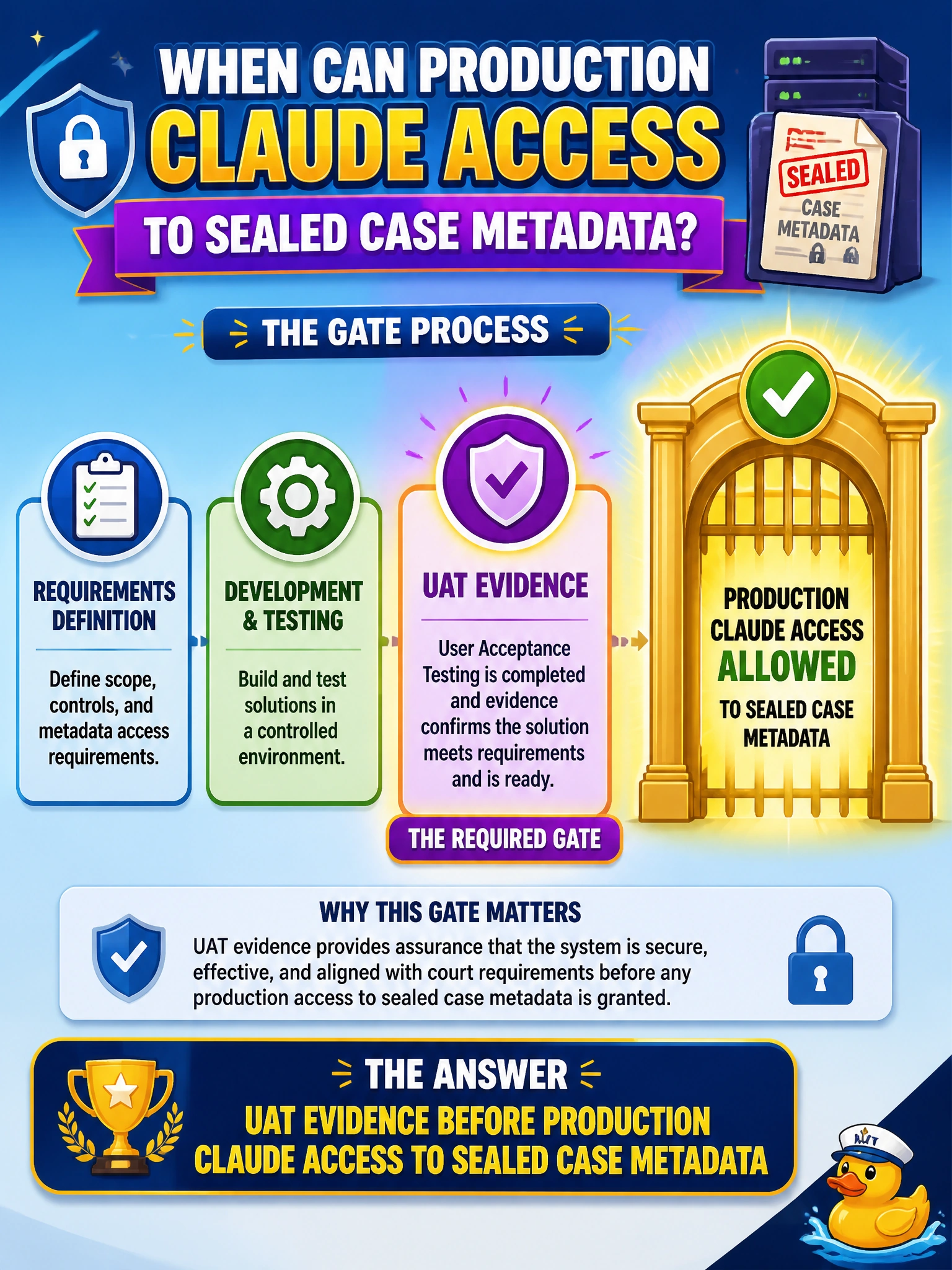
Short Explanation
Sealed case metadata is the vault. You'll need UAT receipts before Claude gets the keys—not SIT sign-off for court records interfaces.
Full Explanation
Court IT boards gate production Claude access to sealed case metadata behind acceptance evidence. Requiring UAT evidence before that access is correct because sealed materials carry heightened confidentiality and due-process risk; test and acceptance gates in the Claude application life cycle must prove controls, redaction behavior, authorization, and logging before production entitlements expand. Conceptually this is least-privilege staging: capability is earned by evidence, not by court-records interface SIT completion.
Relying on SIT completion evidence for court records system interfaces fails by concept: interface testing is not acceptance evidence for Claude's sealed-metadata controls and cannot be audited as production authorization. Load test evidence for public docket search concurrency levels fails sequencing: public search performance testing does not validate Claude's sealed-metadata controls before production entitlements expand. Completed operational readiness approval for helpdesk support transition fails factually—helpdesk readiness is not acceptance evidence for Claude's sealed-metadata controls, and substituting it inverts risk logic by treating support handoff as proof of data protection.
Exam caveat: sealed/sensitive data access items expect UAT-before-production, not court-records interface SIT evidence alone. Do not pick helpdesk operational-readiness substitutions for sealed-metadata acceptance. Keep court sealed-case framing. Operational check: complete UAT scripts for authorization, leakage, and logging; attach evidence to the go-live package; grant production sealed-metadata access only after board acceptance; and re-test after prompt or model changes.