
A public-health app team wants to stay safe across Claude model releases. Which life-cycle practice fits?
Select an answer to reveal the explanation.
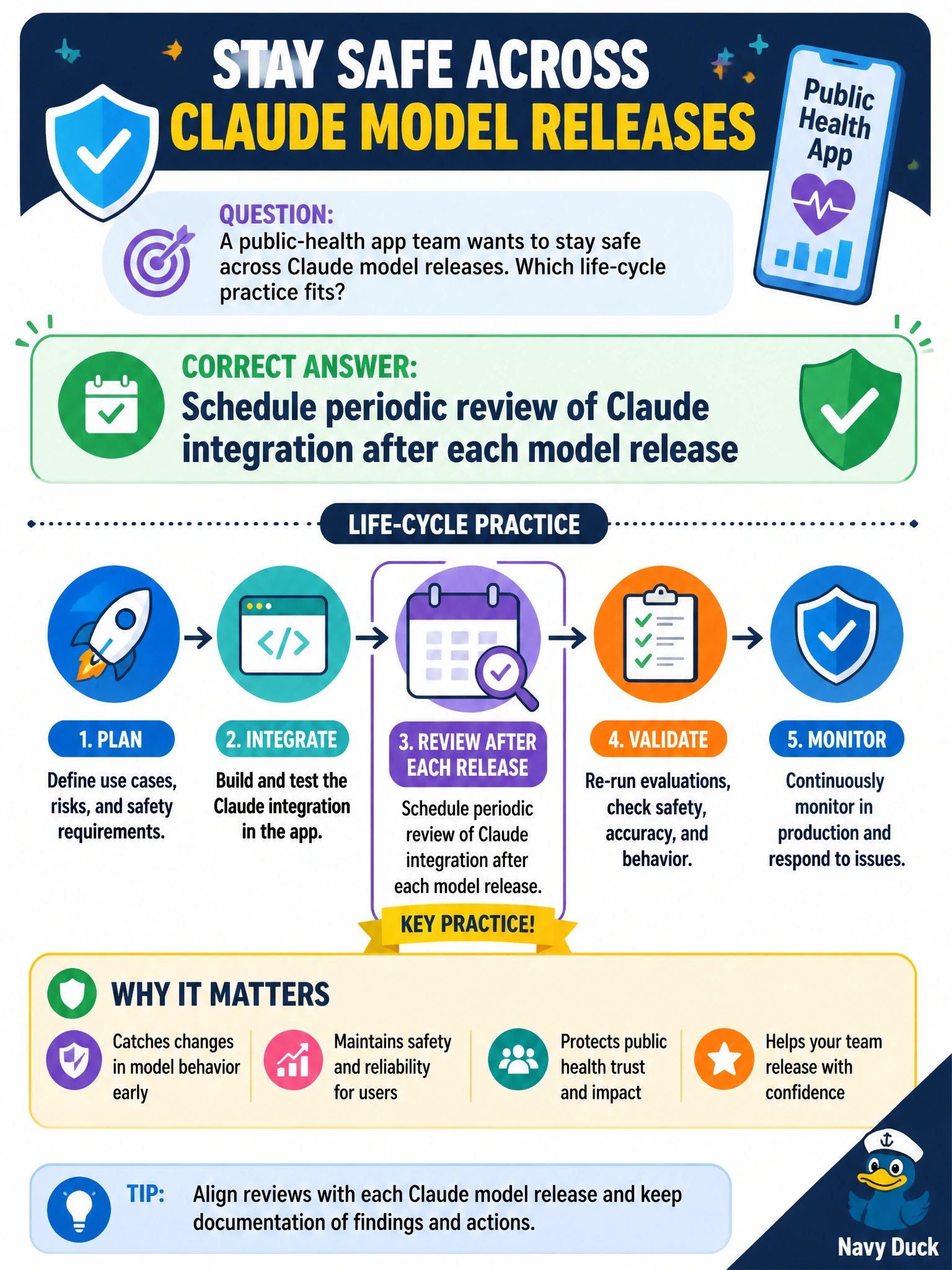
Short Explanation
Models move, so you don't want your clinic app getting surprised. Put a calendar reminder to re-check the Claude integration after each release instead of freezing the version or trusting last year's eval.
Full Explanation
Public-health applications that depend on Claude must remain safe across vendor model releases, which change behavior, tooling quirks, and sometimes safety edges. Scheduling periodic review of Claude integration after each model release is the correct life-cycle practice because maintenance includes revalidation—regression tests, prompt/tool checks, and clinical workflow spot reviews—whenever the model substrate moves. Conceptually this treats model upgrades as change events that can silently alter triage language, refusals, or summarization fidelity for resident-facing health apps.
Locking the Claude model version at launch to preserve output behavior fails by concept: it assumes frozen behavior on a moving platform and blocks needed revalidation after releases. Tracking only token spend and latency trends for release safety decisions fails because cost and performance metrics do not capture safety regressions, behavioral drift, or clinical accuracy; they cannot replace functional revalidation. Reusing initial pre-launch evaluation results for subsequent model versions fails change control: a prior evaluation does not cover new model behavior, so silent regressions can reach clinics without fresh checks.
Exam caveat: model-release maintenance items reward scheduled revalidation, not locking a model version forever, reusing stale evaluations, or relying only on spend and latency trends.
Operational check: subscribe to model release notes, run a regression pack on staging after each release, require sign-off before production model bumps, and record review dates in the app's operate checklist.