
A transit team is about to launch a Claude rider assistant that replaces a legacy FAQ bot. What life-cycle step should they plan?
Select an answer to reveal the explanation.
Short Explanation
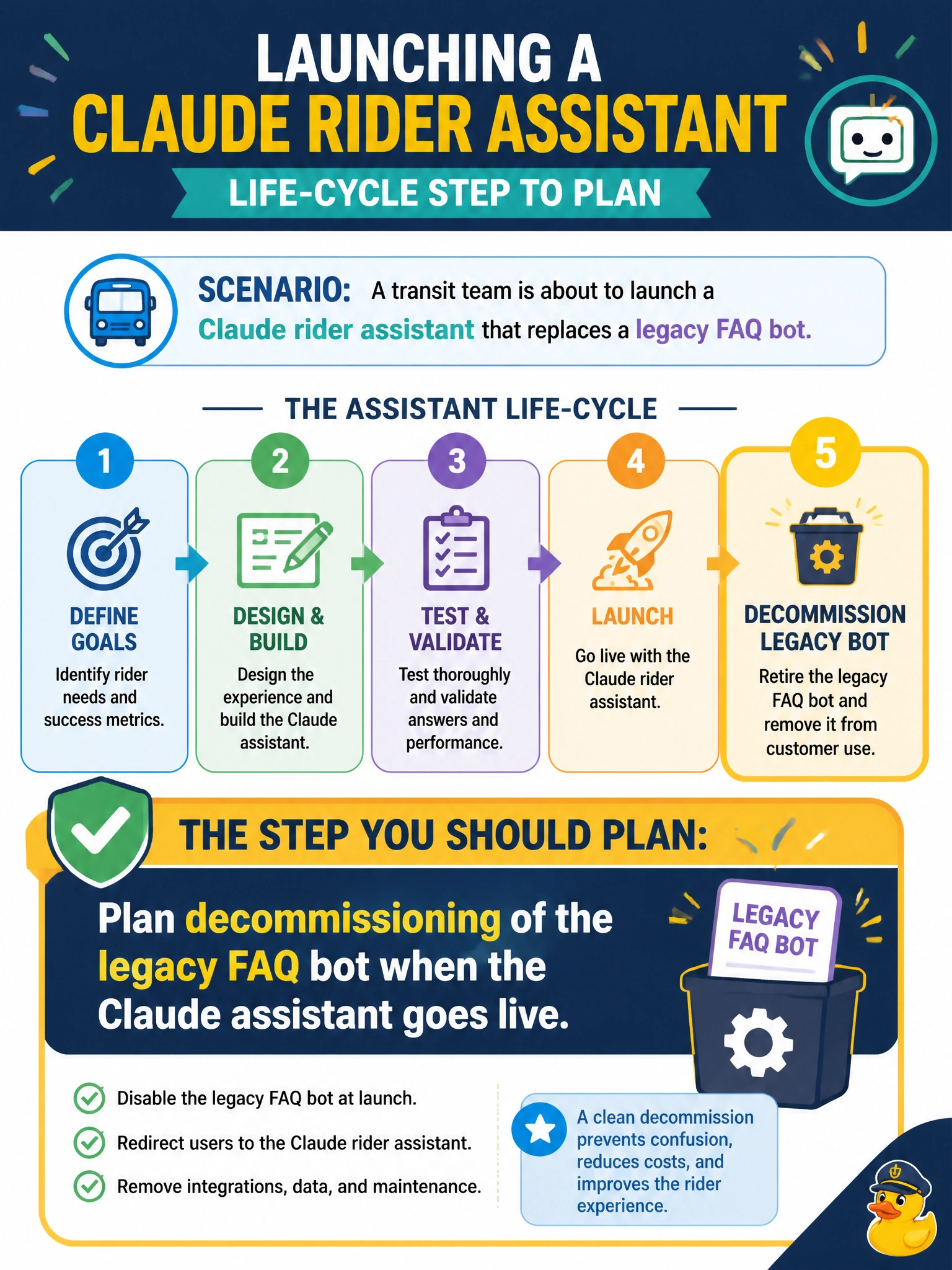
Paying to retrain the legacy bot every quarter is throwing good money after bad. Plan the legacy retire when the Claude assistant takes the wheel.
Full Explanation
When a transit team launches a Claude rider assistant that replaces a legacy FAQ bot, the life-cycle plan must include decommissioning the legacy bot. Planning that retire/cutover step is correct because operate/maintain/retire transitions prevent twin-running confusion, split traffic, duplicated content ownership, and lingering insecure endpoints. Municipal rider services need a single authoritative channel once cutover criteria are met; otherwise residents and agents get conflicting answers and monitoring stays noisy.
Scheduling quarterly retraining for the legacy FAQ bot's intents fails because it keeps pouring resources into a retiring system instead of cutting over to the single authoritative Claude channel. Migrating Claude assistant transcripts into the legacy FAQ bot knowledge base fails because it duplicates content in the old system and blocks clean decommissioning. Renewing the legacy FAQ bot vendor contract to maintain redundant rider support after launch fails operationally: it funds parallel systems, splits traffic, and leaves insecure endpoints live instead of executing the planned retire.
Exam caveat: replacement launches imply explicit legacy decommission planning, not silent coexistence. Do not confuse 'launch' with 'life-cycle complete.' Keep transit rider-assistant framing. Operational check: define cutover criteria, redirect or drain legacy FAQ traffic, decommission the old bot under change control, confirm monitoring no longer alerts on legacy paths, and document the retire date in the CMDB.