
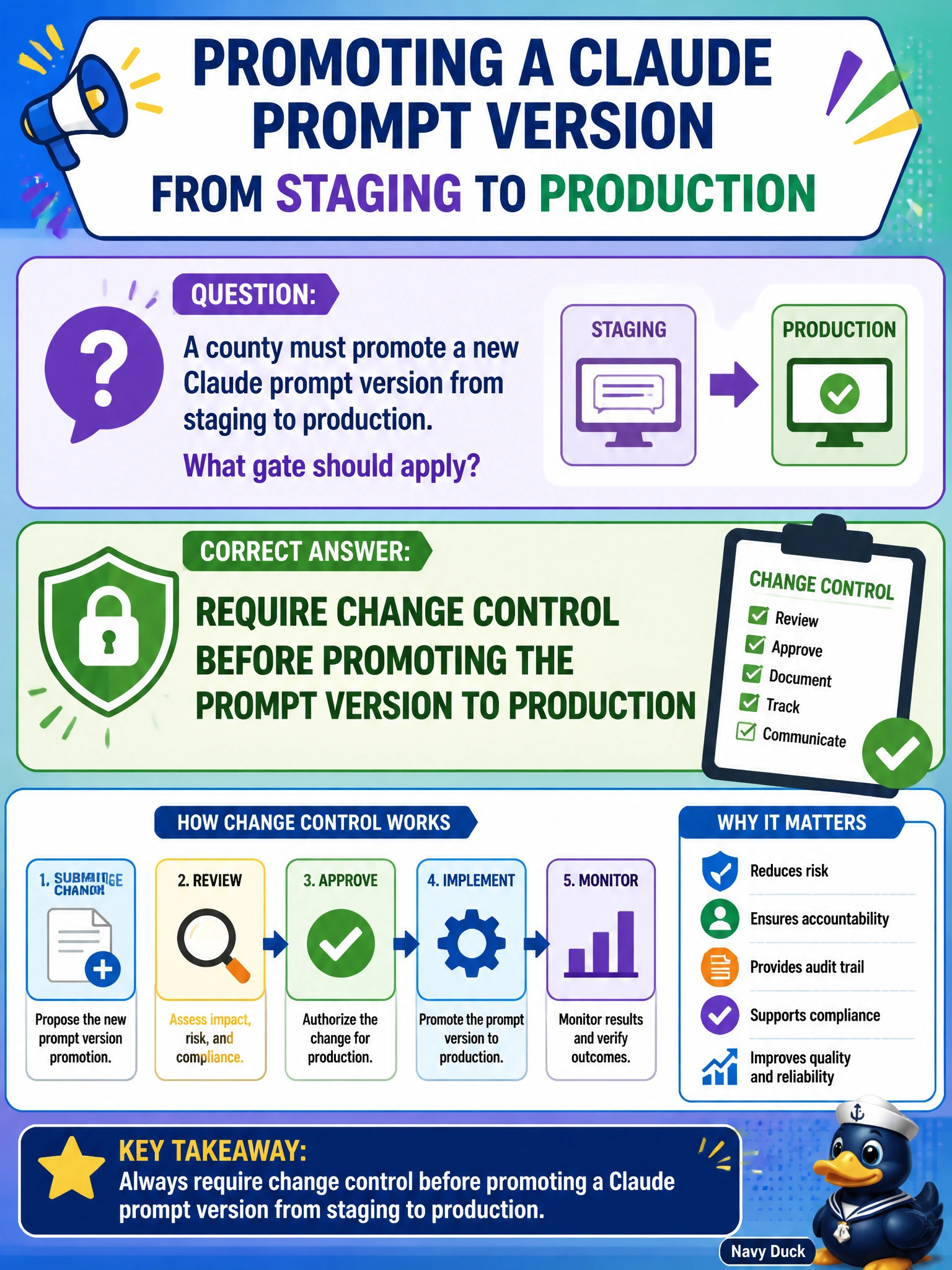
A county must promote a new Claude prompt version from staging to production. What gate should apply?
Select an answer to reveal the explanation.
Short Explanation
Prompts are production config wearing a trench coat. Promote them through change control like any other live civic change.
Full Explanation
Promoting a new Claude prompt version from staging to production is a production configuration change and must pass change control. Requiring change control before promotion is correct because prompts steer civic behavior—answers, tool use, tone, and compliance hedges—and unsupervised edits create audit gaps, regressions, and unexplained resident-facing shifts. Municipal IT change management exists precisely for live configuration that can alter service outcomes; Claude prompts are not exempt because they are text.
Requiring rollback verification only after the prompt is live in production fails by concept: it puts the gate after promotion instead of before, letting unreviewed prompts reach residents before any rollback check. Requiring model retraining approval before promoting prompt text fails access control and change discipline: it conflates a prompt text change with model retraining, imposing an irrelevant gate on a simple configuration promotion. Requiring production monitoring sign-off before validating staging evaluation scores fails the classification: it inverts the release sequence, placing a production gate ahead of staging evidence that the prompt actually works.
Exam caveat: treat prompt promotion as change-managed configuration, not casual copy-paste. 'Prompts aren't software' is a common trap. Keep county staging-to-production framing. Operational check: ticket prompt diffs, require review/approval, promote staging→prod through the change gate, retain prior versions for rollback, and sample production answers after each prompt release.