
A school district needs Claude to summarize IEPs with different visibility for teachers versus admins. What must requirements capture?
Select an answer to reveal the explanation.
Short Explanation
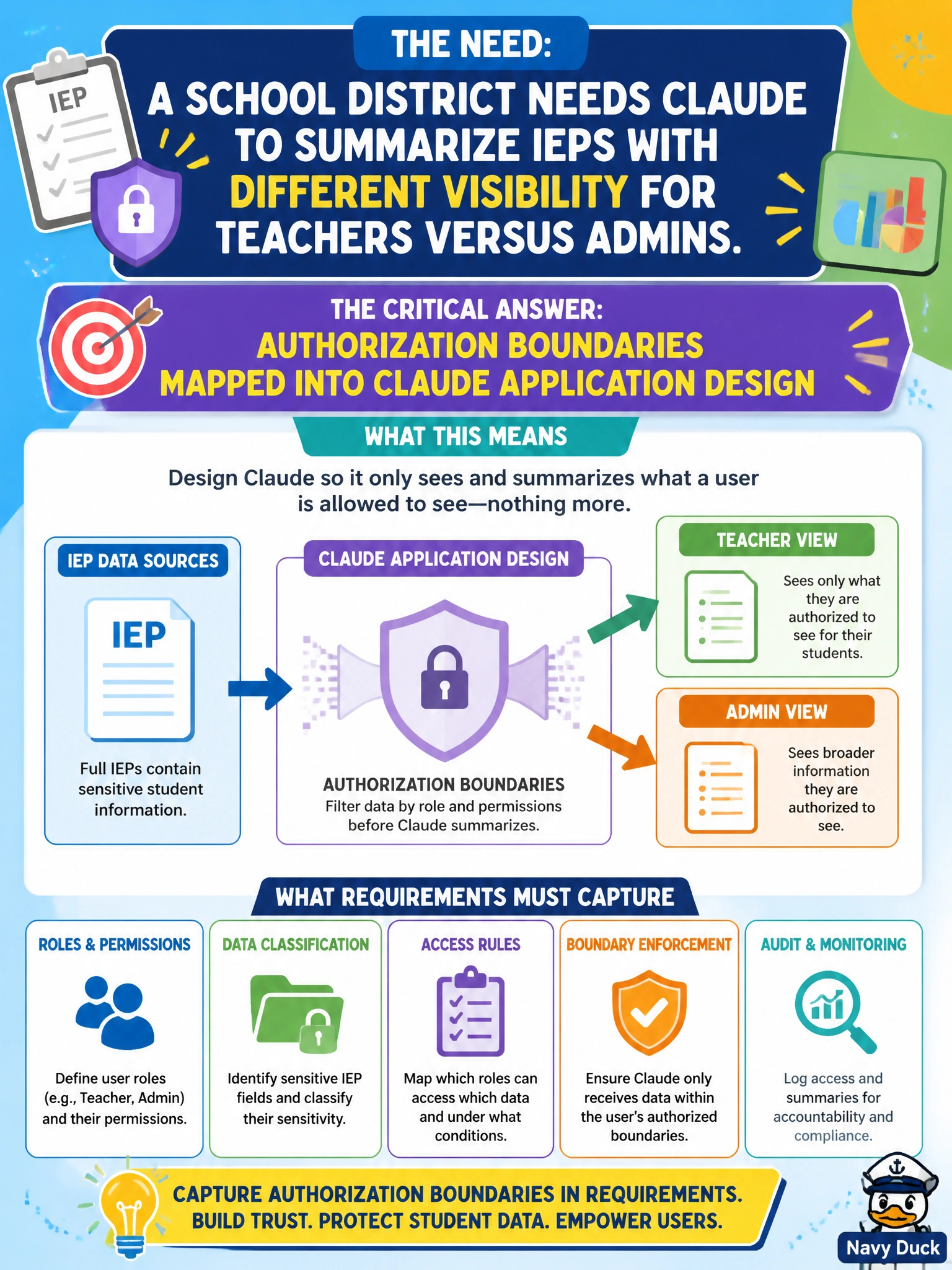
Teachers and admins aren't the same badge at the door. Requirements have to map who sees which IEP fields before Claude ever drafts a summary.
Full Explanation
School-district Claude summarization of IEPs involves highly sensitive student education records with different visibility for teachers versus admins. Requirements must capture authorization boundaries mapped into Claude application design so role-based access control governs which fields, documents, and summary depths each role may retrieve or see. Conceptually this works because authorization is not a UI garnish—it must shape tools, retrieval filters, prompt-time data injection, and logging so teachers do not receive admin-only content and admins do not overshare into teacher channels.
Using one shared admin key pasted into every teacher client fails by concept: shared secrets destroy accountability and collapse role boundaries. Echoing full student PII to every role and relying on UI-level masking for privacy fails because client-side masking does not stop the raw data from being transmitted or inspected; the privacy failure happens before any mask is ever drawn. Assuming sharing is safe because administrators already approved the system fails because a one-time approval is not an access-control mechanism; it says nothing about which role should see which IEP fields on any given request, so unrestricted sharing still reaches teachers or admins who should not see that content.
Exam caveat: education/PII items reward authorization-boundary requirements over convenience sharing. Shared admin keys are a classic wrong answer. Keep IEP teacher-versus-admin framing. Operational check: define role matrices for IEP fields, enforce server-side filters before Claude context assembly, prohibit shared admin credentials in teacher clients, and audit summary outputs by role during UAT.