
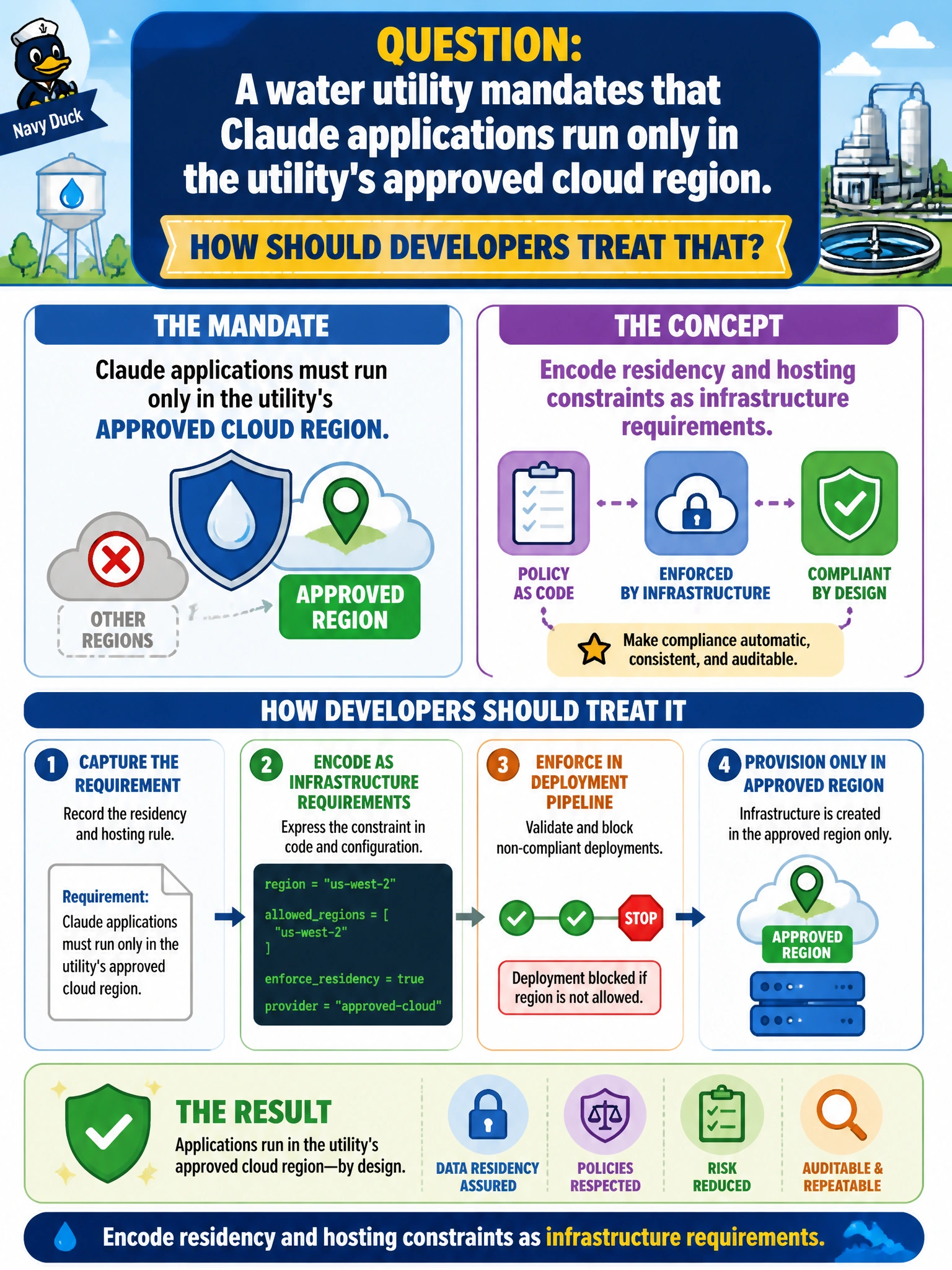
A water utility mandates that Claude applications run only in the utility's approved cloud region. How should developers treat that?
Select an answer to reveal the explanation.
Short Explanation
Water ops data has a home address. If the utility says "this region only," that lock goes in the requirements, not by tweaking sampling temperature and token limits.
Full Explanation
When a water utility mandates that Claude applications run only in an approved cloud region, developers must encode residency and hosting constraints as infrastructure requirements. That is correct because data locality, contractual hosting boundaries, and utility cybersecurity baselines are nonfunctional requirements that drive region selection, networking, and vendor configuration before code ships. Municipal/utility operational technology and customer data often carry explicit residency rules; ignoring them is a compliance failure, not a minor deployment detail.
Controlling residency through prompt instructions and system message wording fails by concept: prompt wording cannot determine where Claude is hosted or enforce data residency; that must be an infrastructure requirement. Satisfying hosting mandates with output filters and acceptable use controls fails as control design—output filters cannot dictate which approved cloud region processes the data. Tuning sampling temperature and token limits to address region constraints fails life-cycle discipline: generation parameters do not control where Claude runs or where data resides, so residency must be set before deployment.
Exam caveat: map region/residency mandates to infrastructure requirements, not optional preferences. Do not accept prompt instructions or system message wording as permission to leave the approved boundary.
Operational check: document approved regions in requirements, configure Claude hosting/invocation to those regions, block deployments that target disallowed locations, and periodically attest residency against the utility's cloud policy.