
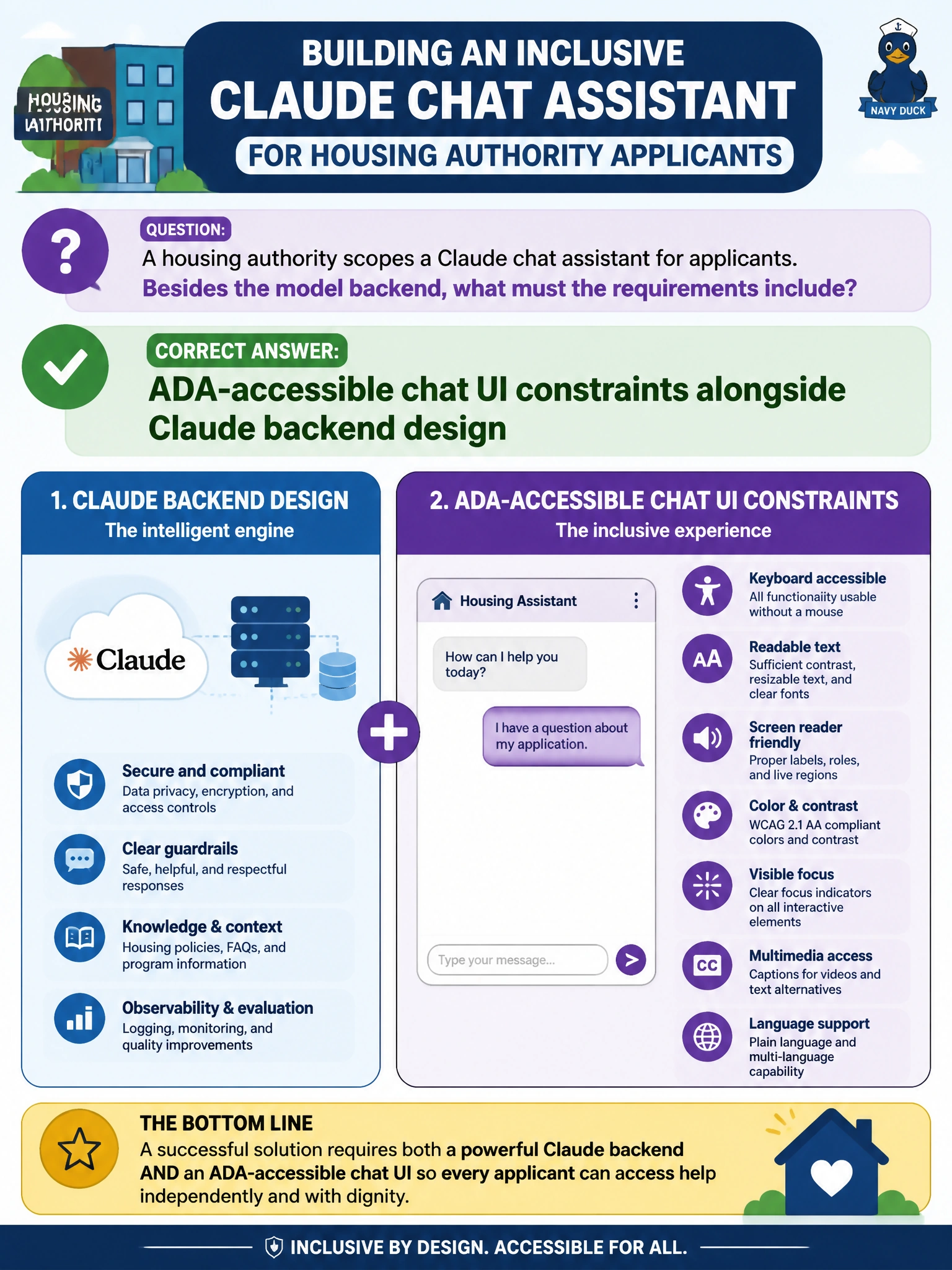
A housing authority scopes a Claude chat assistant for applicants. Besides the model backend, what must the requirements include?
Select an answer to reveal the explanation.
Short Explanation
Applicants still need a door they can open—keyboard, screen reader, the works. Accessibility sits next to the Claude backend in the same requirements sheet.
Full Explanation
Housing-authority Claude chat assistants serve applicants who must be able to use the interface regardless of disability. Requirements must therefore include ADA-accessible chat UI constraints alongside Claude backend design—keyboard operability, screen-reader semantics, contrast, focus order, captions where needed—not only model or GPU choices. Conceptually this is correct because civic digital services are public accommodations: backend intelligence without an accessible front door fails both compliance and mission. Scoping documents that list only the model leave the applicant experience ungoverned.
Specifying Claude response latency targets alongside backend version-control practices fails by concept: performance SLAs and release discipline are reasonable engineering hygiene, but they are not what the stem is testing—an applicant who cannot operate the chat UI at all gets no benefit from a fast, well-versioned backend. Setting chat transcript retention policies alongside Claude logging standards fails for the same reason: records management governs what happens to a conversation after it occurs, not whether an applicant with a disability can have that conversation in the first place. Defining applicant messaging tone standards alongside Claude brand styling practices fails because tone and branding shape how a message reads, not whether assistive technology can reach it in the first place—polish without access control.
Exam caveat: application-scoping items often hide plausible-sounding engineering or governance pairs (latency, retention, tone) as distractors; correct answers pair Claude backend with the mandatory interface/accessibility requirement. Keep housing-applicant portal framing. Operational check: put ADA chat UI criteria in the same requirements artifact as Claude design, include assistive-technology test cases in UAT, and review releases against WCAG-oriented municipal standards alongside any latency, retention, or tone requirements the team separately tracks.