
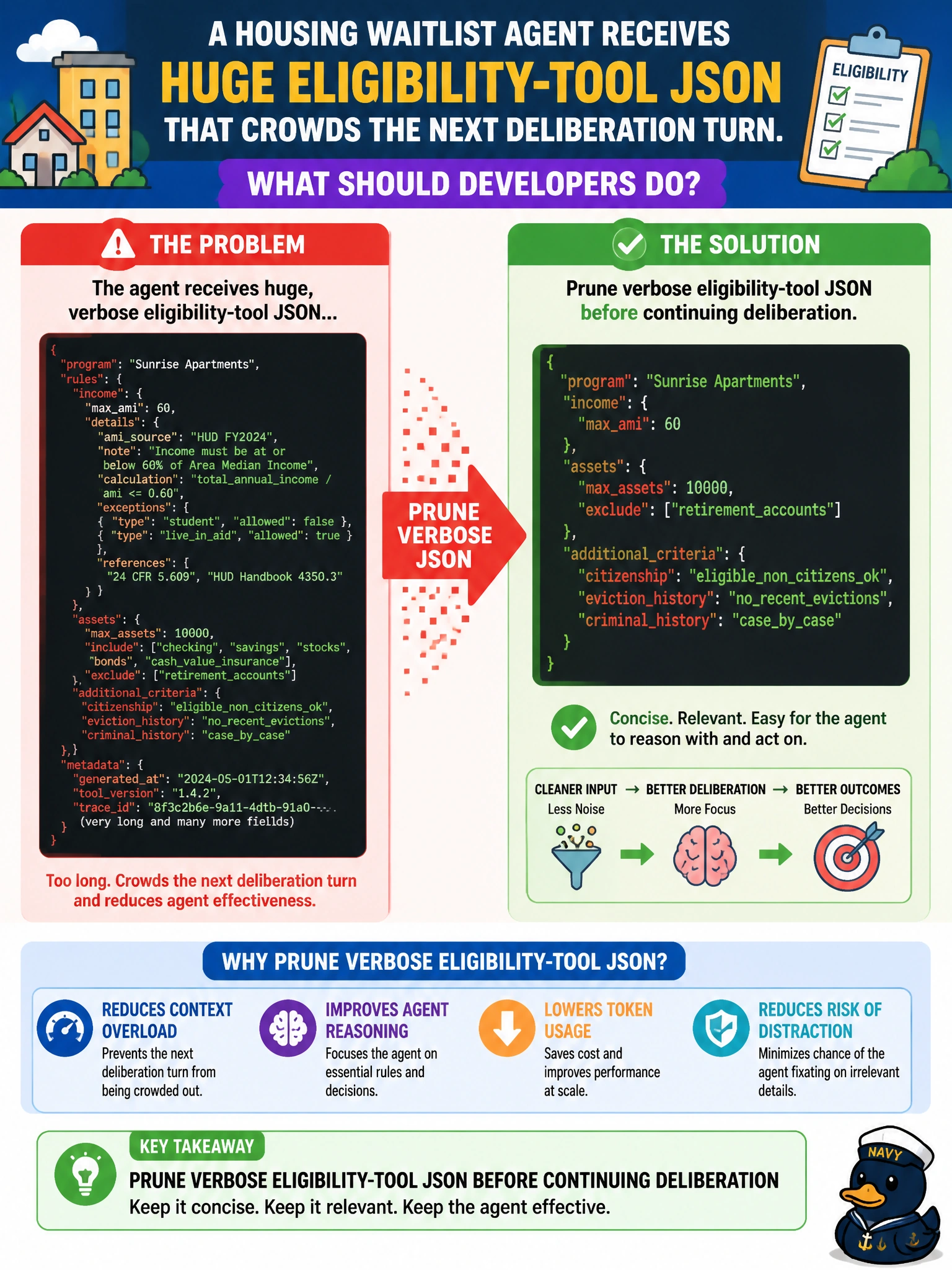
A housing waitlist agent receives huge eligibility-tool JSON that crowds the next deliberation turn. What should developers do?
Select an answer to reveal the explanation.
Short Explanation
Giant eligibility dumps are like dumping the whole filing cabinet on the desk every time. Prune first, then think—keep only what the next step needs.
Full Explanation
Housing waitlist agents often receive bulky eligibility-tool JSON—program codes, income grids, household members, document flags—that can crowd out the next deliberation turn if left intact. Pruning verbose eligibility-tool JSON before continuing deliberation is correct because context-window management is an agent-engineering control: keep the fields the next reasoning step needs, summarize or drop the rest, and preserve headroom for policy logic. That works for municipal housing portals where eligibility payloads are large but only a subset drives the immediate decision, and unbounded growth degrades both quality and cost.
Appending the full JSON twice to emphasize accuracy fails by concept: duplication increases token pressure without adding information and worsens crowding. Raising temperature so the agent ignores extra tokens fails because temperature changes sampling randomness; it is not a context-management strategy and can make eligibility decisions less reliable. Disabling pruning so context always grows without bound fails as an architecture choice—unbounded growth invites truncation of critical earlier instructions, higher latency/cost, and unstable waitlist determinations.
Exam caveat: CCDV-F frequently tests 'prune/summarize tool output before the next turn' versus tricks like temperature or duplication. Do not confuse emphasis with more tokens. Keep housing-waitlist eligibility framing so the answer stays operationally civic. Operational check: after each eligibility tool call, run a prune/summarize step that retains decision-critical keys, measure tokens entering deliberation, alert when tool dumps exceed a budget, and sample cases to confirm waitlist reasoning still cites the pruned facts correctly.