
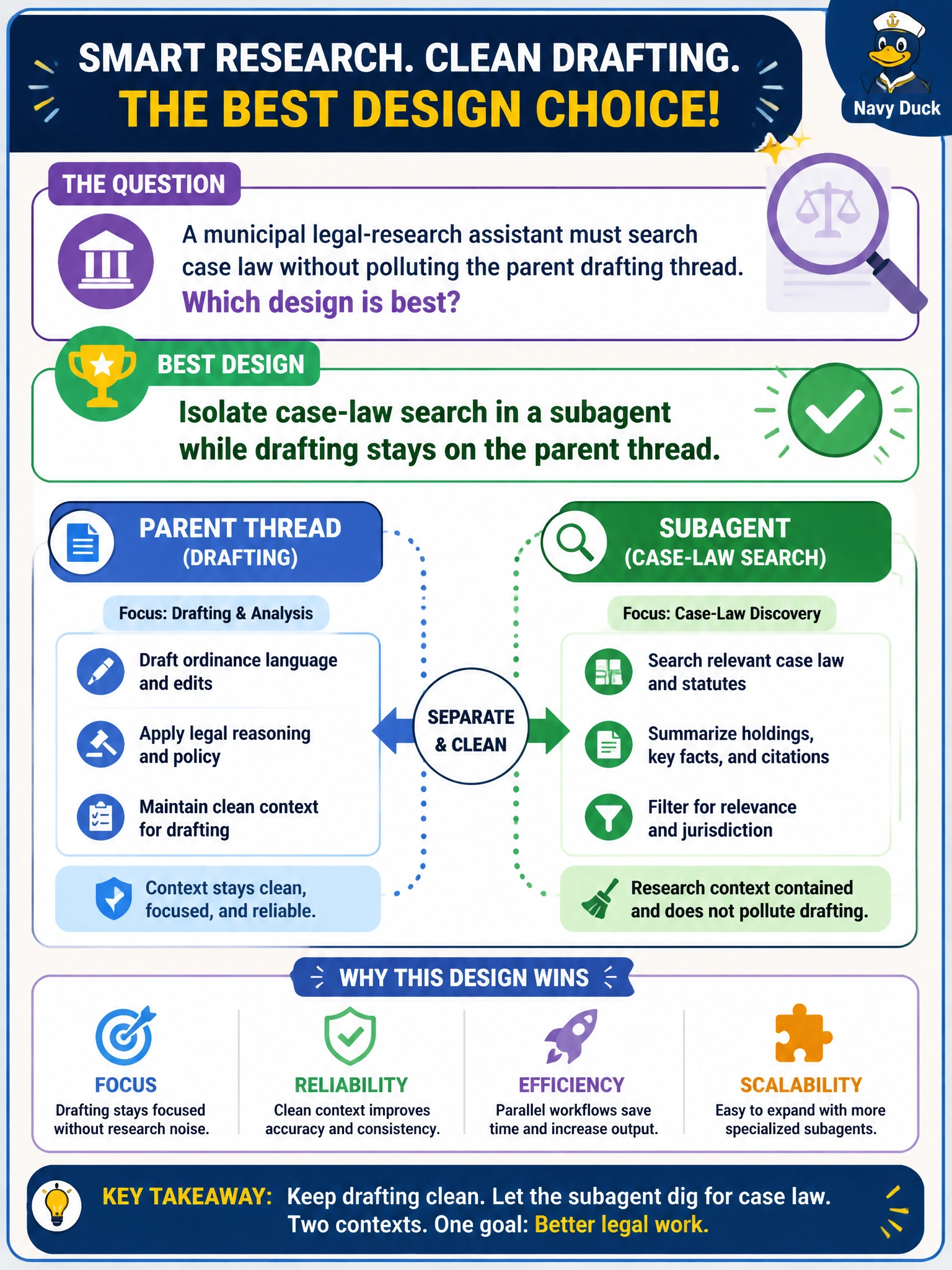
A municipal legal-research assistant must search case law without polluting the parent drafting thread. Which design is best?
Select an answer to reveal the explanation.
Short Explanation
Research is the back room; drafting is the front counter. A search subagent keeps dusty digests off the drafting desk until you ask for them.
Full Explanation
Municipal legal-research assistants must retrieve case law without contaminating the parent drafting thread that produces citizen-facing or court-bound text. Isolating case-law search in a subagent while drafting stays on the parent thread is correct because subagents provide context isolation: noisy retrieval digests remain in the research worker, and only curated findings return to drafting. Conceptually this least-privilege separation protects drafting quality, citation discipline, and auditability—the parent keeps a clean narrative context while the subagent bears the search tool surface.
Retaining summarized case-law tool output in the parent drafting context window for reuse fails by concept: even compressed research artifacts dilute drafting instructions, invite quote mix-ups, and expand blast radius when a bad search pollutes the draft. Equipping the parent drafting agent with scoped case-law search tool access fails because the parent still carries tool schema and raw results in the same thread it uses to write, defeating separation of concerns. Returning full search trajectories from subagent to parent for drafting fails operationally: it floods the draft thread with raw tool traces and intermediate research noise, destroying the clean narrative context and confusing research side effects with conversation lifecycle management.
Exam caveat: subagent questions often contrast isolation with giving the parent case-law tool access, even when scoped, or returning full search trajectories to the drafting thread; isolation is the point. Retain municipal legal-research versus drafting framing. Operational check: route case-law tools only to a research subagent, return summarized citations to the parent, forbid raw dump paste into the draft thread by default, and review sample opinions for retrieval residue that should never have entered the drafting context.