
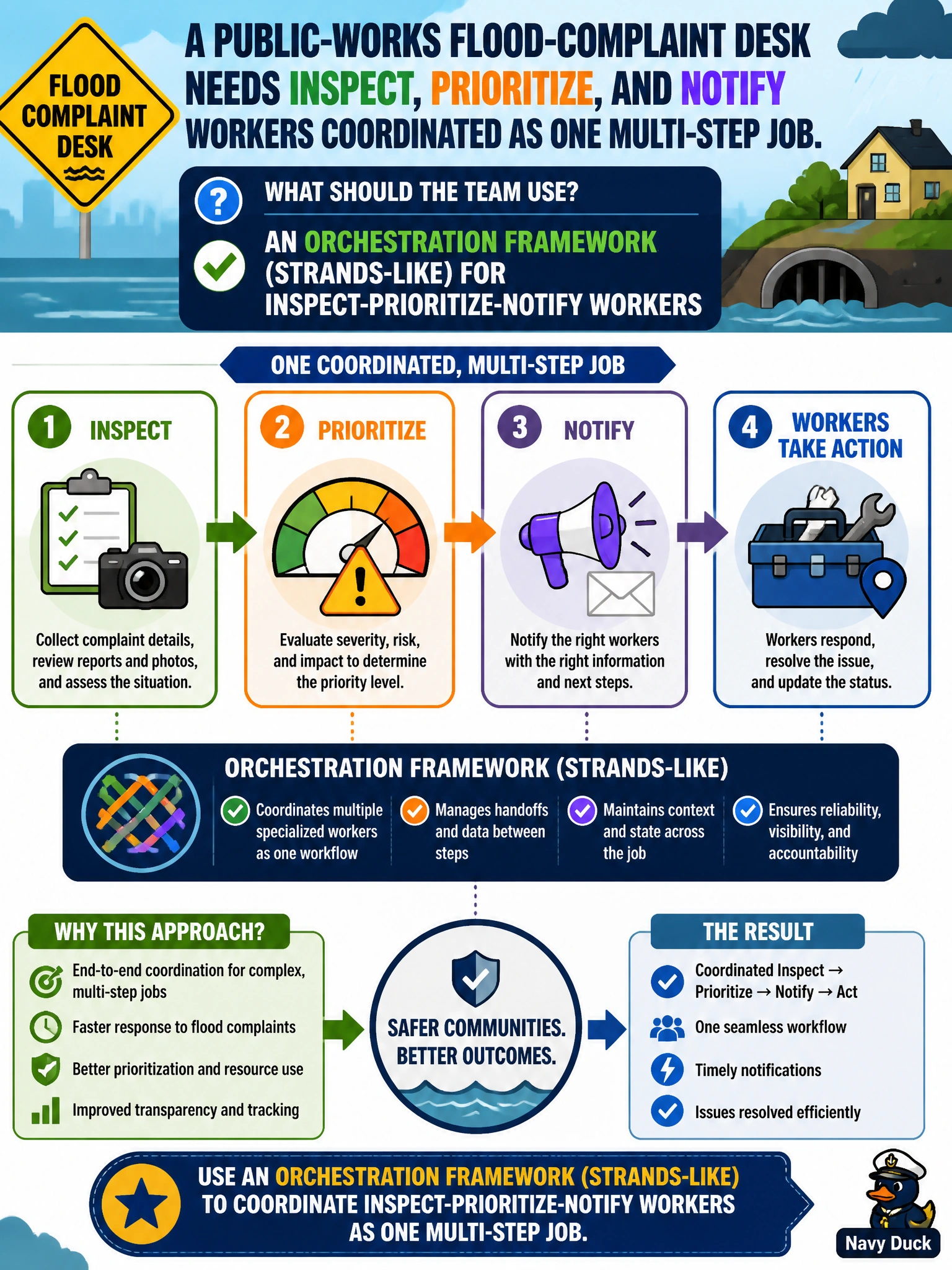
A public-works flood-complaint desk needs inspect, prioritize, and notify workers coordinated as one multi-step job. What should the team use?
Select an answer to reveal the explanation.
Short Explanation
Flood work is a relay race—inspect, rank, then alert—not separate agents working on their own, so you've got to orchestrate the handoffs. Orchestration frameworks keep those workers in order.
Full Explanation
Public-works flood-complaint handling is a coordinated multi-step job: inspect conditions, prioritize severity and impact, then notify the right crews and residents. An orchestration framework (Strands-like) is correct because it models those specialized workers as an explicit task graph with handoffs, retries, and shared job context instead of improvisation. Conceptually this fits municipal flood desks where skipping order creates safety and liability risk—notification without inspection, or inspection without prioritization, produces the wrong response. Orchestration also makes worker responsibilities, timeouts, and escalation paths observable for after-action review.
Separate independent agents for inspection, prioritization, and notification fail by concept: without an orchestration layer, each agent works in isolation and cannot guarantee stage order, completion criteria, or handoffs, so inspect/prioritize/notify collapse into disconnected noise. A scheduled batch pipeline for nightly aggregation of closed flood inspection reports fails because it only processes already-closed reports on a fixed schedule and does not solve the live multi-worker coordination problem the stem asks for. A retrieval-augmented knowledge base for answering flood policy questions fails as a control design: it can answer policy questions but cannot orchestrate inspect→prioritize→notify workers or enforce that inspection evidence exists before notification.
Exam caveat: multi-agent/orchestration items reward explicit worker graphs over separate agents that run without shared context or handoffs. Do not pick the scheduled batch pipeline for nightly closed-report aggregation when the stem asks how to coordinate live inspect-prioritize-notify workers. Keep flood-complaint public-works framing visible in your reasoning. Operational check: implement inspect→prioritize→notify as orchestrated workers with required stage outputs, block notify until inspection evidence exists, alert on skipped stages, and rehearse a flood desk tabletop to verify handoffs under load.