
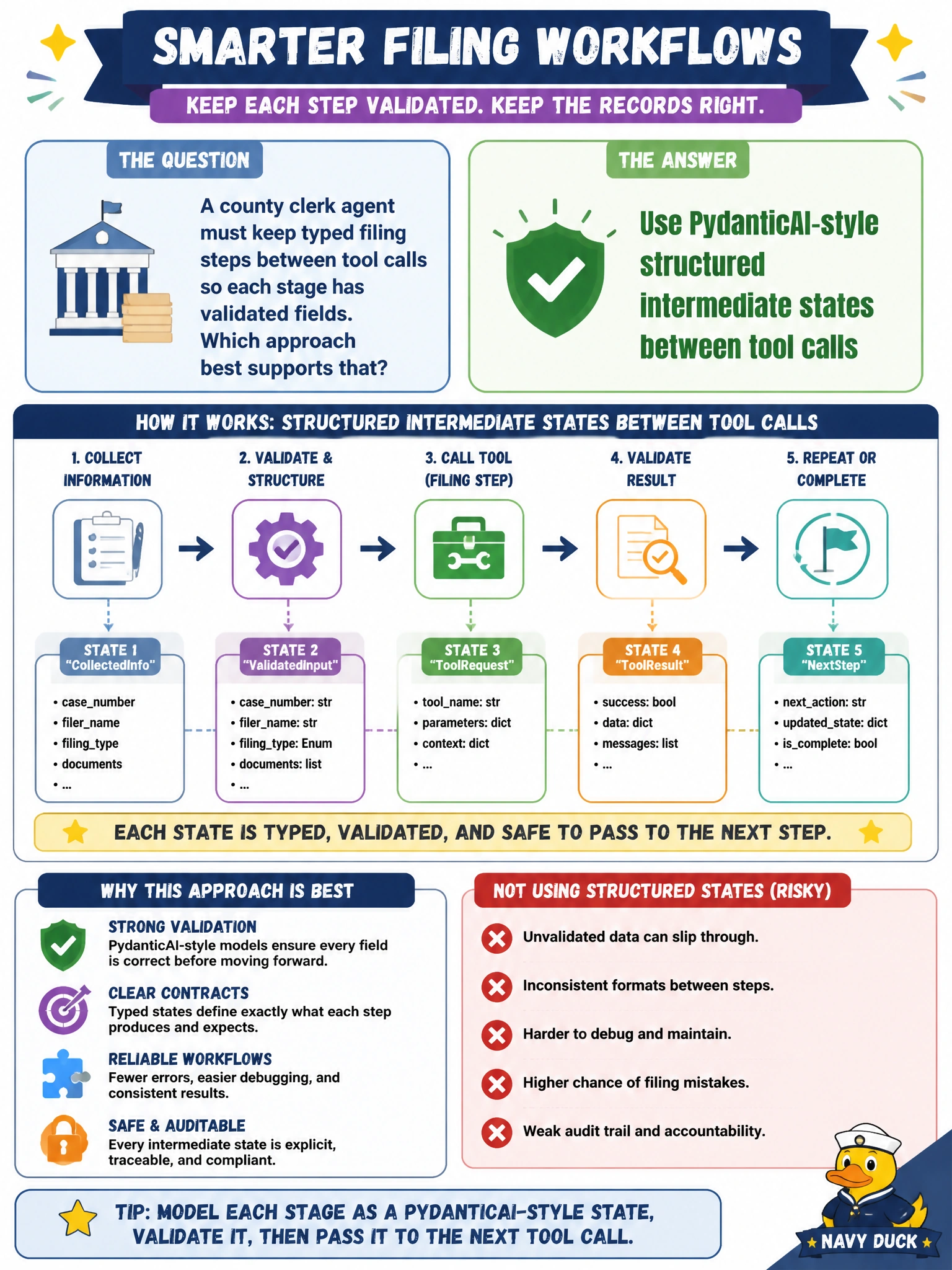
A county clerk agent must keep typed filing steps between tool calls so each stage has validated fields. Which approach best supports that?
Select an answer to reveal the explanation.
Short Explanation
Clerk filings are stamp-and-check forms, not napkin doodles. Typed intermediate states keep each tool hop on a validated checklist.
Full Explanation
County clerk filings are multi-stage procedures where each tool hop must leave validated fields for the next stage—party names, case numbers, fee codes, exhibit lists—rather than relying on session-scoped conversation context to carry filing drafts across tool calls. PydanticAI-style structured intermediate states are correct because they type and validate those fields between tool calls, so each stage only proceeds when required attributes pass schema checks. That works in municipal clerking because filings are stamp-and-check workflows: invalid intermediate state should fail fast before a bad PDF or docket submission is produced. Structured state also creates an auditable trail of what was validated when, which aligns with records discipline.
Using session-scoped conversation context to carry filing drafts across tool calls fails by concept: conversation drafts are informal, untyped, and cannot enforce required fields between hops, so later tools inherit unverified assumptions and omissions. Using Pydantic validation for the final filing submission payload fails because end-of-pipeline checks are not a control for intermediate tool hops—errors compound across stages and are harder to localize after a bad payload is assembled. Using transient key-value storage to cache intermediate tool outputs for assembly fails because raw cached dumps are not curated state; they can clobber validated fields, drop earlier confirmations, and erase the typed checklist the clerk process depends on.
Exam caveat: candidates may equate session-scoped conversation context carrying filing drafts with structured state; CCDV-F wants explicit typed intermediates between tools, not just drafts held in conversation. Operational check: define Pydantic (or equivalent) models per filing stage, reject tool continuation on validation failure, log schema errors for clerk review, and spot-check that intermediate objects retain prior validated fields instead of being replaced by transient key-value caches holding raw tool outputs.