
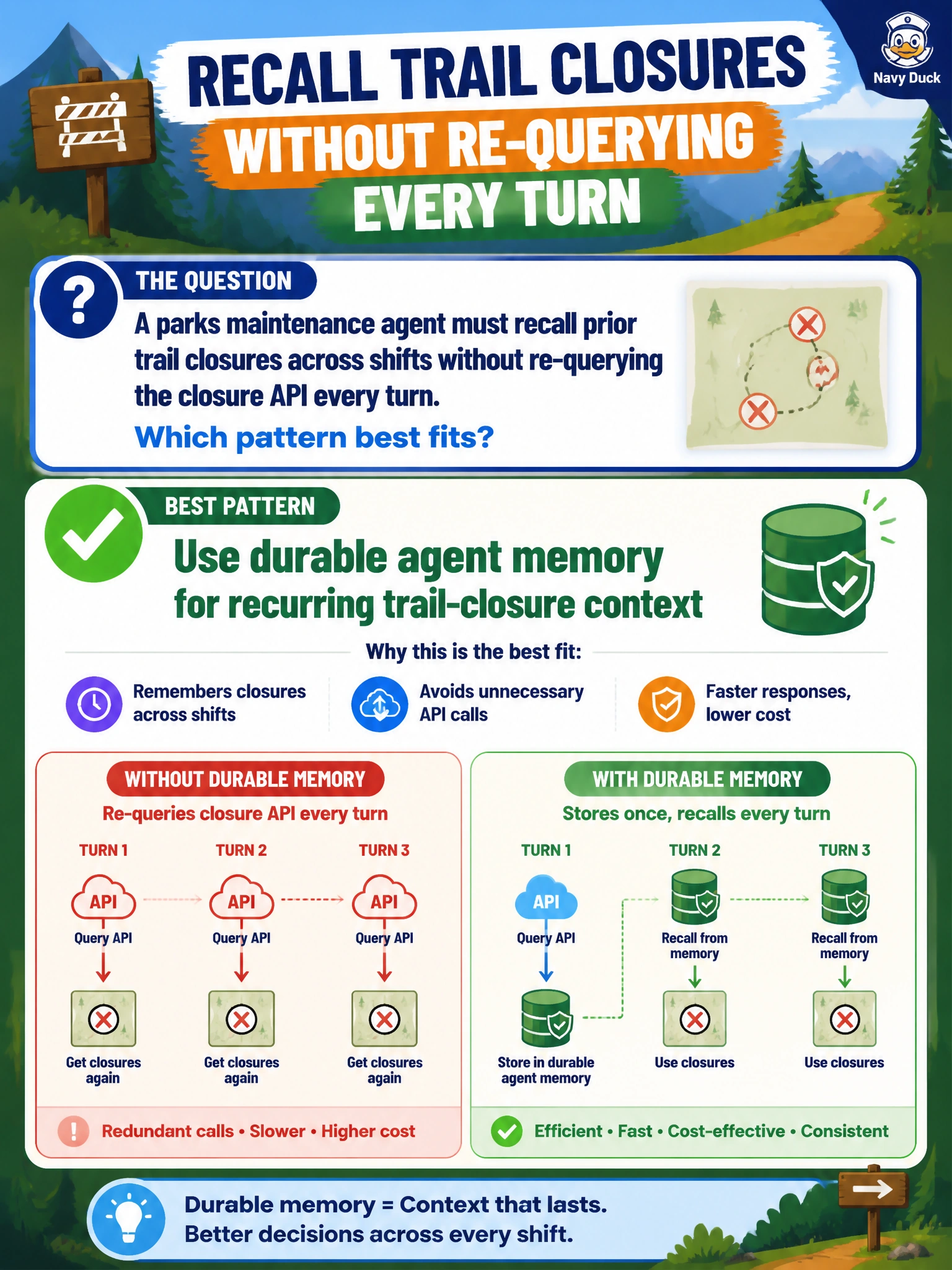
A parks maintenance agent must recall prior trail closures across shifts without re-querying the closure API every turn. Which pattern best fits?
Select an answer to reveal the explanation.
Short Explanation
Trail crews leave a whiteboard of what's shut—so the next shift doesn't rediscover it the hard way. Durable memory is that whiteboard for the agent.
Full Explanation
In parks maintenance workflows, trail closures recur across shifts and must be remembered without hammering the closure API on every conversational turn. Durable agent memory is the correct pattern because it persists recurring trail-closure facts as first-class agent state that later turns and later crews can recall, while still allowing tools to refresh when facts change. Conceptually this works for municipal field operations: closures are operational truth that outlive a single chat session, so the agent needs a durable store rather than ephemeral chat alone. Retaining validated closure IDs, effective windows, and affected trail segments in memory also reduces resident re-prompting and keeps API rate budgets available for true updates.
Relying on session working memory for cross-shift closure recall fails by concept: it treats each shift's chat as the system of record, loses facts when the session ends, and recreates the same discovery cost across shifts instead of retaining known closures. Keeping trail-closure notes in the turn-level prompt cache fails because cache contents vanish when the turn ends, so closures are not available across shifts, and it confuses temporary turn storage with managed memory that persists and can be updated and expired. Saving trail-closure context inside tool description fields fails because tool descriptions are configuration, not durable state, so they cannot reliably hold or update closure facts across turns and shifts and risk embedding stale operational details in static tool metadata.
Exam caveat: CCDV-F agent items often contrast durable memory with stashing notes in the turn-level prompt cache; durable memory is selective, updatable state, not ephemeral turn storage. Keep the civic framing—parks trail closures across shifts—so you do not drift into generic chatbot trivia. Operational check: persist closure IDs and windows in agent memory, TTL or invalidate on reopen events, require a tool refresh before advising residents on safety-critical closures, and sample overnight sessions to confirm the agent recalls prior closures without a full API re-query every turn.