
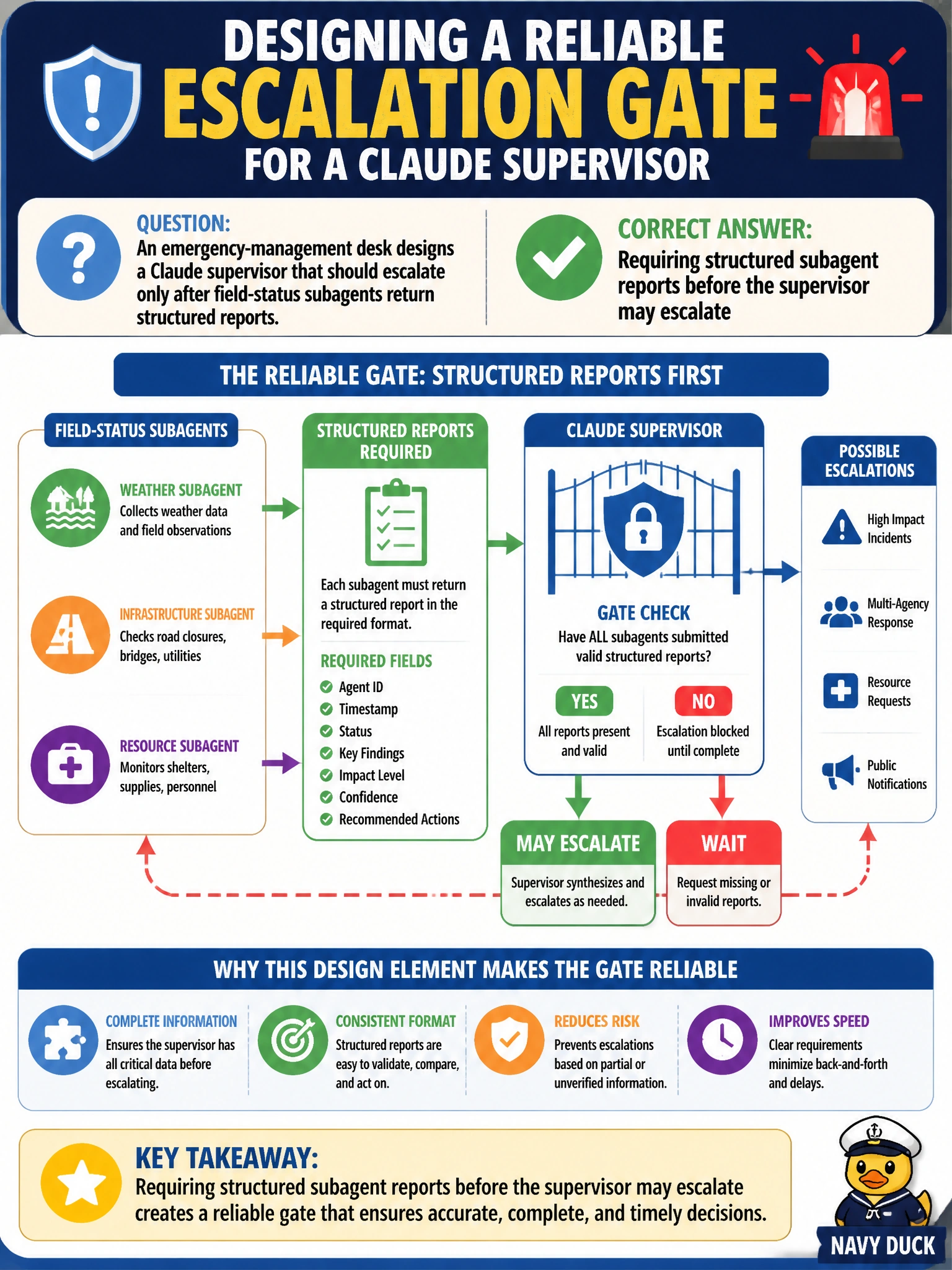
An emergency-management desk designs a Claude supervisor that should escalate only after field-status subagents return structured reports. What design element makes that gate reliable?
Select an answer to reveal the explanation.
Short Explanation
Think of the supervisor like an incident commander waiting for radio check-ins before calling mutual aid. Structured reports are those check-ins—without them, escalation is just guessing.
Full Explanation
Requiring structured subagent reports before the supervisor may escalate is the design element that makes an emergency-management escalation gate reliable. The Claude supervisor should behave like an incident commander waiting for radio check-ins: field-status subagents return typed reports (location, severity, resource need, confidence), and only then may escalation fire. Gating on structured intermediates ties escalation to verified results rather than narrative improvisation, which improves mutual-aid decisions and after-action auditability.
Directing the supervisor to summarize subagent chat history for escalation review fails because chat summaries are not structured field reports and let the supervisor act on impressions rather than verified status, which can trigger false or premature escalation. Configuring subagents to stream interim narrative updates to the shared dashboard fails because narrative streams are not structured reports and give the supervisor unvetted, incomplete impressions instead of the verified fields the gate requires. Setting the supervisor to poll subagent activity logs to time escalation decisions fails because activity logs show process, not completed structured reports, so polling them cannot satisfy the gate and may let escalation fire on incomplete field status.
Exam caveat: structured gates improve reliability; they are not a substitute for human incident command judgment when sensors or subagents are unavailable. Define timeout and degraded-mode escalation explicitly rather than silent wait-forever behavior.
Operational check: define a report schema, block supervisor escalate tools until required fields are present, log gate decisions, simulate missing/partial reports, and confirm that chat summaries, narrative streams, and activity-log polls cannot trigger escalation when structured validation is enabled.