
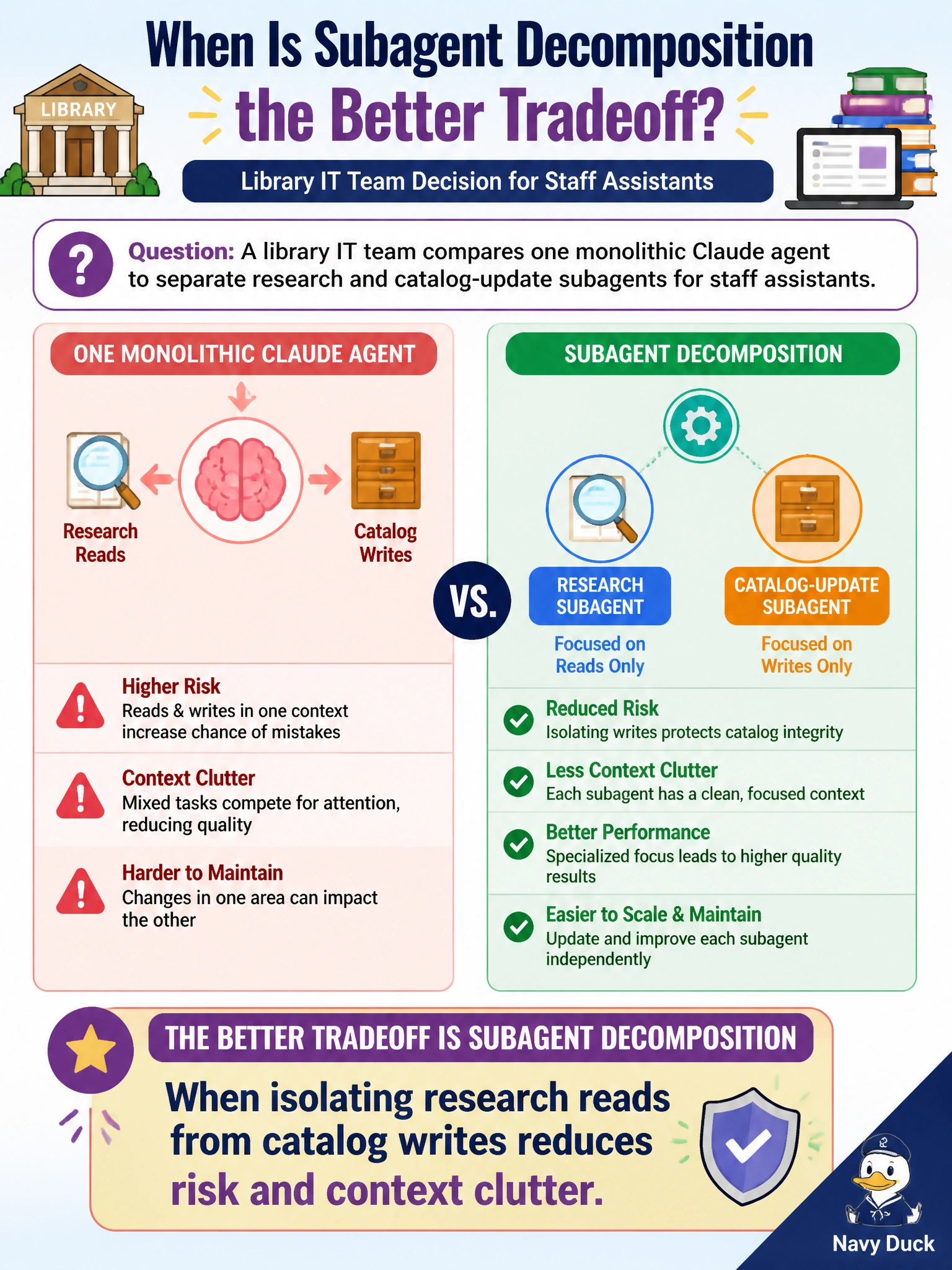
A library IT team compares one monolithic Claude agent to separate research and catalog-update subagents for staff assistants. When is subagent decomposition the better tradeoff?
Select an answer to reveal the explanation.
Short Explanation
Research browsing and catalog edits are different jobs—like reading the stacks versus updating the card catalog. Splitting them into subagents keeps a curious search from accidentally rewriting holdings.
Full Explanation
Subagent decomposition is the better tradeoff when isolating research reads from catalog writes reduces risk and context clutter for library staff assistants. Research browsing tends to pull large retrieval dumps; catalog updates need precise, permissioned write tools. Separate Claude subagents keep read-heavy research noise out of the write path and keep write credentials off the research path, which shrinks accidental-edit risk and keeps each context focused on one job—like reading the stacks versus updating the card catalog.
Giving research and catalog subagents overlapping write tools fails by concept: overlapping write credentials erase least-privilege benefits and create backup confusion rather than reliable coverage, since duplicate write paths increase accidental-edit risk instead of reducing it. Expecting token reuse from splitting research reads and catalog writes across subagents fails because decomposition is about reducing context clutter and permission risk, not boosting token reuse; separating concerns doesn't inherently reuse tokens and can add orchestration overhead. Routing routine catalog edits through research subagents fails as a reason to decompose: it mixes write access into the research path, recreating the exact clutter and accidental-edit risk that separating read and write subagents is meant to avoid, and it doesn't meaningfully enrich search results.
Exam caveat: decomposition adds orchestration overhead. Prefer it when permission boundaries or context interference are material; a tiny single-purpose agent with an already-minimal tool surface may not need splitting.
Operational check: assign read-only research tools to one subagent and catalog-write tools to another, route staff intents accordingly, monitor write attempts from the research path (should be zero), and compare error rates and context sizes against the prior monolith.