
A housing authority clerk needs Claude to apply a fixed eligibility checklist and must not invent new criteria mid-call. Which approach best enforces that constraint?
Select an answer to reveal the explanation.
Short Explanation
Eligibility rules are like a stamped form with numbered boxes—you fill what is printed, you don't doodle new boxes. A constrained workflow keeps Claude on the form, but a guided agent that picks its own steps can still skip or reorder items and drift mid-call. Quoting the handbook or just collecting details for later review doesn't force a live, step-by-step check.
Full Explanation
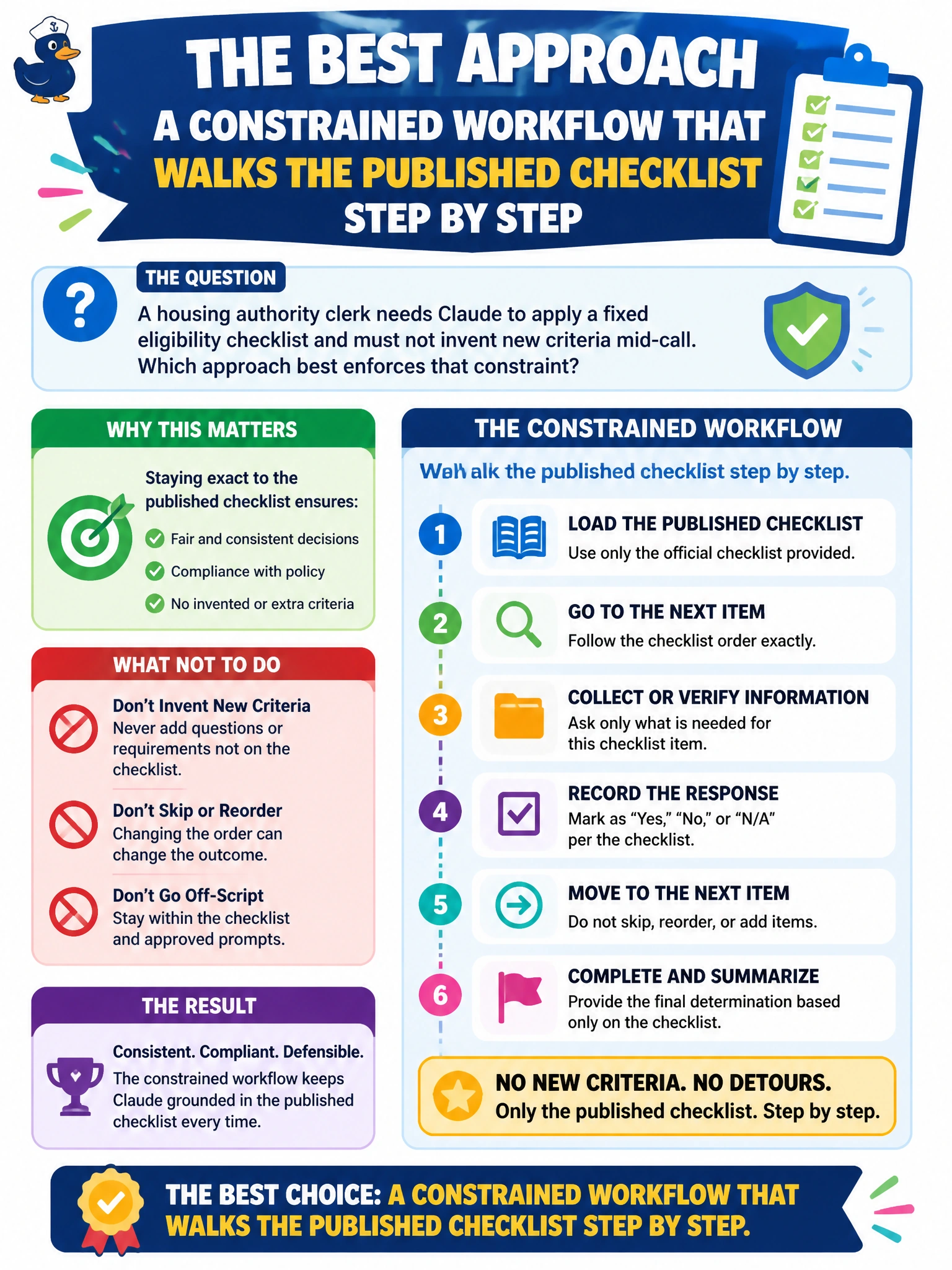
A constrained workflow that walks the published eligibility checklist step by step best enforces that a housing-authority clerk's Claude assistant must apply fixed criteria and must not invent new rules mid-call. Civic eligibility is defined by policy documents and program rules; the assistant's job is to evaluate applicants against those printed boxes, not to doodle new ones. Encoding the checklist as ordered, validated steps ties each decision to an explicit criterion, supports consistent determinations across callers, and creates an audit trail of which checks passed or failed.
A guided agent that consults the checklist while choosing steps autonomously fails because autonomous step selection lets the assistant skip, reorder, or adapt checklist items mid-call, which is exactly the drift housing programs must prevent for fairness and compliance. A policy-grounded assistant that cites handbook passages in responses fails because quoting policy text does not force criterion-by-criterion evaluation, so the assistant can still interpret or invent criteria mid-call while sounding authoritative. A data-collection workflow that records applicant details for later review fails because gathering information without live, structured checks lets the clerk or assistant apply criteria inconsistently or invent them during the call, with no machine-checkable pass/fail evidence at decision time.
Exam caveat: constrained workflows assume the published checklist is current; process owners must version policy updates into the workflow. Constraint is about fidelity to approved rules, not about refusing legitimate clarifications that map to existing criteria.
Operational check: load the authority's published checklist into workflow nodes with required fields, reject completion if any mandatory criterion is skipped, cite policy section IDs in the clerk-facing output, and periodically compare a sample of determinations to manual specialist review for invented criteria.