
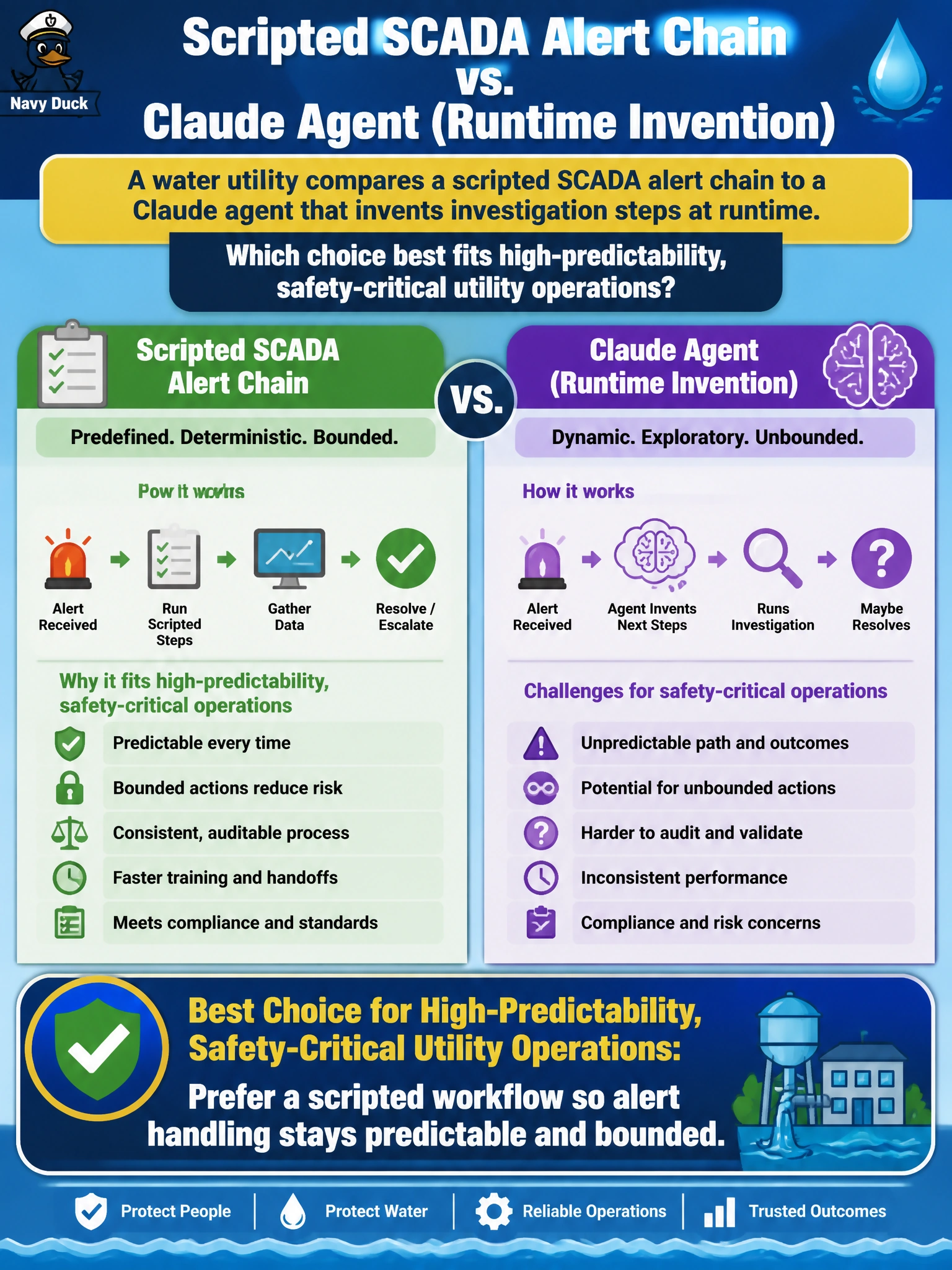
A water utility compares a scripted SCADA alert chain to a Claude agent that invents investigation steps at runtime. Which choice best fits high-predictability, safety-critical utility operations?
Select an answer to reveal the explanation.
Short Explanation
Utility alerts are more like a fire drill than a brainstorming session—everyone already knows the order of doors to check. A scripted workflow keeps that order; an autonomous agent tailoring investigation steps per alert is the wrong vibe for safety-critical ops.
Full Explanation
For high-predictability, safety-critical water-utility operations, prefer a scripted workflow so SCADA alert handling stays predictable and bounded. Alert chains in utilities resemble drills with known doors to check: acknowledge, classify severity, pull prescribed telemetry, notify on-call roles, and escalate along documented paths. Deterministic workflows make those steps auditable and prevent runtime invention from skipping mandatory safety gates. A Claude agent that invents investigation steps at runtime can expand blast radius, reorder critical checks, or omit required human gates under time pressure.
Preferring an autonomous agent to tailor investigation steps per alert fails by concept: letting runtime invention replace bounded runbooks is precisely what safety-critical ops forbid. Using a Claude agent with SCADA tool access to expand triage coverage fails because open-ended tool access can trigger uncontrolled actions and bypass the verified, bounded steps that SCADA instrumentation and runbooks require. Preferring a free agent for alert triage to improve adaptability across incidents fails because adaptability cannot override authorized human approval and bounded escalation paths; safety-critical ops require mandatory gates, not model discretion.
Exam caveat: agents can assist investigation under human supervision or for non-control advisory tasks, but inventing the control path at runtime is the wrong default for SCADA-class alerting. Predictability beats cleverness when physical plant risk is on the line.
Operational check: encode the approved alert runbook as a workflow with hard stops before any control action, require dual authorization for setpoint tools, log every stage with timestamps and operator IDs, and tabletop-test that invented agent paths cannot bypass acknowledgment or escalation gates.