
A transit authority splits schedule lookups and fare-policy answers into separate Claude subagents. What is the primary benefit of that isolation?
Select an answer to reveal the explanation.
Short Explanation
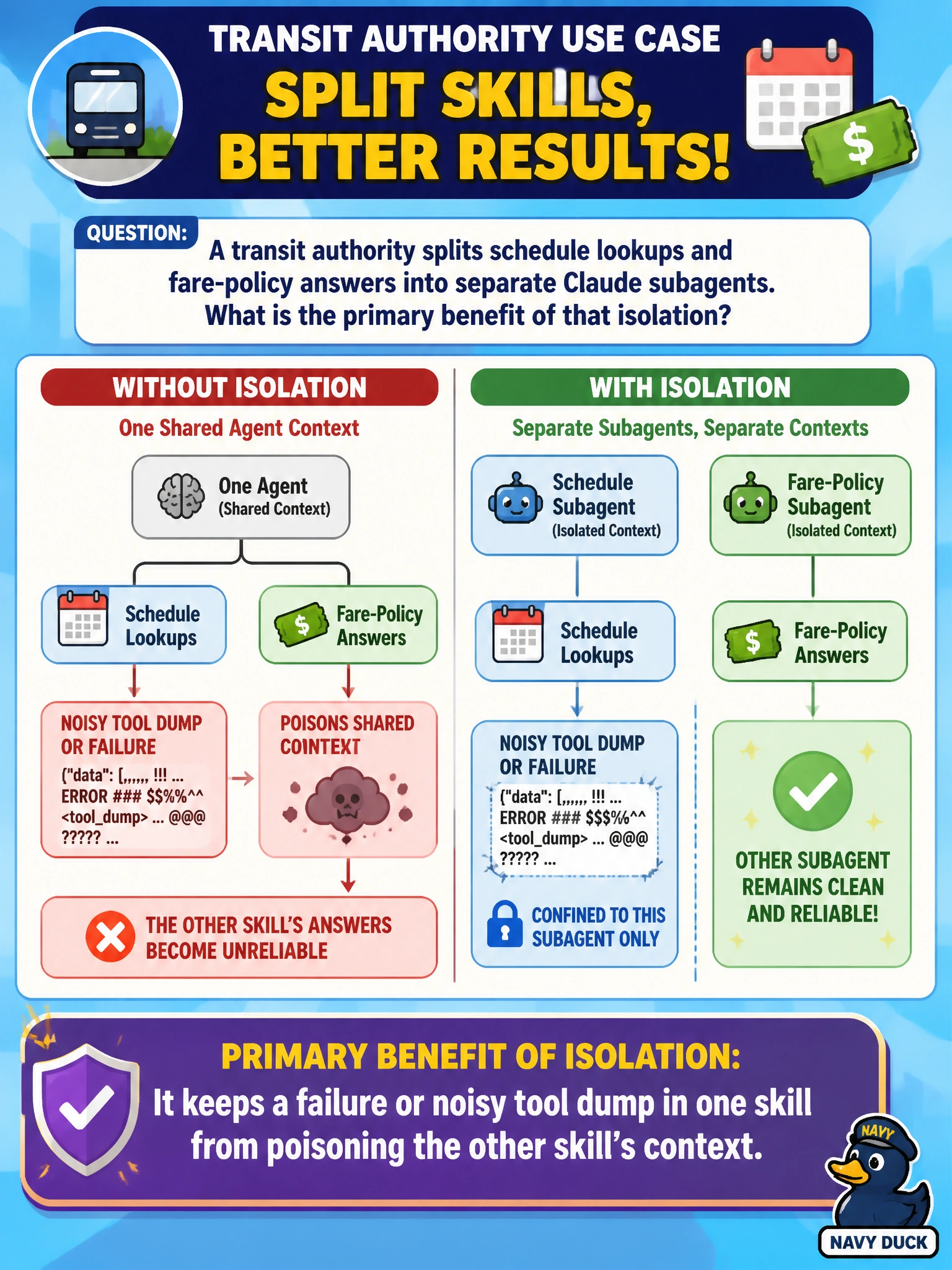
Separate subagents are like two radio channels—one for schedules, one for fares. If the schedule channel fills with static, the fare channel still stays clear for the rider.
Full Explanation
Splitting schedule lookups and fare-policy answers into separate Claude subagents primarily keeps a failure or noisy tool dump in one skill from poisoning the other skill's context. Isolation confines intermediate tool output, retries, and error text to the subagent that produced them, so a verbose trip-planner response cannot crowd out fare-rule retrieval (or vice versa) inside a shared window. Transit support commonly mixes schedule APIs and policy corpora; skill separation preserves clarity and reduces cross-contamination when riders ask compound questions.
Running schedule and fare specialists concurrently to shorten response time fails because the stem asks about isolation, not speed; parallel execution does not by itself keep a noisy tool dump or failure in one skill from leaking into the other skill's context, which is the actual benefit being tested.
Providing specialists with focused prompts and tool lists tuned for schedule or fare-policy vocabulary fails as the primary benefit because the question asks specifically about isolation against failures and noisy tool dumps; tighter prompts are a secondary focusing effect, not the containment boundary that prevents one skill's error output from crowding out the other's context.
Maintaining separate memory stores for schedule chats and fare chats to support rider follow-ups fails because the isolation described concerns a single lookup's context window and tool output, not long-term chat memory or follow-up history; separate memory does not address a noisy schedule-tool dump crowding out fare-rule retrieval in the same interaction.
Exam caveat: isolation improves containment and focus; it does not by itself guarantee answer correctness, freshness, or compliance. Orchestration still must merge specialist results carefully for multi-part rider questions.
Operational check: register schedule and fare tools on distinct subagents, return compact structured summaries to the parent, monitor per-skill context growth and tool-error rates, and verify that a deliberate schedule-tool failure never appears in the fare specialist's working context.