
A county 311 program wants one Claude manager agent to delegate streetlight outages to one specialist and pothole reports to another. What architecture pattern best fits this design?
Select an answer to reveal the explanation.
Short Explanation
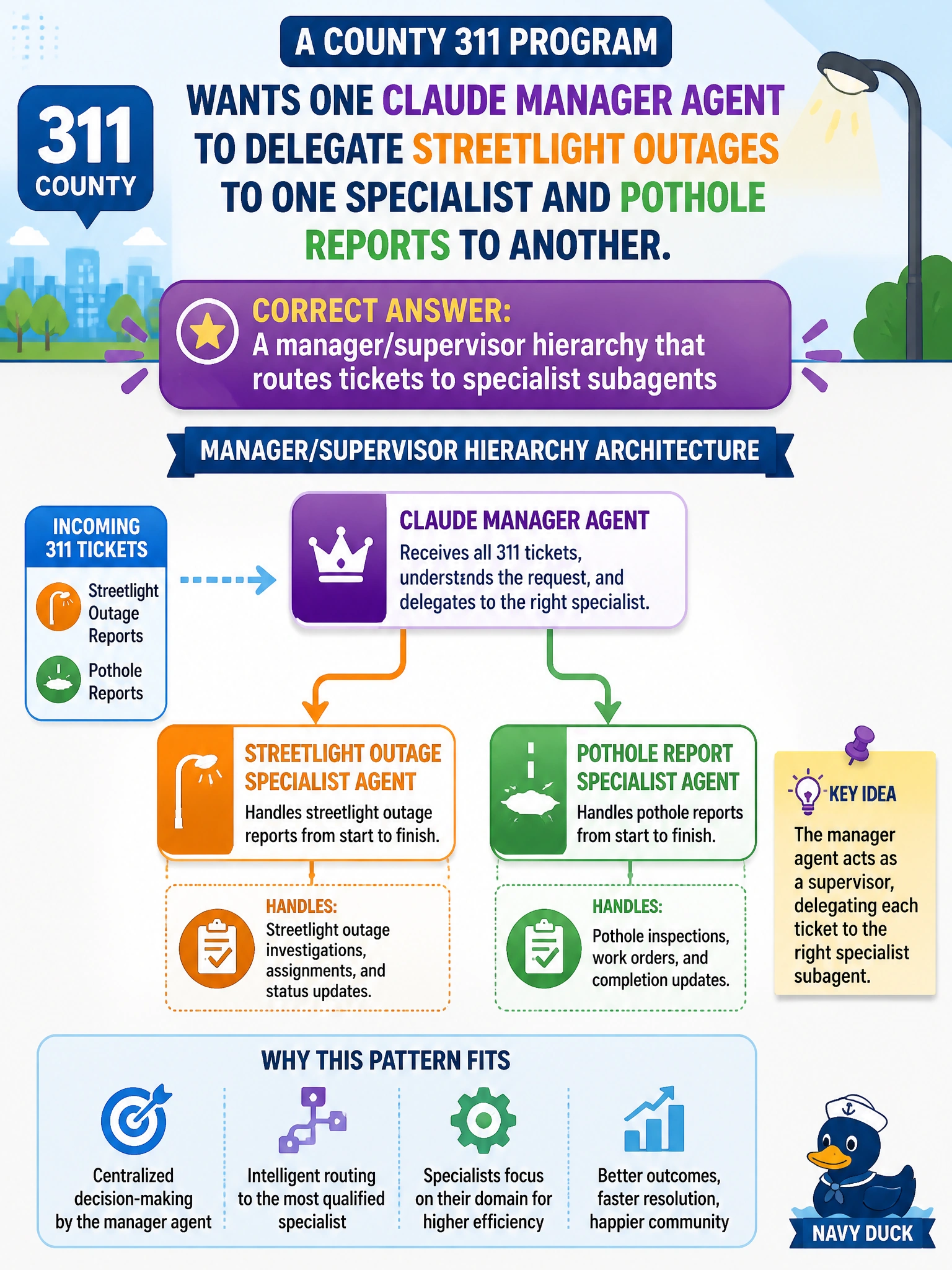
Picture a 311 dispatcher who does not climb every pole or fill every pothole— they hand each ticket to the right crew. A manager agent works the same way: it routes, and specialists do the deep work.
Full Explanation
A manager/supervisor hierarchy that routes tickets to specialist subagents best fits a county 311 design where one Claude manager delegates streetlight outages to one specialist and pothole reports to another. The coordinating agent owns classification and handoff; each specialist keeps a narrower toolset and context (outage GIS and work-order APIs versus pavement and street-maintenance systems). That separation mirrors civic dispatch: the dispatcher does not climb every pole, and specialists do not need every other crew's tools in their working memory.
A single agent with conditional tool filtering based on ticket classification fails by concept: filtering which tools are visible does not solve the underlying problem—one session still accumulates both streetlight and pothole context and history, so the mixing and blast-radius issues a manager/specialist split avoids are still present underneath the filter. A queuing system that batches tickets and sends them to specialists in bulk fails because batching delays the live classification and handoff a 311 intake needs; specialists still need per-ticket routing during intake, not an offline batch assignment that defers delegation. A peer-to-peer mesh where specialists exchange tickets through shared memory fails because it removes the central manager that owns classification and handoff; without a supervisor, tickets can circulate between specialists with no clear owner, which is the opposite of the directed delegation this 311 design requires.
Exam caveat: manager/specialist is an architecture pattern, not a guarantee of correctness—routing quality still depends on clear task schemas, specialist scopes, and escalation rules. Do not confuse hierarchy with unsupervised recursion.
Operational check: define ticket classes and routing criteria, give each specialist only its tools, require structured handoff payloads (ticket ID, location, severity), keep the manager from executing specialist tools directly, and measure misroutes and specialist context size in production 311 traffic.