
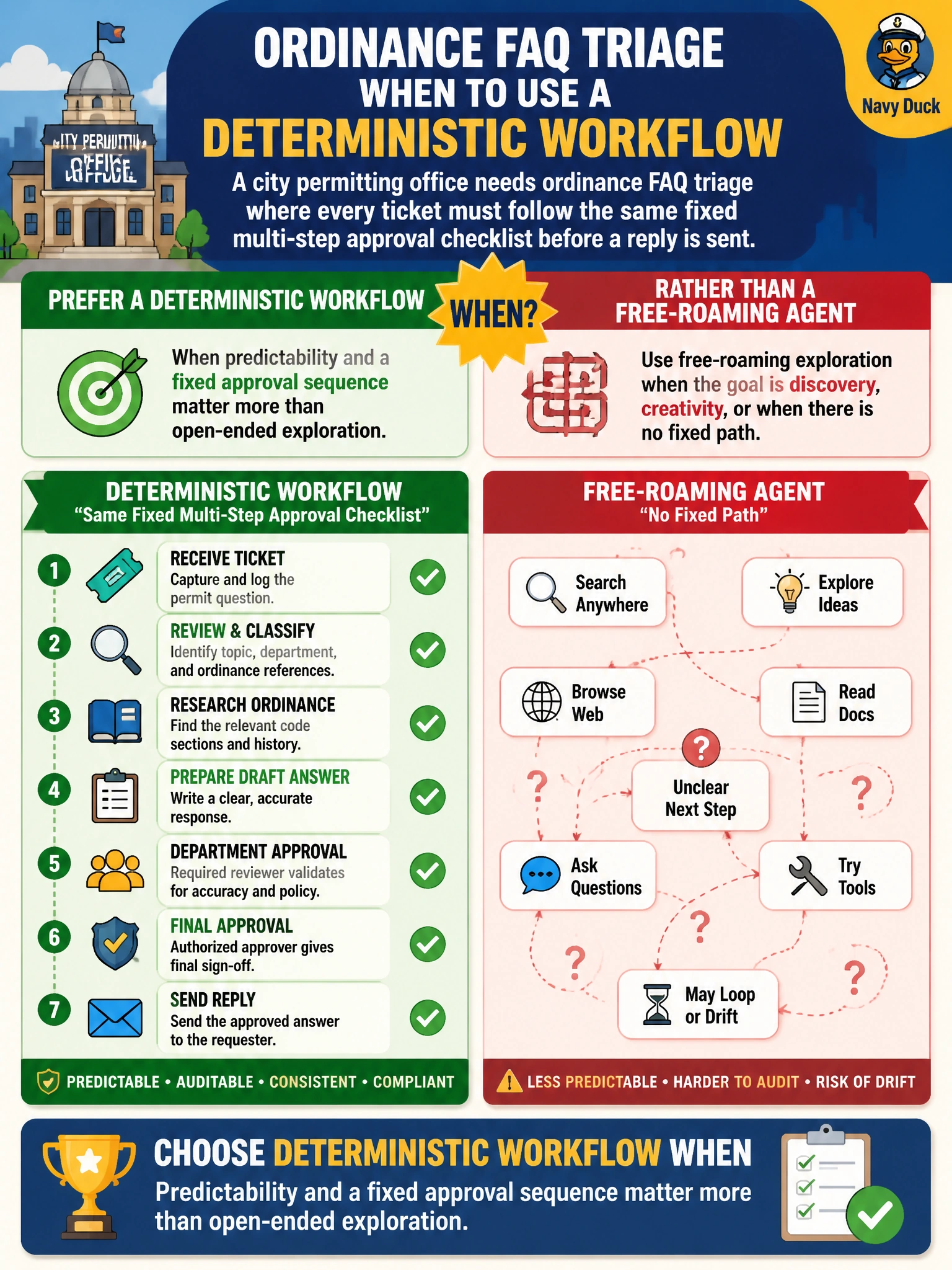
A city permitting office needs ordinance FAQ triage where every ticket must follow the same fixed multi-step approval checklist before a reply is sent. When should the team prefer a deterministic workflow over a free-roaming Claude agent?
Select an answer to reveal the explanation.
Short Explanation
Think of a permitting checklist like a stamped route through City Hall—same windows, same order, every time. When the path is fixed and auditability matters, a workflow is the conveyor belt; a free-roaming agent is more like letting someone wander the building looking for answers.
Full Explanation
Prefer a deterministic workflow when municipal ordinance FAQ triage must follow a fixed multi-step approval checklist before any resident reply leaves the permitting office. Predictability and a fixed approval sequence matter more than open-ended exploration because ordinance answers are policy-bound: the same required steps—intake classification, citation lookup, supervisor gate, and standardized reply—must run in order so auditors can reconstruct who approved what. A workflow encodes those gates as explicit stages with stop conditions; a free-roaming Claude agent optimizes for flexible next-action choice, which is the wrong control model when every ticket must traverse the same stamped route.
Expecting Claude to adapt verification steps to each ticket context fails by concept: verification steps are fixed in the workflow and applied uniformly, not customized per ticket by an agent chasing context. Wanting Claude to reorder checklist checks from ticket history to raise throughput fails because reordering mandatory gates breaks the fixed sequence; throughput gains cannot justify skipping or reshuffling required approval stages. Relying on saved agent transcripts for post hoc step reconstruction fails as the deciding factor because transcripts capture whatever an agent happened to do, not the mandatory sequence itself; auditability comes from enforced workflow gates, not after-the-fact reconstruction.
Exam caveat: deterministic workflows are not always superior to agents; they win when the path is known, shared, and must not drift. Agents win when branching depends on runtime discovery. Do not treat "agent" as automatically more advanced for civic ops.
Operational check: encode the published approval checklist as ordered workflow steps with mandatory gates, log step completion per ticket ID, block reply emission until the final approval stage succeeds, and sample tickets weekly to confirm no silent skips of intermediate reviews.