
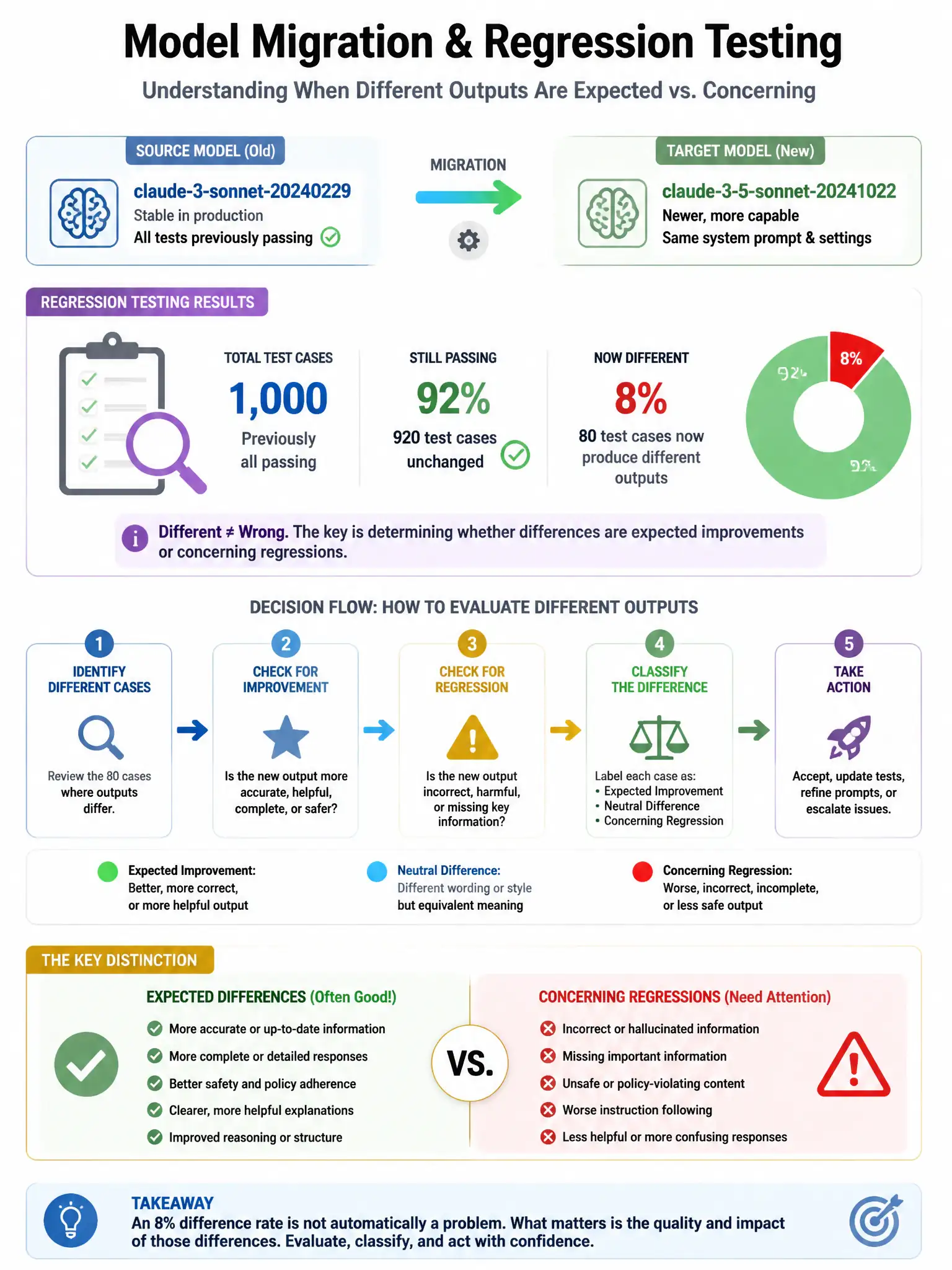
A team is migrating from claude-3-sonnet-20240229 to claude-3-5-sonnet-20241022. During regression testing, they discover that 8% of previously passing test cases now produce different outputs — not wrong outputs, just different phrasing or structure. The PM wants to declare the migration failed due to behavioral change. How should the architect respond?
Select an answer to reveal the explanation.
Short Explanation
Here's the deal — different doesn't mean wrong. You should separate functional regressions from stylistic divergence, audit the 8% divergent cases, and only block the migration if outputs are actually broken.
Full Explanation
The correct response is the one that distinguishes between functional regressions, such as outputs that are factually wrong, violate safety policies, or break downstream parsers, and stylistic divergence, such as different but equivalent phrasing. Model version upgrades routinely produce phrasing, formatting, and structure variations that are functionally equivalent — a sentence reordered, a bullet converted to prose, a synonym substituted. These are not regressions in any meaningful sense. The correct migration quality gate is functional correctness: are the outputs factually accurate, safety-compliant, and parseable by downstream systems? Auditing the 8% to separate stylistic divergence from functional regressions allows the migration to proceed on the correct evidence basis, and documenting behavioral change acceptance criteria makes future migrations more rigorous. The option that agrees with the PM and delays migration until an identical output version is available is wrong because requiring identical outputs between model versions is an unrealistic and counterproductive standard — it would prevent any model version upgrade forever, and newer models are typically more capable, not less. The option that runs the divergent test cases five more times and uses the majority output as the canonical answer is wrong because averaging across runs addresses variability within a model version, not the behavioral differences between two different model versions — this approach misdiagnoses the problem. The option that pins the divergent test cases to the old model version while migrating all other cases to the new model is wrong because split-version deployment creates a maintenance burden of running two model versions indefinitely and introduces its own complexity — it should not be the standard migration strategy for stylistic divergence.