
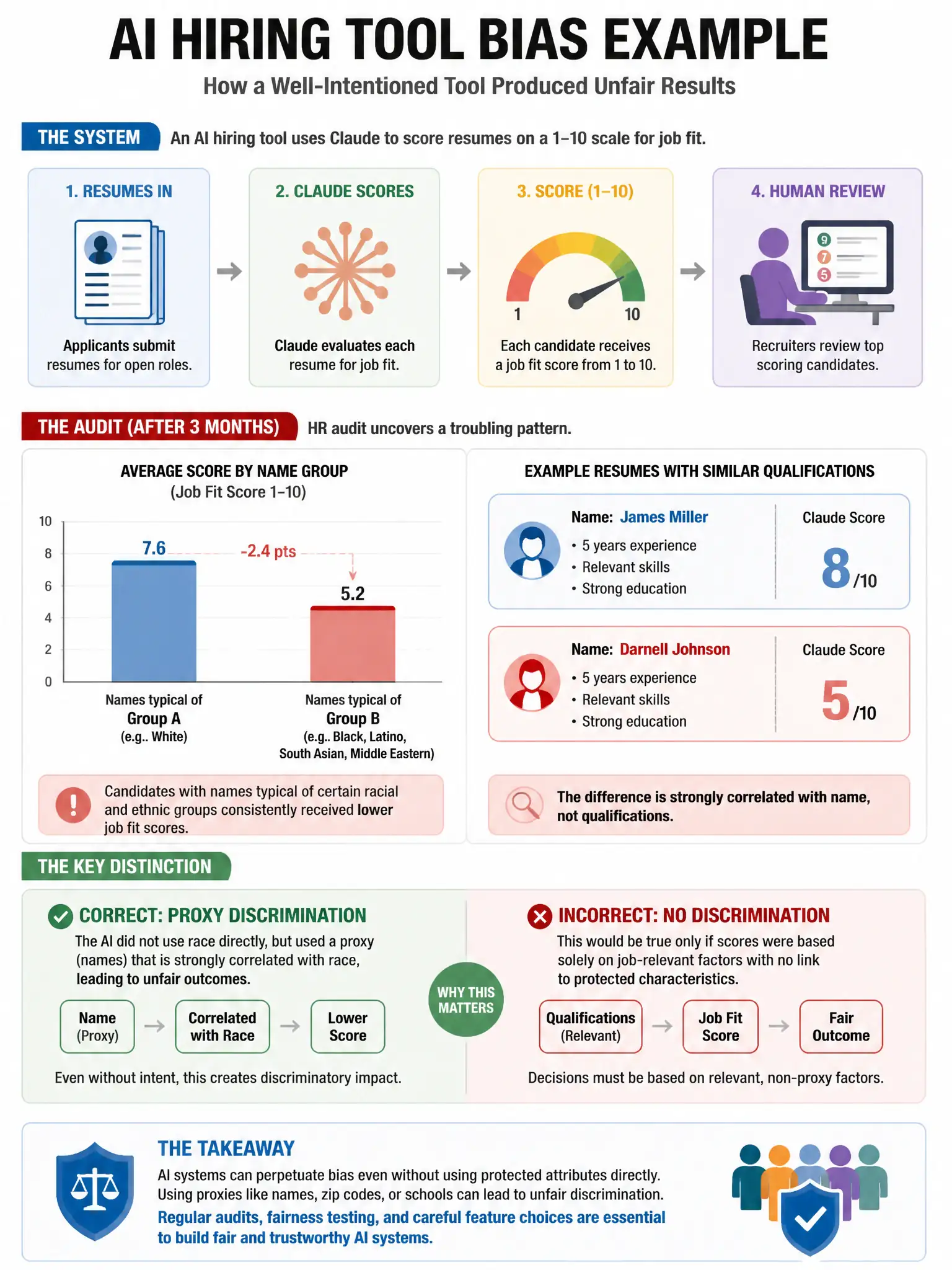
A hiring tool uses Claude to score candidate resumes on a 1-10 scale for job fit. After 3 months in production, an HR audit discovers that candidates with names typical of certain ethnic groups receive systematically lower scores on equivalent qualifications. What is the immediate and long-term architectural response?
Select an answer to reveal the explanation.
Short Explanation
Here's the deal — when an audit finds systematic demographic bias in a hiring tool, you suspend automated scoring, require human review, audit for disparate impact, and notify affected candidates. Then you rebuild the tool around anonymized qualification signals, re-check prompts and training data, and monitor with automated alerts.
Full Explanation
The correct response is the one that combines immediate mitigation and long-term architectural remediation: suspend automated scoring and require human review for all decisions, audit scored candidates for disparate impact, notify affected candidates, redesign the tool to evaluate only anonymized qualification signals, re-evaluate the model's training data and prompting for demographic bias, and implement ongoing disparate impact monitoring with automated alerts. Discovering systematic demographic bias in a hiring tool requires immediate mitigation because biased decisions are still being made, and it requires long-term remediation because the architecture itself allowed demographic proxies to influence scoring. This is both an ethical requirement and a legal one — employment discrimination laws apply to artificial-intelligence-assisted hiring decisions. The disclaimer-only response is wrong because adding a disclaimer while continuing to use the biased tool does not mitigate harm; biased decisions continue to be made, and a disclaimer does not remove liability for disparate impact discrimination. The re-prompt-only response is wrong because re-prompting alone is insufficient; names may have been irrelevant from the start, but bias may have been encoded through correlated signals in resume text such as geography, school names, and extracurriculars, and a name-ignoring prompt does not address these proxy variables. The retraining-only response is wrong because collecting more diverse training data to retrain the model is a long-term mitigation that takes significant time; it does not address the immediate harm to candidates already scored with the biased system.