
A product team wants to use a Claude-based system to provide feedback on user-submitted creative writing. Users include minors (ages 13+). The team asks the architect to ensure the system will not provide feedback that enables harmful content creation. In the context of Constitutional AI principles, what system design approach is most appropriate?
Select an answer to reveal the explanation.
Short Explanation
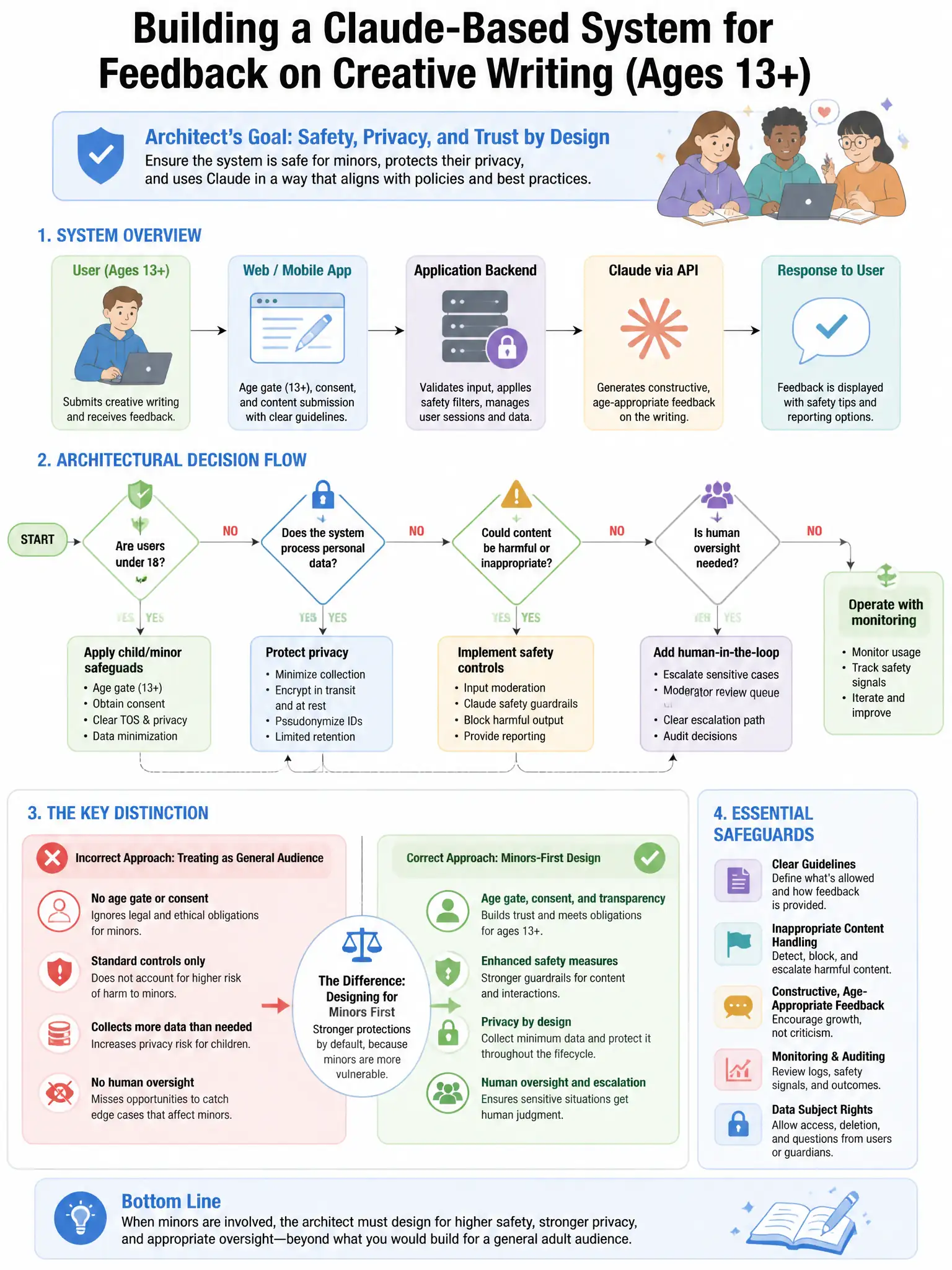
Here's the deal — you need to define usage policies for minors, encode them in the system prompt, filter inputs and outputs, and have the feedback function critique craft while declining policy-violating content. That's how Constitutional AI works: explicit, context-appropriate values plus technical controls. It keeps the tool useful while enforcing age-appropriate boundaries.
Full Explanation
The correct approach is to define usage policies appropriate for the audience (minors) covering prohibited content categories; encode those policies in the system prompt with clear behavioral guidelines; implement age-appropriate content filtering on both inputs and outputs; and design the feedback function to critique craft elements while declining to engage with content that violates the policy. This matches Constitutional AI principles because it encodes explicit values and behavioral guidelines appropriate to context. The system serving minors needs usage policies specifically designed for that audience, system prompt instructions that operationalize those policies for Claude, and technical controls such as input and output filtering that provide defense-in-depth. The system should remain useful by giving craft feedback on legitimate content while enforcing age-appropriate boundaries. The blanket-blocking approach is wrong because blocking all feedback on writing that mentions violence, conflict, or dark themes would make the system useless for legitimate creative writing, since most literature involves conflict; the policy must target harmful content, not difficult themes. The default-safety approach is wrong because Claude's default safety training is calibrated for general audiences, and deploying to minors requires additional context-specific configuration and stricter content policies than the defaults provide. The human-review-first approach is wrong because requiring all submitted writing to be reviewed by human moderators before Claude provides feedback creates latency incompatible with writing feedback tools and is economically prohibitive at scale; automated controls should handle the majority of cases, with human review reserved for flagged edge cases.