
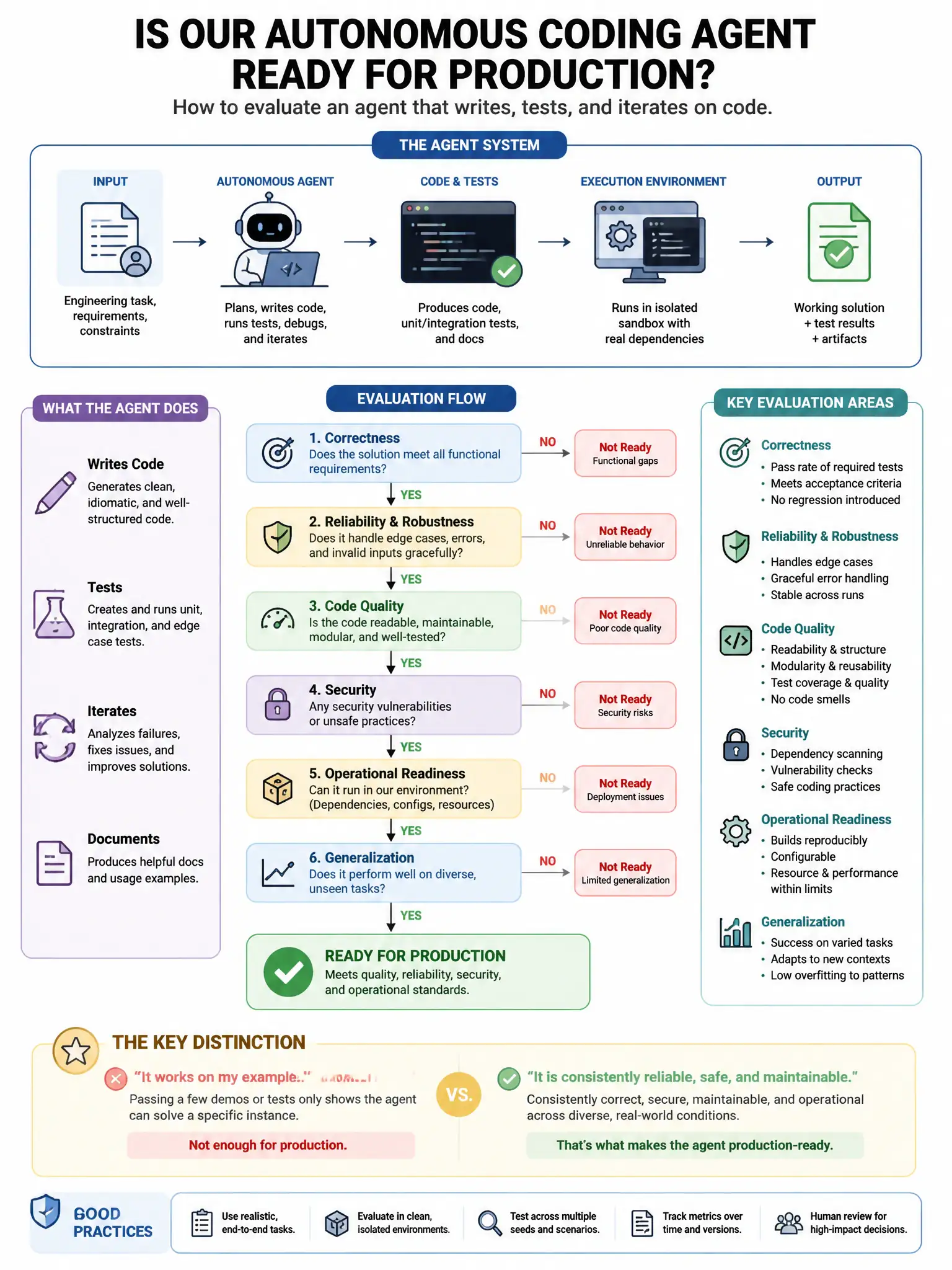
A team has built an autonomous coding agent that writes, tests, and iterates on code. They want to evaluate whether the agent is ready for production use on real engineering tasks. Which evaluation methodology gives the most reliable production readiness signal?
Select an answer to reveal the explanation.
Short Explanation
Here's the deal — if you want a production readiness signal, run the agent on real issue tickets. Synthetic benchmarks don't capture ambiguous requirements, incomplete context, or domain-specific codebases. Task completion rate, test pass rate, and human review of edge cases give you the most reliable signal.
Full Explanation
The end-to-end evaluation on 50 realistic engineering tasks sampled from actual production issue tickets, measuring task completion rate, code correctness (test pass rate), and human review of edge case handling is correct because production readiness evaluation must use tasks that reflect real production conditions: actual issue tickets expose the agent to ambiguous requirements, incomplete context, and domain-specific codebases that synthetic benchmarks do not capture. Task completion rate measures whether the agent can navigate real-world complexity; test pass rate provides objective correctness measurement; human review catches subtle issues in edge cases. The benchmark suite of 200 isolated coding challenges with known solutions and pass@k is wrong because isolated coding challenges (competitive-programming-style) measure algorithmic problem-solving capability, not the ability to navigate ambiguous requirements, understand existing codebases, or handle the open-ended nature of real engineering tasks. The 3 senior engineers reviewing 10 outputs and rating them 1-5 for quality is wrong because 10 outputs reviewed by engineers is statistically insufficient and subject to reviewer bias — it does not cover the variance in real task difficulty. The token efficiency metric (tasks completed per million input tokens) is wrong because token efficiency (tasks per million tokens) measures cost, not quality — an agent can be token-efficient while producing incorrect code.