
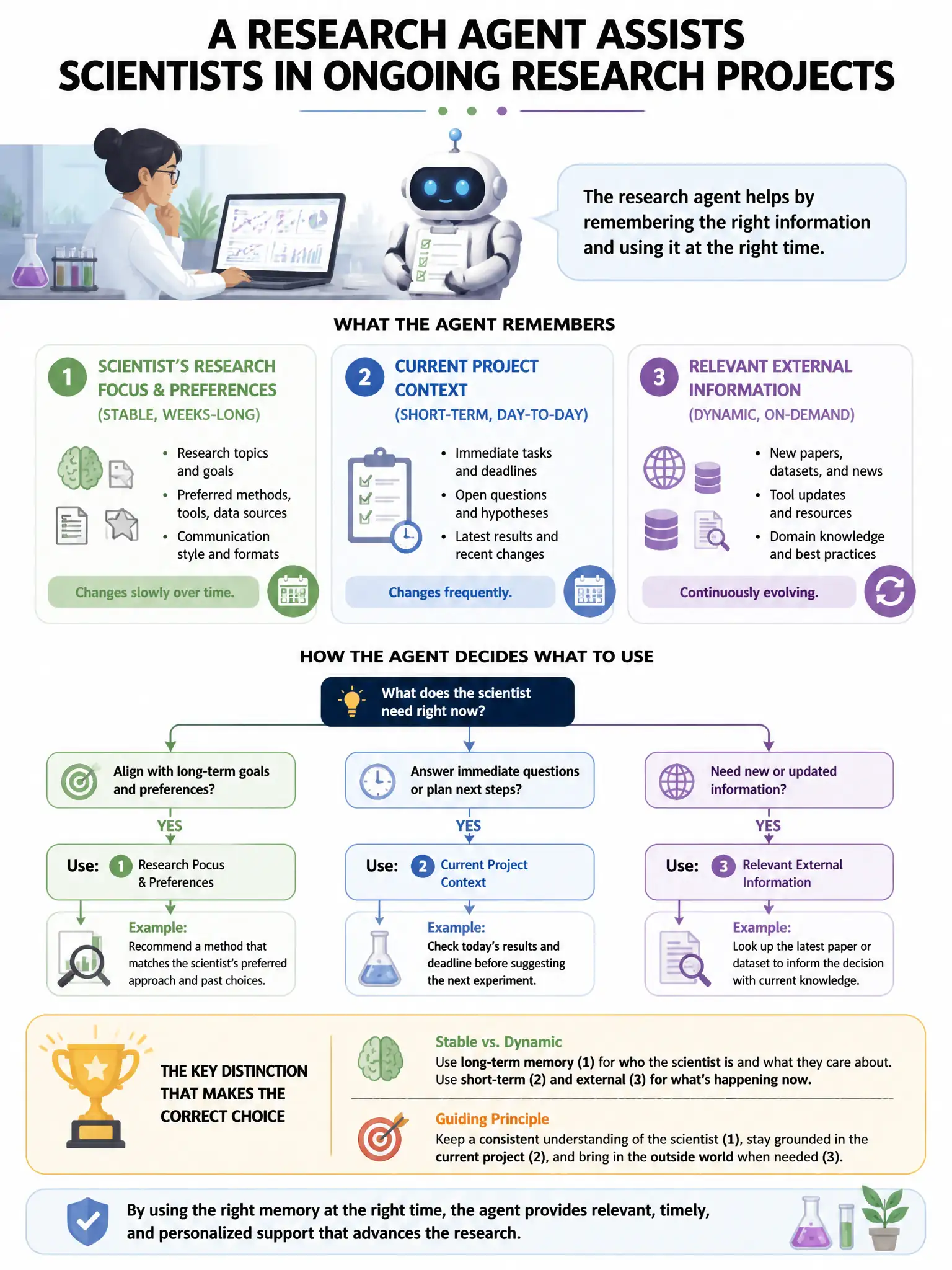
A research agent assists scientists in ongoing research projects. The agent needs to remember: (1) the scientist's research focus and preferences (stable, weeks-long), (2) the current experiment's hypotheses and prior results (project-level, days-long), and (3) the current conversation's context (session-level, hours-long). What memory architecture correctly maps these retention needs?
Select an answer to reveal the explanation.
Short Explanation
Here's the deal — you need three memory tiers because these needs don't share the same lifetime or retrieval pattern. Keep stable research focus in a long-term vector store, experiment data in a project database, and session state in the context window.
Full Explanation
The three-tier memory architecture — long-term vector store for research focus and preferences, project-level structured database for experiment data, and in-context window for session state, each read into context at the appropriate granularity — is correct because different memory types have fundamentally different access patterns, retention durations, and retrieval semantics that require different storage mechanisms. Long-term preferences are semantic and stable, so they suit vector search for similarity-based retrieval. Project-level experiment data is structured and relational, so it suits a database with structured queries. Session state is sequential and transient, so it suits the in-context window. Uniform storage in any single system mismatches at least two of the three retention needs. Storing all memories in the model weights and updating them after every conversation is wrong because it treats volatile session and project state as permanent parametric knowledge, making updates slow, risky, and hard to retrieve with the exact granularity needed for hypotheses, results, and conversation context. Using only the context window for all three types and relying on conversation summaries to bridge sessions is wrong because a single context window can only hold a limited amount of history — weeks-long research preferences cannot be maintained in context across sessions — and summaries are lossy for structured scientific data that requires exact values such as p-values and sample sizes. Storing all memory in a key-value cache with a 24-hour TTL across all memory types is wrong because a 24-hour TTL eliminates long-term memory such as research preferences, which must persist across weeks, and a uniform TTL ignores the fundamentally different lifetimes of the three memory types.