
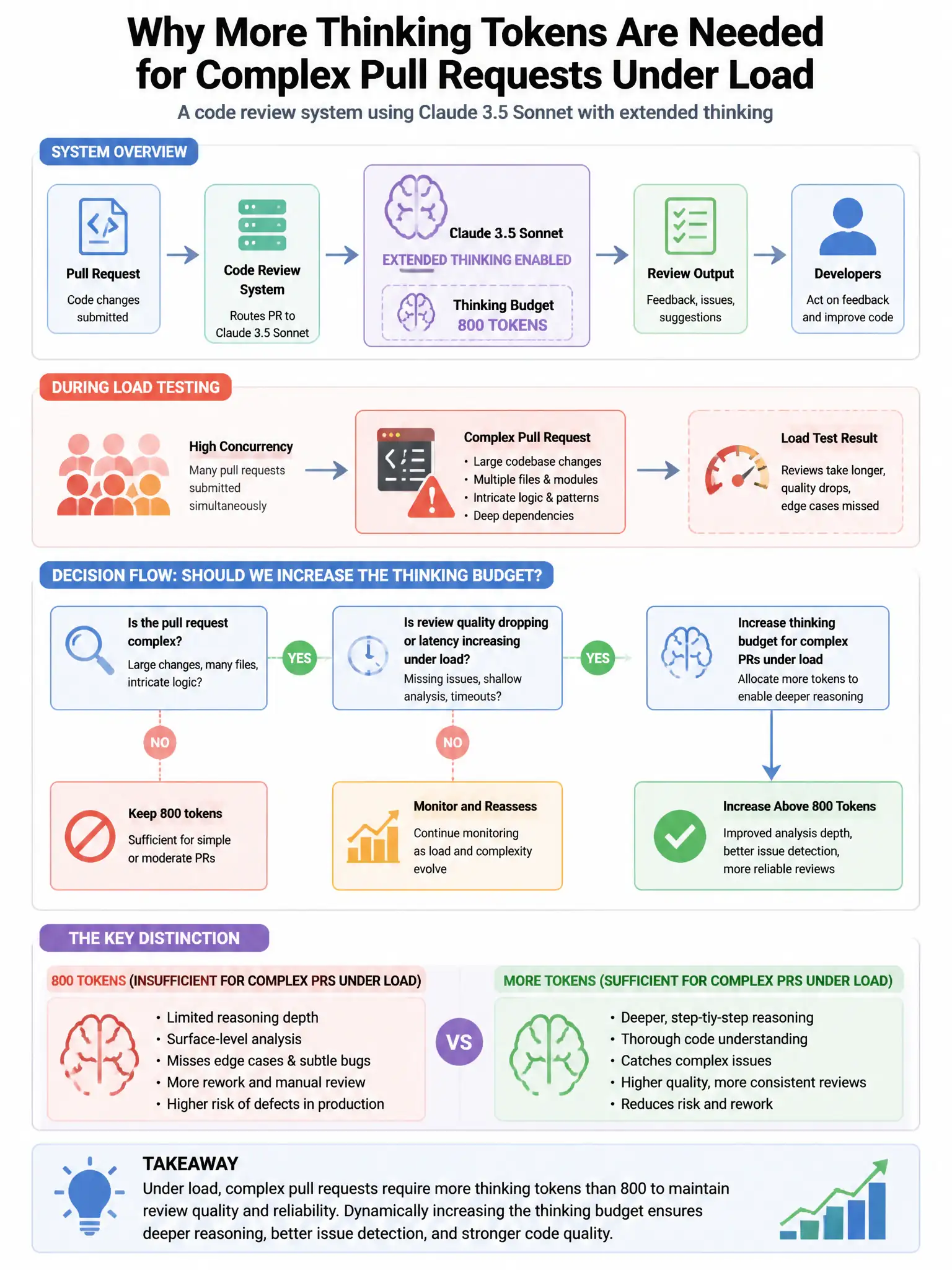
A code review system uses claude-3-5-sonnet with extended thinking enabled and a thinking budget of 800 tokens. During load testing, the team discovers that on complex pull requests, the model frequently exhausts the thinking budget before completing its reasoning, resulting in truncated analyses. What is the correct architectural response?
Select an answer to reveal the explanation.
Short Explanation
Here's the deal — dynamic budget allocation solves the exhaustion problem efficiently. Complex pull requests genuinely need more thinking tokens, while simple ones need far fewer, so a fast complexity heuristic can route each request to the right budget tier.
Full Explanation
Dynamic budget allocation is correct because it solves the exhaustion problem efficiently — complex pull requests (many files changed, deep call graphs) genuinely need more thinking tokens, while simple pull requests (single-line fixes, documentation) need far fewer. Fast complexity heuristics (file count, diff size, cyclomatic complexity proxy) route each request to an appropriate budget tier. Increasing the thinking budget to 5000+ tokens for all requests is wrong because setting a uniformly high budget wastes tokens on simple pull requests (driving up cost significantly) without adding quality — budget should match task complexity. Switching to claude-3-haiku which does not use extended thinking and will always return complete responses is wrong because it loses the reasoning capability that makes the code review valuable; Haiku's non-thinking responses will miss subtle logic errors that extended thinking catches. Disabling extended thinking entirely and relying on standard chain-of-thought prompting instead is wrong because standard chain-of-thought prompting produces reasoning in the output token stream, consuming visible tokens and still requiring similar depth of reasoning — it does not avoid the underlying compute constraint.