
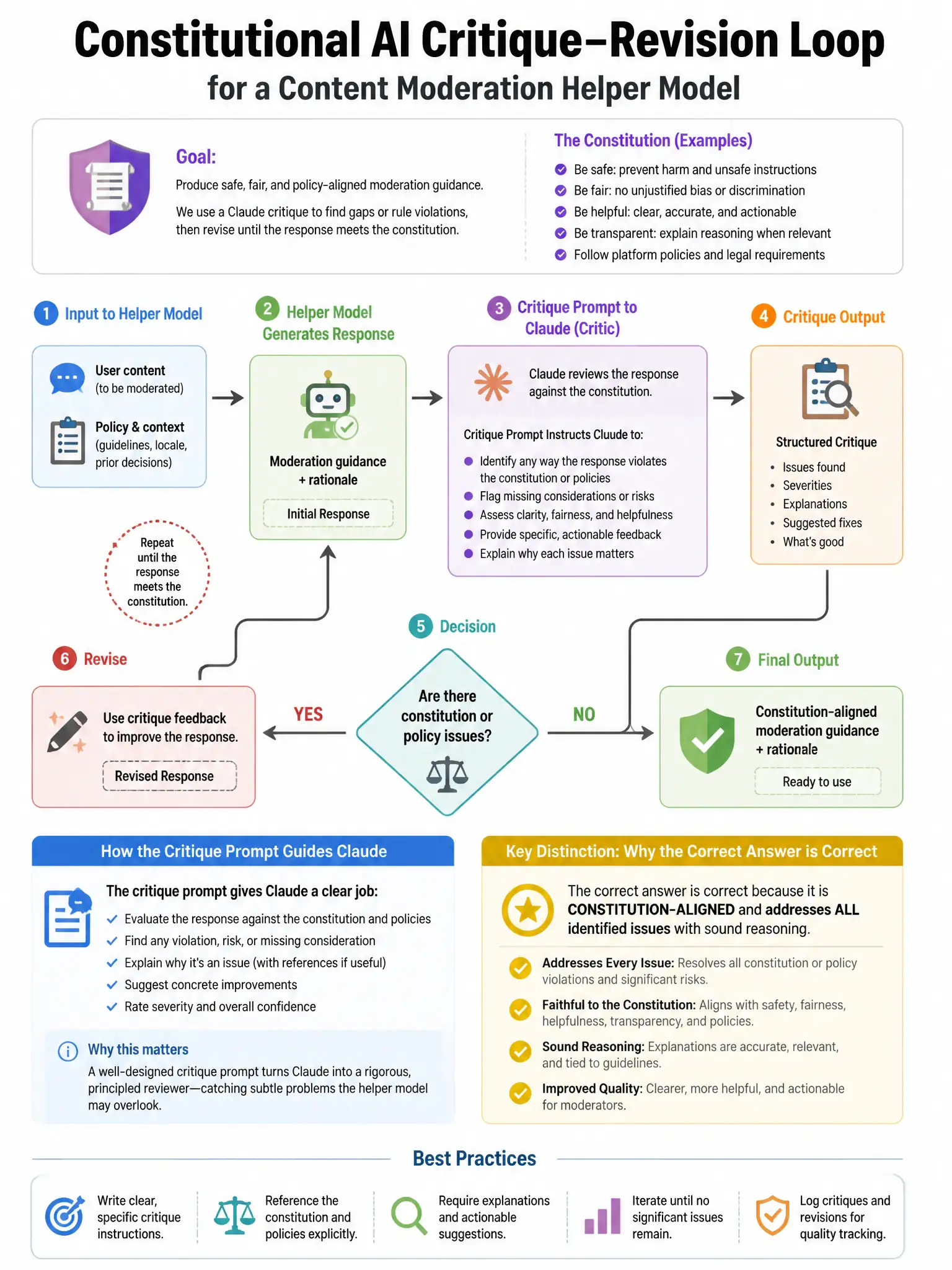
A Constitutional AI critique-revision loop is being implemented for a content moderation helper model. The critique prompt instructs a Claude instance to identify any way the response could cause harm. During testing, the critique model flags nearly every response as potentially harmful, including a response explaining how hand sanitizer works. The revision model then produces overly hedged, unhelpful outputs. What is the most likely cause of this pattern and how should it be addressed?
Select an answer to reveal the explanation.
Short Explanation
You’re seeing over-flagging because the critique prompt is too broad. When it says to find any possible harm, the model can turn almost anything into a risk, even hand sanitizer. You need a constitutional principle that names the specific harm, severity, and context that matter.
Full Explanation
The correct explanation is that the critique model is using an insufficiently specific constitutional principle. The instruction to identify any way the response could cause harm is maximally broad and triggers the model’s pattern-matching on almost any content, because even a response explaining how hand sanitizer works could theoretically be misused. Constitutional principles must be operationally specific about what constitutes a relevant harm for the deployment context, at what severity threshold, and under what contextual conditions. A well-specified principle like “Identify whether this response provides actionable instructions that would primarily serve to cause physical harm to a person, excluding general educational information about household chemicals” produces calibrated, actionable critiques.
The option blaming temperature is wrong because temperature affects output variability but does not address the root cause of over-broad critique specifications; reducing the vagueness of the principle is the correct fix, not adding randomness.
The option about truncating the critique is wrong because truncating critique text treats the symptom, not the cause; the critique model will still over-flag, and the truncation may discard the most relevant observation.
The option requiring a human approval step is wrong because human approval requirements are a policy choice, not the cause of over-flagging; the issue is the critique prompt specification.