
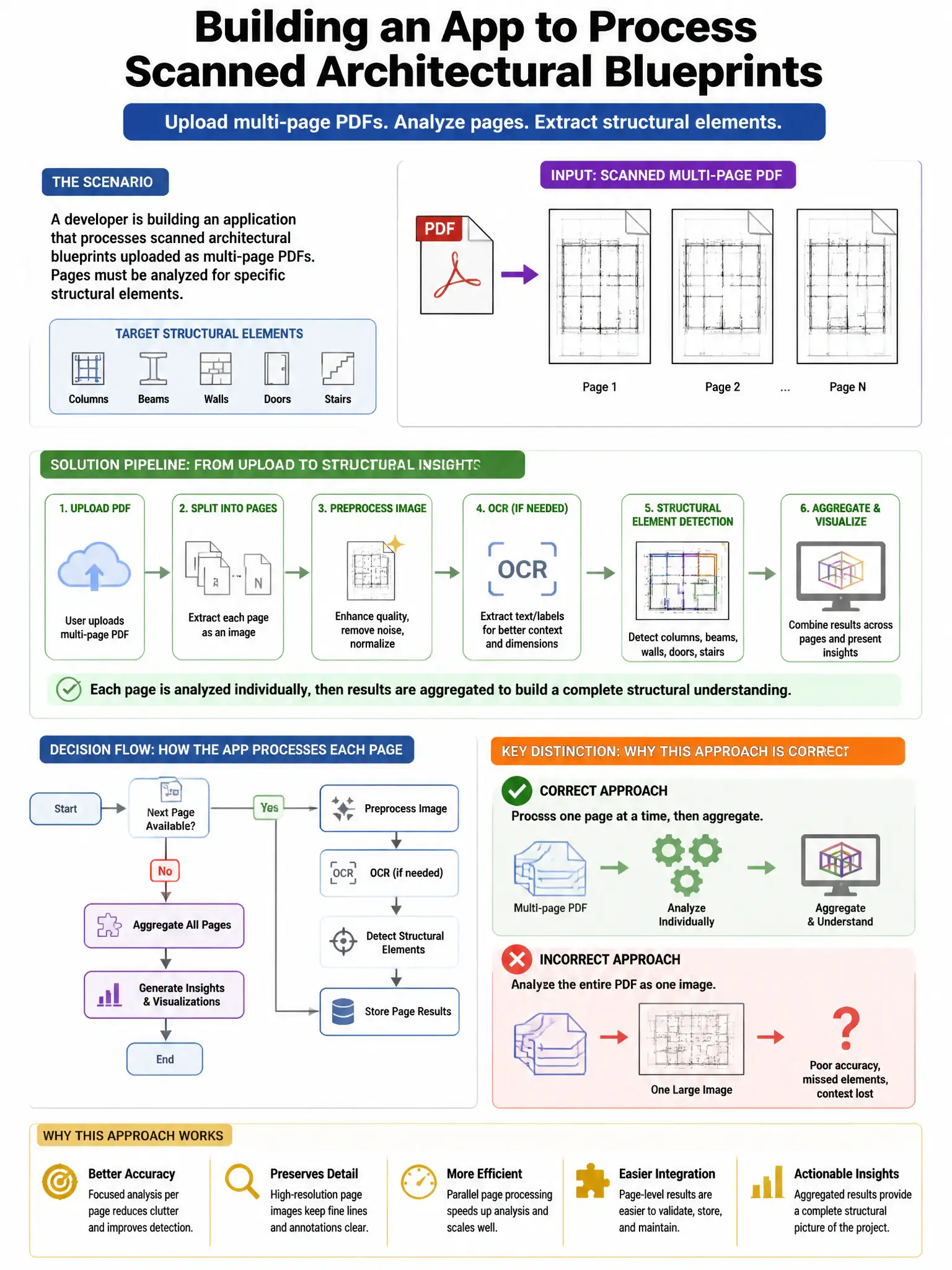
A developer is building an application that processes scanned architectural blueprints uploaded as multi-page PDFs. Pages must be analyzed for specific structural elements. The team converts each page to a separate PNG image. On complex blueprint pages, Claude accurately identifies major structural components but misses small annotation labels (font size ~6pt). What is the best solution that stays within the API's image handling constraints?
Select an answer to reveal the explanation.
Short Explanation
Here's the deal — if the blueprint PDF has a text layer, you use it. Pull the annotation text with a PDF parser and send it with the image, so Claude gets reliable labels without squinting at tiny 6pt text.
Full Explanation
Using the PDF's embedded text layer, when available, and extracting annotation text programmatically with a PDF parsing library is correct because many architectural blueprint PDFs retain a text layer from the CAD authoring tool, such as AutoCAD or Revit, even when the page is scanned. Passing that extracted text alongside the image gives Claude accurate annotation text without depending on vision-based OCR of tiny fonts, and it combines the spatial understanding from the image with reliable text from the native text layer. The approach that sends the same blueprint page twice — once as a full-page image and once as a 4x upscaled copy of the full page — in the same API request, instructing Claude to use both images to extract annotations, is not the best solution because it still depends on vision-based reading of the small labels; if the upscaled copy is still not legible to Claude, the annotations remain missed, and it also consumes additional image tokens without providing the deterministic text that the embedded PDF layer can supply. Increasing the PNG DPI to 600 and sending the full-page image is wrong because the Anthropic API resizes images for processing, so very high source DPI does not proportionally increase the effective resolution Claude uses, and there is a practical limit on image token consumption. Switching from PNG to SVG format for blueprint pages is wrong because the Anthropic API does not natively parse SVG XML as structured data; it would be rasterized for vision processing, losing the resolution advantage, or interpreted as text, which would be unmanageable for complex blueprint SVGs.