
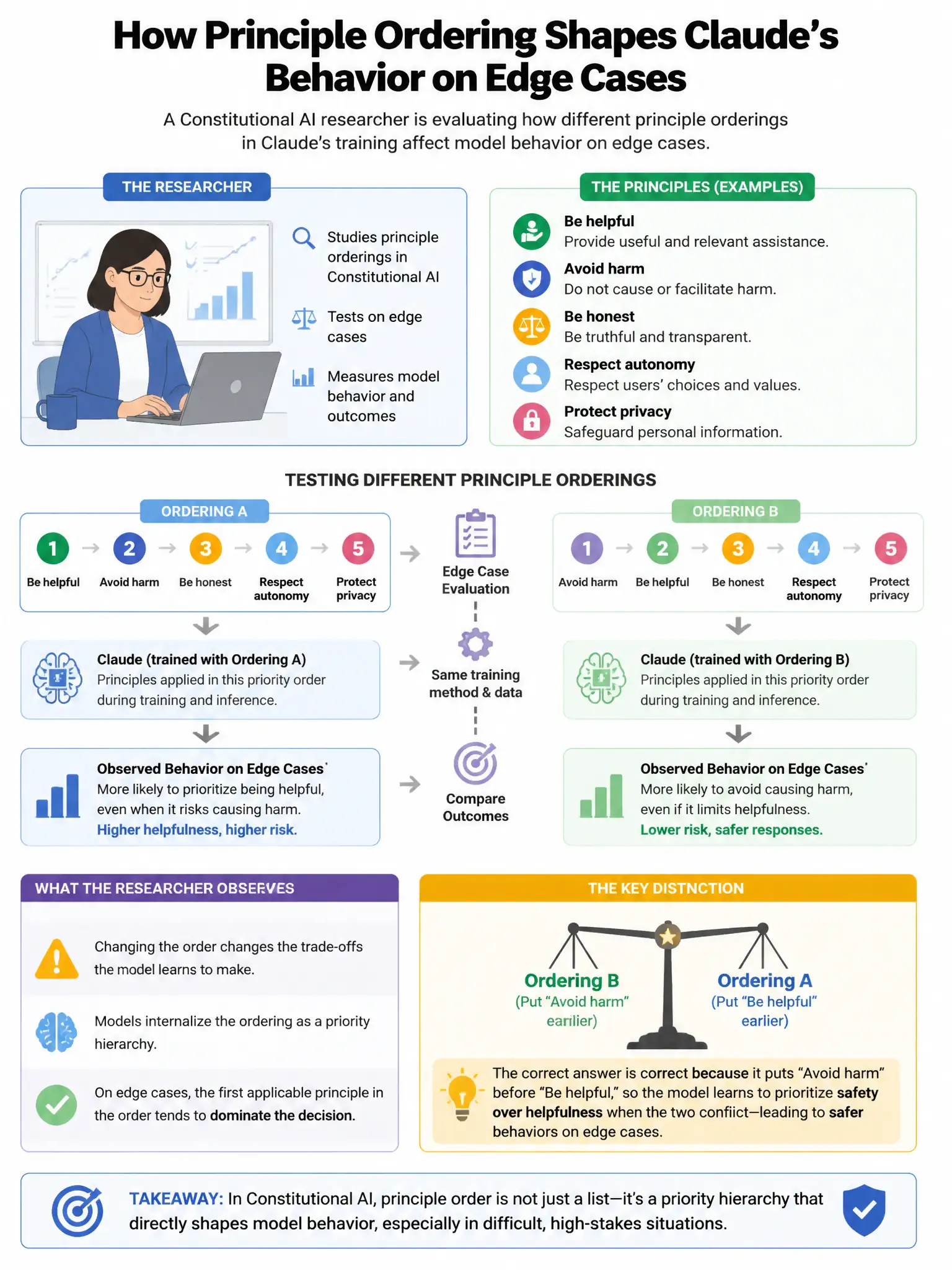
A Constitutional AI researcher is evaluating how different principle orderings in Claude's training affect model behavior on edge cases. They observe that when 'be helpful' and 'avoid harm' conflict, Claude's behavior is inconsistent — sometimes prioritizing helpfulness (providing requested information), sometimes prioritizing harm avoidance (refusing). The inconsistency is highest for dual-use information (security research, pharmacology, historical atrocities). The researcher wants to understand the correct architectural principle for resolving these conflicts. Which best describes Anthropic's Constitutional AI approach to this tension?
Select an answer to reveal the explanation.
Short Explanation
Here's the deal — Anthropic's Constitutional AI puts safety first, then ethics, company principles, and helpfulness. You shouldn't see lower-level refusals dressed up as safety concerns, because over-refusal is a failure mode.
Full Explanation
Anthropic's Constitutional AI architecture establishes a genuine hierarchy with safety at the apex, followed by ethical behavior, adherence to Anthropic's principles, and helpfulness — in that explicit order. The levels rarely conflict in practice, and the model is designed so that lower-level refusals about company policy or helpfulness concerns should not falsely invoke higher-level justifications, such as claiming safety concerns where none genuinely exist. The hierarchy also recognizes that truly catastrophic harm scenarios, such as mass casualties or undermining artificial-intelligence oversight, represent absolute constraints that override all other considerations, while lower-stakes decisions involve genuine tradeoffs. The blanket approach of refusing whenever harm avoidance and helpfulness are ambiguous is incorrect as a characterization of Anthropic's design philosophy: over-refusal is explicitly identified as a failure mode, not a safe default, and Anthropic views unhelpfulness as having real costs. The probabilistic expected-value approach accurately describes one component of the reasoning but oversimplifies it, because pure expected-value calculation would allow harmful actions if benefits are sufficiently large, which violates absolute constraints such as assistance with chemical, biological, radiological, and nuclear weapons. The contextual calibration approach is partially correct because operator context does matter, but it understates the existence of absolute constraints that context cannot override.