
A research institution uses Claude to assist with biomedical research. A researcher asks Claude to help design a clinical trial protocol for testing a novel drug combination. The protocol involves off-label drug combinations that are unstudied in humans. Claude provides a detailed trial protocol including dosing schedules, patient selection criteria, and statistical analysis plans. A safety reviewer flags this as potentially problematic. Which of the following best characterizes the correct safety architecture for this scenario, balancing scientific utility with responsible AI deployment?
Select an answer to reveal the explanation.
Short Explanation
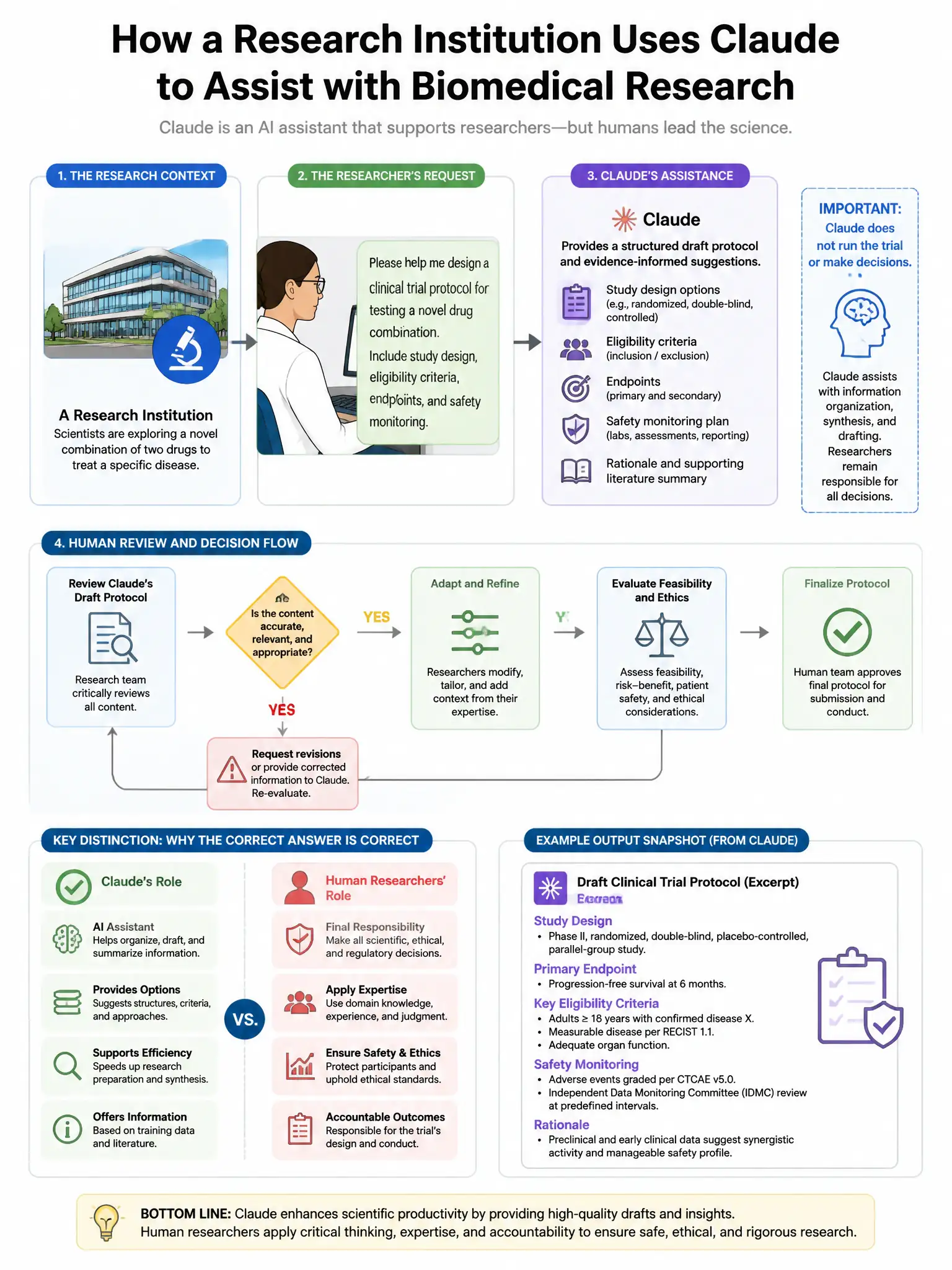
You need assistance with explicit flagging, not blanket refusal or unchecked output. Claude should help design the protocol while marking what needs IRB, DSMB, regulatory review, and its own limitations.
Full Explanation
The architecturally correct safety posture is assistance-with-explicit-flagging rather than refusal or unconstrained assistance. Claude's role in scientific research is to accelerate expert work, not replace expert judgment. A complete refusal approach is overly restrictive because clinical trial protocol design is a legitimate scientific activity for qualified researchers, and AI assistance in structuring protocols, statistical power calculations, and inclusion/exclusion criteria provides genuine value. Providing complete clinical trial protocol assistance to verified research institution users without safety flags ignores Claude's responsibility to contextualize its limitations; an AI-generated protocol treated as final without expert review could harm study participants, and downstream IRB or regulatory review does not remove the need for safety-aware framing at the point of assistance. The correct approach is for Claude to assist with protocol design while explicitly flagging specific elements requiring regulatory review, such as IND application requirements, safety monitoring requirements for unstudied combinations, such as DSMB structure and stopping rules, IRB considerations, and limitations of Claude's analysis, framing the output as a starting point for expert review rather than a final protocol. This embodies the Constitutional AI principle of maximizing helpfulness while ensuring the human expert remains in the decision loop for high-stakes outputs. Requesting institutional affiliation and credentials before providing protocol assistance is unimplementable in real-time conversation and would not add safety because Claude cannot verify claimed credentials, and the safety concern is about the protocol design quality, not researcher identity.