
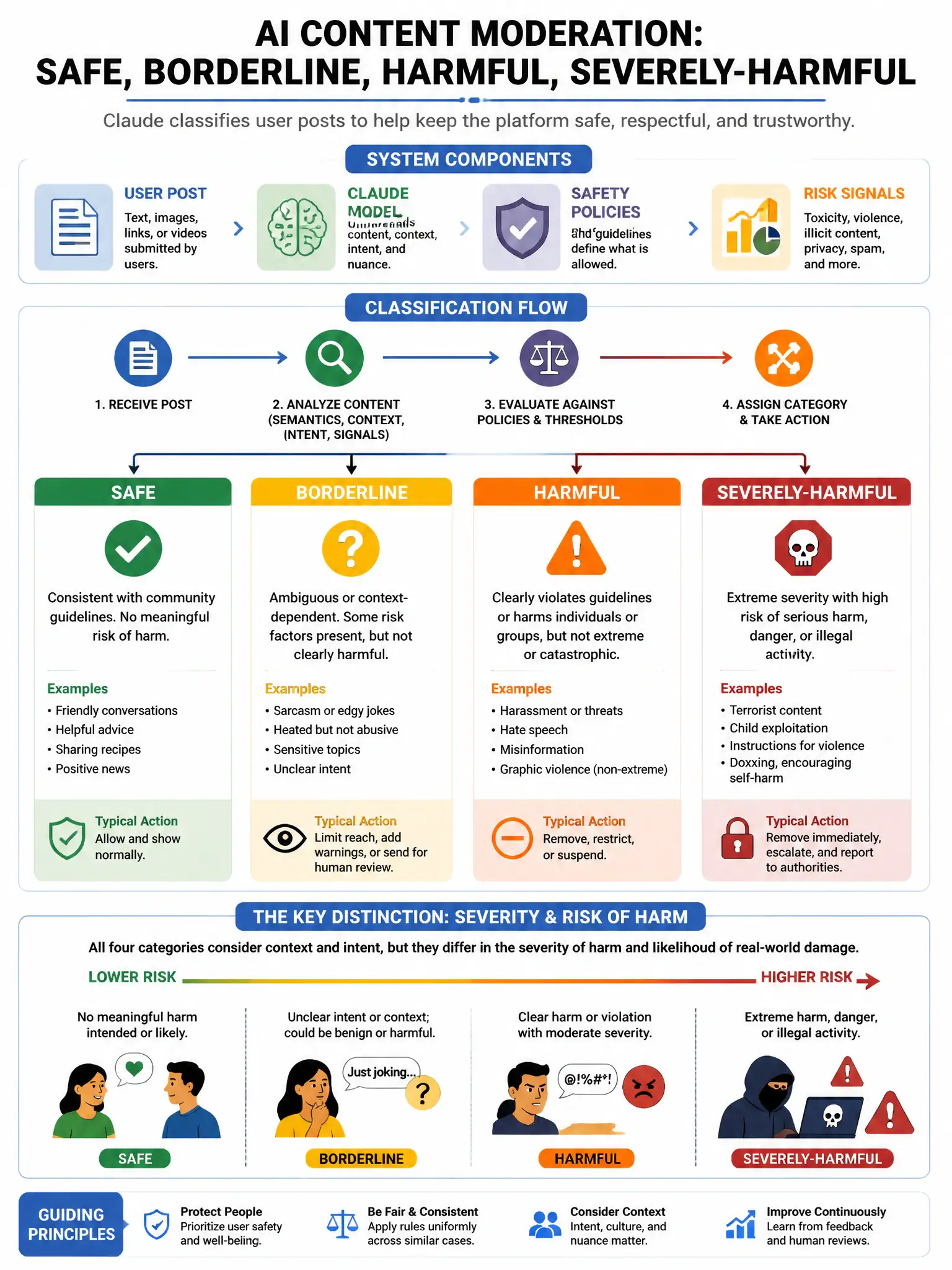
An AI safety team is designing a content moderation system for a major social platform. Claude must classify user posts into: Safe, Borderline, Harmful, Severely-Harmful. The 'Borderline' category is the primary accuracy challenge — posts that are provocative but legal, potentially triggering but not policy-violating. Currently, Claude classifies 8% of posts as Borderline. Human reviewers classify 3% as Borderline, and 5% of Claude's Borderline classifications are later escalated to Harmful. The team wants to calibrate Claude's Borderline classification to match human reviewer standards. Which is the most rigorous calibration approach?
Select an answer to reveal the explanation.
Short Explanation
Here's the deal — you need a systematic calibration study with confusion matrix analysis. The current 8% versus 3% Borderline rates and the 5% escalation rate show a problem, but they don't tell you which content patterns are causing it. That study finds the exact disagreement clusters, then you build targeted few-shot examples to fix them.
Full Explanation
Systematic calibration study with confusion matrix analysis is the most rigorous approach for aligning Claude's Borderline classification with human reviewer standards. The current data (8% versus 3% Borderline, 5% Borderline-to-Harmful escalation rate) provides initial signals but not enough to identify specific error modes. The calibration study: sample 500 posts from each Claude-assigned category, have human reviewers classify independently, compute the full confusion matrix — what does Claude call Borderline that humans call Safe? What does Claude call Safe that humans call Harmful? — analyze the specific content types driving each disagreement cluster, and generate few-shot examples that directly address the identified error patterns. This approach is rigorous because it identifies the specific content patterns where Claude diverges from human judgment, enabling targeted correction rather than general instruction. The approach that adds more examples of Borderline content to the system prompt's few-shot section, specifically including the posts that human reviewers classified as Safe that Claude classified as Borderline, addresses one error direction — Claude's false positives — but ignores the 5% of Claude's Borderline classifications later escalated to Harmful, which is a false-negative signal. The confidence-based routing system, where Claude outputs a classification with a confidence score from 0 to 1 and posts with confidence below 0.75 on any classification are routed to human review, doesn't calibrate Claude's classification; it routes uncertain cases to humans, which is a valid operational strategy but not a calibration approach. The approach that replaces the four-class classification with a continuous harm score from 0 to 10, with human reviewers setting category thresholds and calibrating the Borderline threshold to match the desired 3% rate by adjusting the threshold on the continuous score distribution, is an interesting alternative architecture, but changing from classification to regression is a major architectural change, not a calibration approach.