
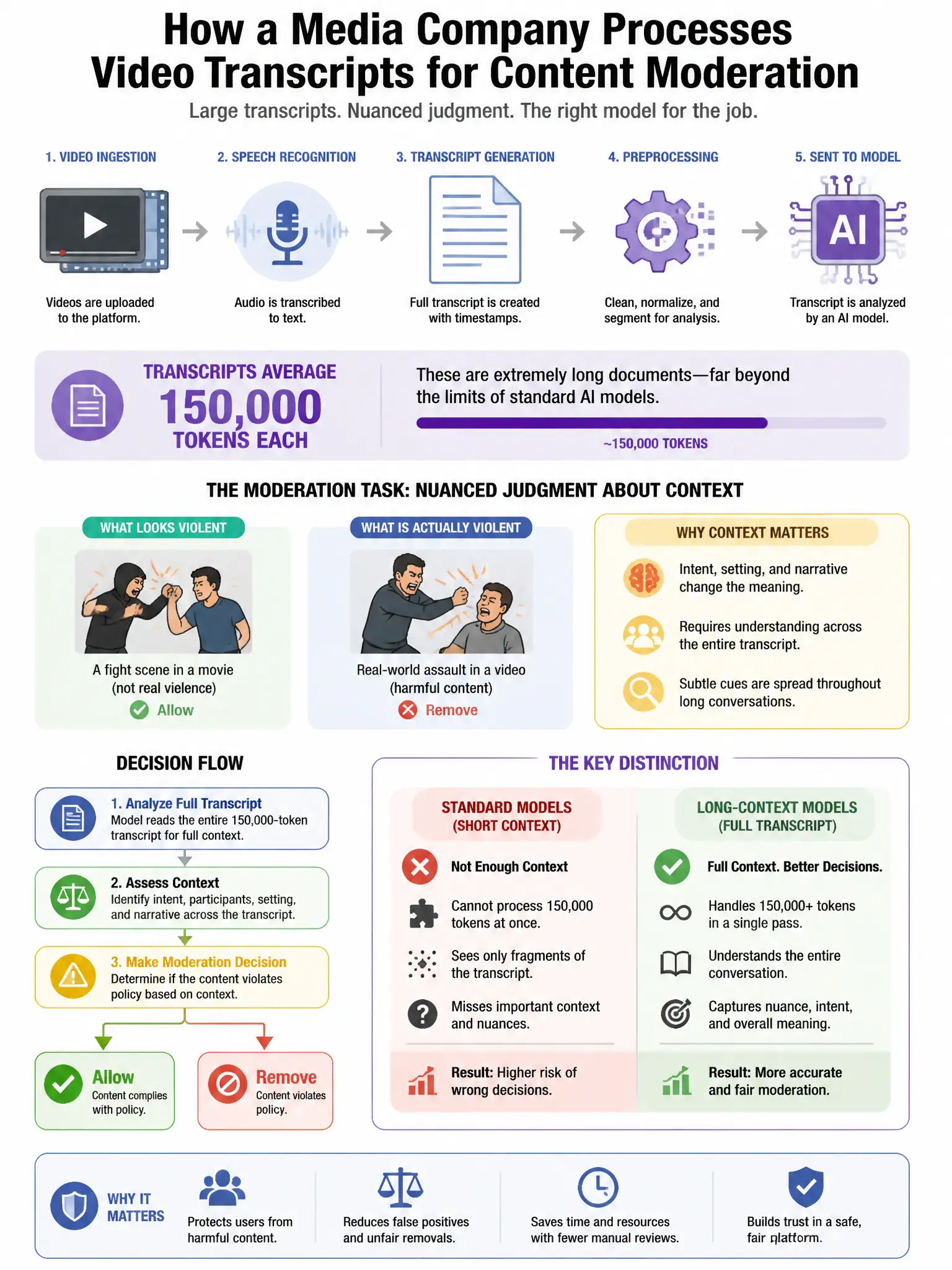
A media company processes video transcripts for content moderation. Transcripts average 150,000 tokens each. The moderation task requires nuanced judgment about context (a violent scene in a documentary vs. gratuitous content), cultural sensitivity across 40 languages, and legal compliance in 12 jurisdictions. Processing volume is 500 transcripts/day. The moderation team currently uses human reviewers at $18/hour taking 45 minutes per transcript. Which model architecture best handles the context length requirement while managing per-unit economics?
Select an answer to reveal the explanation.
Short Explanation
You want Claude 3.5 Sonnet with full 200K context in a single pass. You don't need to split it up, so you avoid chunk-boundary mistakes. It also costs less than Opus while still handling nuanced moderation.
Full Explanation
Claude 3.5 Sonnet with full 200K context for single-pass processing is the correct architectural choice. For 150K-token transcripts, single-pass processing eliminates chunking artifacts — missed context at boundaries, duplicated moderation calls on overlapping segments, and aggregation errors. Sonnet provides the nuance required for cultural and jurisdictional sensitivity. Compared to Opus, it delivers substantial cost savings at scale (500 transcripts/day) with sufficient capability for this task. The chunking approach with 30,000-token segments, 2,000-token overlaps, parallel Sonnet processing, and a final Sonnet aggregation pass is specifically worse here: a violent context split across a chunk boundary may be missed, producing false negatives — exactly the failure mode dangerous for content moderation at scale. The Opus single-pass alternative is valid but unnecessarily expensive when Sonnet handles 200K context adequately. The pre-screening approach with Claude 3 Haiku on 5,000-token summaries generated by an extractive summarizer is high-risk: the extractive summarizer may discard exactly the nuanced passages (brief references, euphemisms, contextual cues) that constitute moderation violations.