
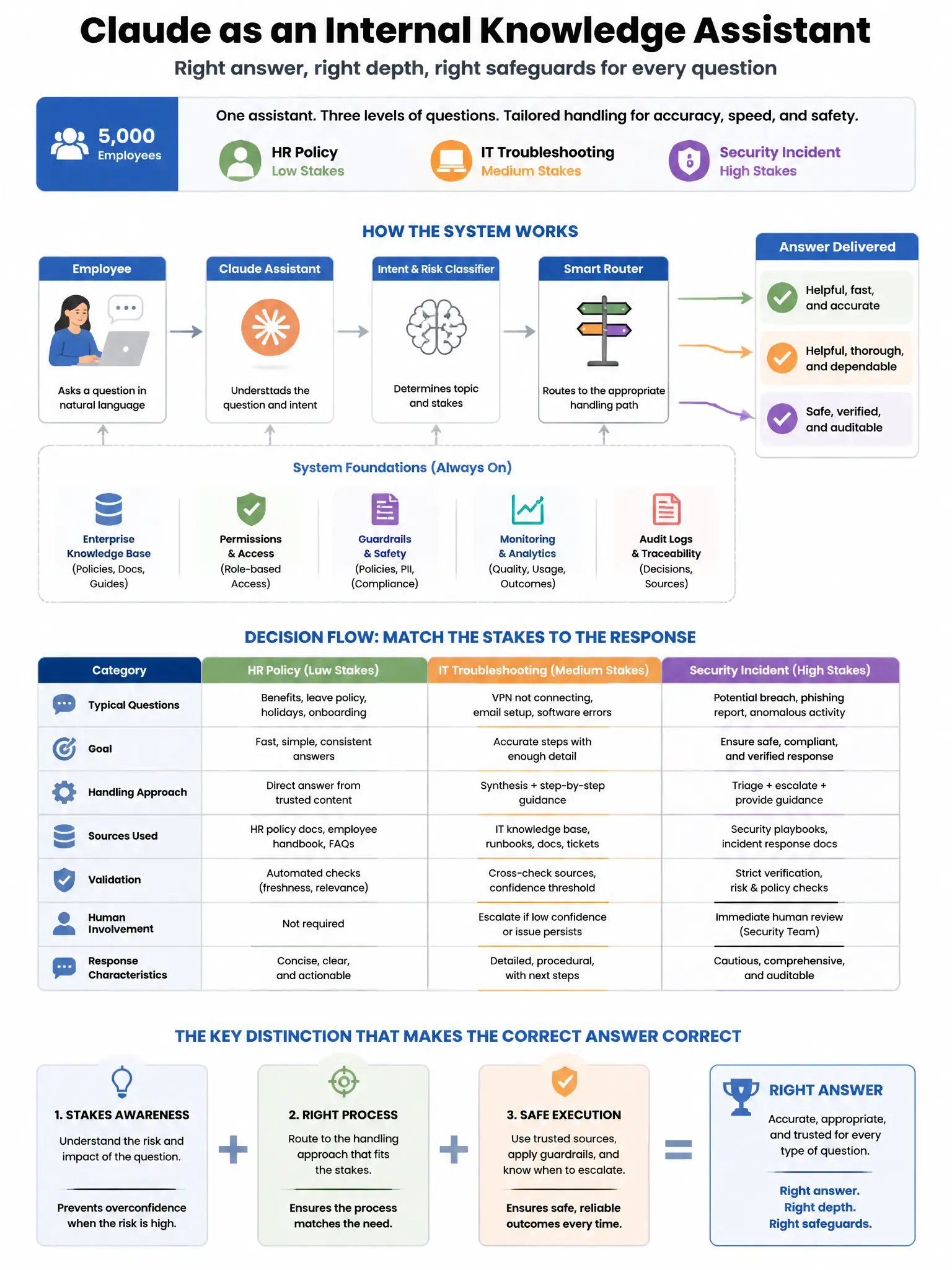
An enterprise deploys Claude as an internal knowledge assistant for 5,000 employees. The system must handle questions across HR policy (low stakes), IT troubleshooting (medium stakes), and financial regulatory guidance (high stakes). Average query complexity varies widely. The architecture team debates whether to use a single model tier or a dynamic routing strategy. Load testing shows 80% of queries are HR/IT, 20% are financial. The company's API spend is currently $120K/month with a single Sonnet deployment. Which routing architecture provides the best accuracy/cost tradeoff?
Select an answer to reveal the explanation.
Short Explanation
Here's the deal — you want an embedding-based router, not another Claude call, because it classifies domain and complexity cheaply and fast. Then you send HR to Haiku, IT to Sonnet, and financial regulatory work to Opus. That matches model power to stakes and cuts most of the $120K spend.
Full Explanation
The embedding-based router (not a Claude call) is architecturally superior for this multi-tier routing problem. It adds zero token cost to classification, introduces minimal latency, and cleanly separates domain/complexity detection from answering. Dispatching Haiku for HR, Sonnet for IT, and Opus for financial regulatory aligns model capability with task stakes — the 80/20 split means most queries hit Haiku, dramatically cutting cost from the $120K baseline. The Claude Haiku classifier approach uses a Claude Haiku classifier, which adds an entire API call's cost and latency to every query before routing — wasteful when embeddings can achieve the same classification. The all-Haiku confidence-score approach is flawed because model-reported confidence is unreliable for routing decisions; the model may be confidently wrong. The single Sonnet deployment ignores the clear cost optimization opportunity — 80% of queries could be served by Haiku at a fraction of Sonnet cost.