
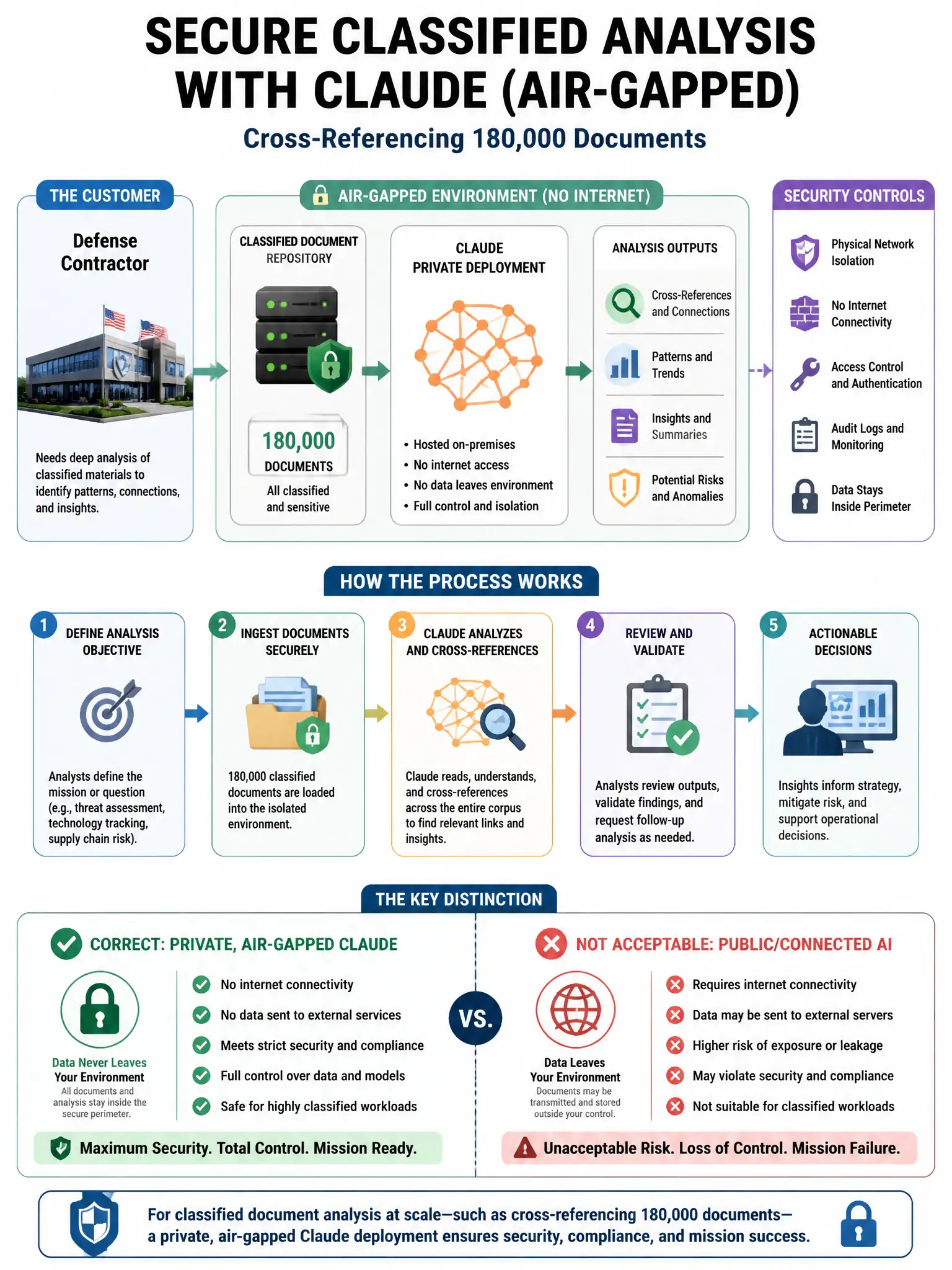
A defense contractor requires Claude for analyzing classified documents (operating on a private, air-gapped Claude deployment). The analysis task involves cross-referencing 180,000-token technical specifications against a 20,000-token regulatory framework document. The contractor's security team insists all analysis must happen in a single API call with no external retrieval. A junior architect proposes using Claude 3 Haiku because 'it's faster and the regulations are simple.' A senior architect disagrees. Which is the most technically sound basis for the senior architect's position?
Select an answer to reveal the explanation.
Short Explanation
Here's the deal — you're doing precision cross-reference work across 200,000 tokens, and Haiku's attention degrades more across positions than Sonnet or Opus. That makes it a risky fit, even if it's faster.
Full Explanation
The senior architect's correct argument is about long-context retrieval fidelity. All current Claude models support 200K context windows, so the claim that Haiku's context window is insufficient to hold both documents simultaneously is factually wrong — Haiku supports the 200K context needed for the combined input. The real architectural concern is that smaller models show more pronounced 'lost in the middle' degradation on precision recall tasks when both the query document and reference document are present across 200K tokens. For cross-referencing work — where the model must find specific clause matches between a 180K specification and a 20K regulatory document — recall accuracy at every position in the context matters critically. The claim that regulatory compliance requires Opus-tier reasoning because Haiku lacks training depth for nuanced regulatory interpretation overstates Haiku's limitation in regulatory reasoning specifically; the primary issue is retrieval fidelity, not reasoning depth. The claim that Haiku cannot process documents in parallel, and that sequential document analysis would require splitting the combined input across multiple requests, violating the single-call requirement, is incorrect — Claude processes the full context window regardless of document count within that window, and there is no parallelism requirement.