
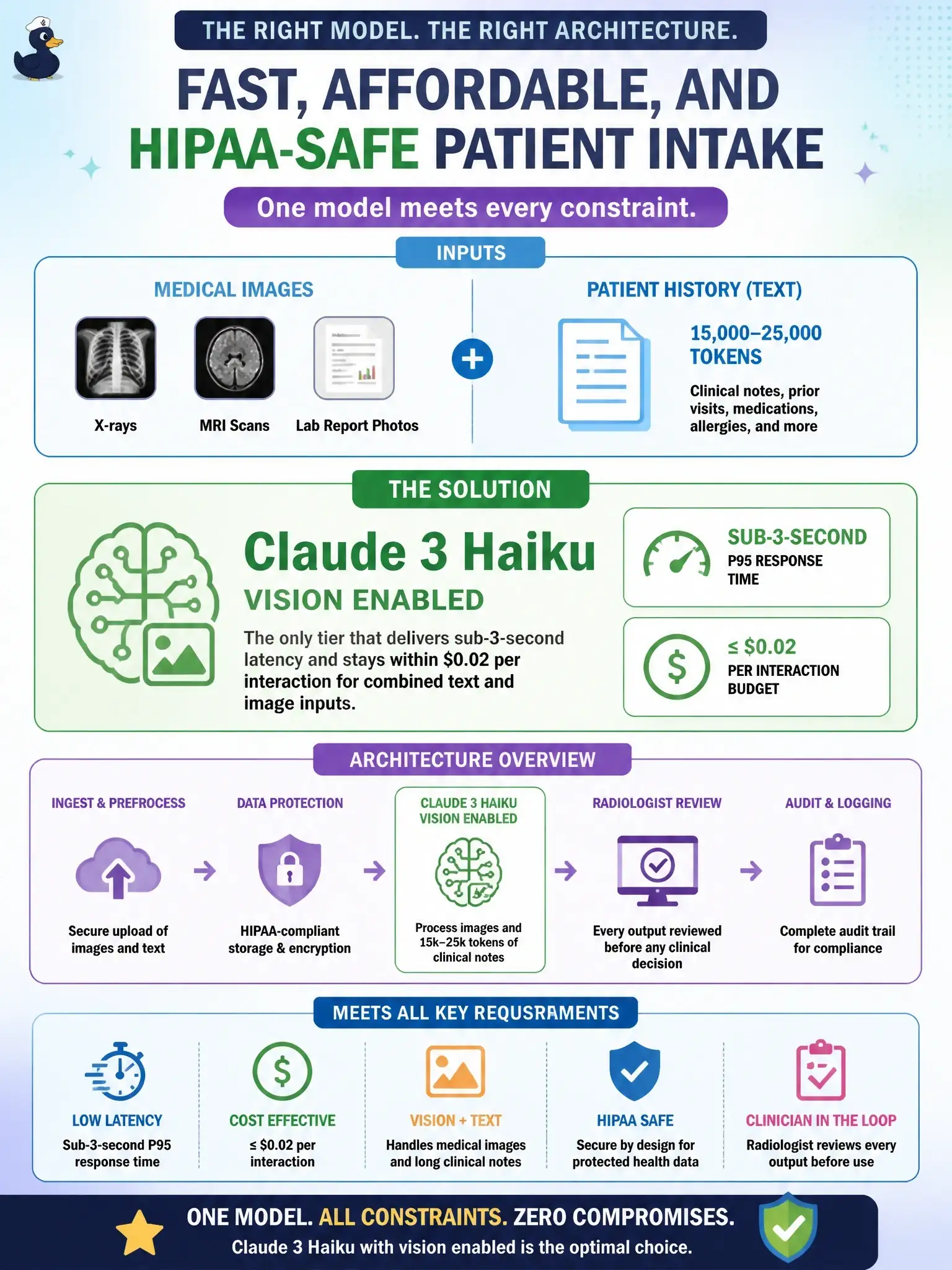
A healthcare startup is building a patient intake system where Claude must process uploaded medical images (X-rays, MRI scans, lab report photos) alongside the patient's text history — typically 15,000–25,000 tokens of clinical notes. The system must operate under HIPAA constraints with minimal latency (sub-3-second P95 response). A radiologist reviews every Claude output before any clinical decision is made. The startup has $0.02 per-interaction budget. Which model and architectural approach best satisfies all constraints simultaneously?
Select an answer to reveal the explanation.
Short Explanation
Do the math before you fall for the fancier model: at Sonnet's $3 per million input tokens, just 15,000 tokens of clinical notes already costs about $0.045, more than double your $0.02 budget. Claude 3 Haiku is the tier built for exactly this kind of fast, cheap, high-volume work, and since a radiologist signs off on every output, you don't need a bigger model to carry the safety load.
Full Explanation
The binding constraint in this scenario is the $0.02 per-interaction budget, and it eliminates every option that routes the clinical notes through a larger model. Anthropic priced Claude 3.5 Sonnet at $3 per million input tokens, so 15,000 to 25,000 tokens of notes cost roughly $0.045 to $0.075 before any image tokens or output are counted. Claude 3 Haiku was positioned as the fast, low-cost tier, with Anthropic citing throughput of about 21,000 tokens per second and roughly 2,500 images processed per US dollar, which keeps a combined text-and-image request well inside both the budget and the sub-3-second latency target. Choosing Sonnet with vision fails because its input price alone exceeds the budget by more than double at the low end of the token range. Choosing Opus fails more severely, since its per-token price is a multiple of Sonnet's, and the claim that safety overrides cost ignores an explicit business constraint. The split pipeline still sends the full 15,000 to 25,000 tokens of text to Sonnet, so it inherits Sonnet's cost overrun while also adding a second sequential call that eats into the latency budget. The radiologist review step is what makes the smaller model acceptable, because a human expert validates every output before any clinical decision. Exam caveat: these Claude 3 generation models are now retired, so apply the same arithmetic to current pricing when choosing a production tier. Operational check: multiply expected input and output tokens by the per-million price for each candidate model and confirm the total stays under the per-interaction cap.