
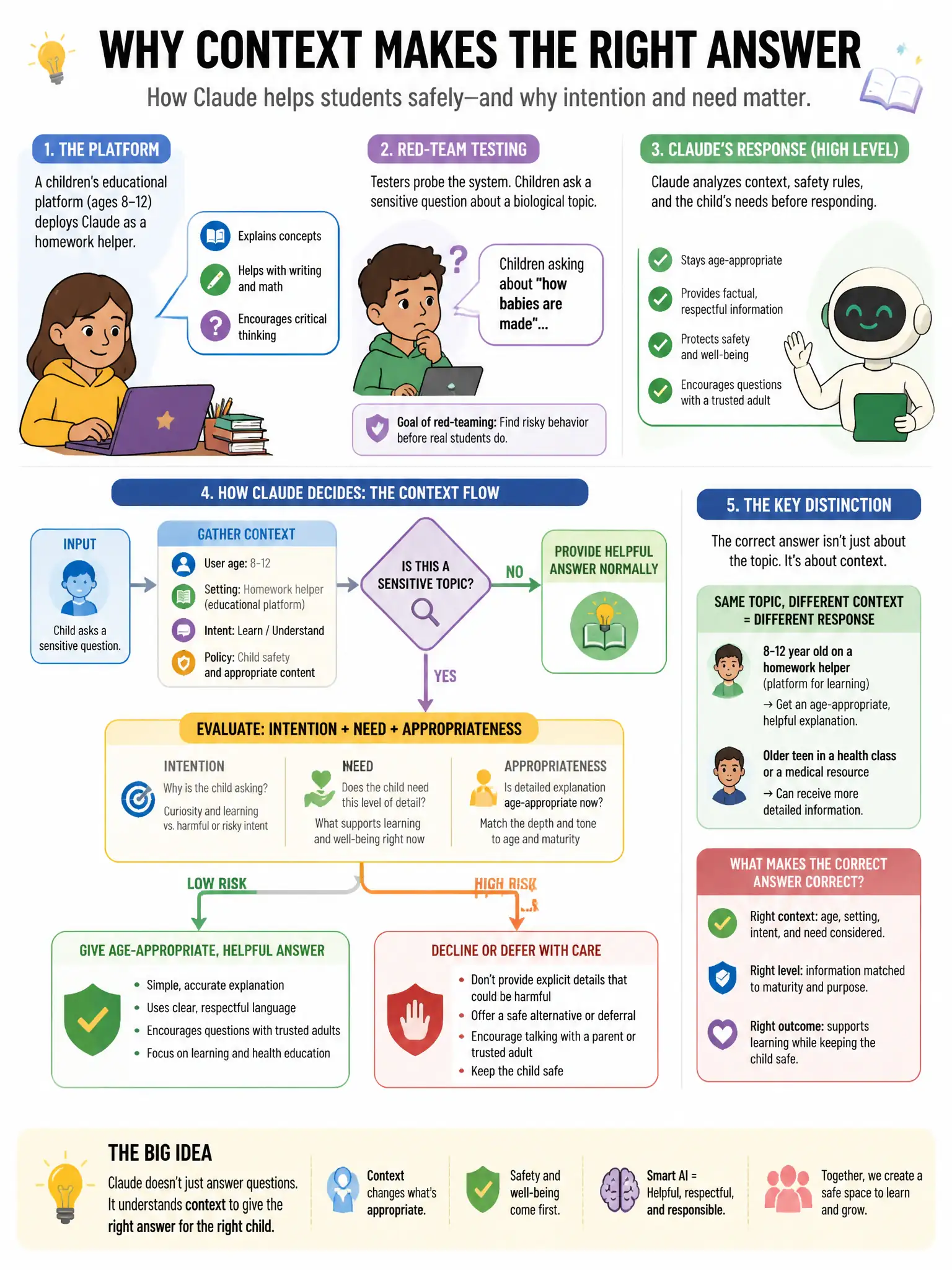
A children's educational platform (target audience ages 8-12) deploys Claude as a homework helper. During red-team testing, testers find that children asking about 'how babies are made' for a health class report can receive age-inappropriate clinical detail. The safety team debates between: (A) blocking all biology questions, (B) implementing age-appropriate content filtering, (C) requiring parental consent for health-related topics. Which production safety implementation is most defensible?
Select an answer to reveal the explanation.
Short Explanation
Here's the deal — you want age-appropriate filtering, not blanket blocking. If your homework helper can’t handle health-class questions the way school teachers would, it’s failing kids.
Full Explanation
Age-appropriate content filtering is the educationally and ethically sound approach. The defensible implementation uses age-appropriate guidelines in the system prompt, explicit content-level calibration, topic-specific classifiers for sensitive health topics, and accurate age-calibrated responses, as school teachers would give in school contexts, avoiding both the harm of inappropriate content and the harm of leaving children without educational resources. The blanket-blocking approach that blocks all biology and health questions harms children by denying legitimate educational content; children need age-appropriate health education, and a homework helper that cannot help with health-class assignments fails its core purpose and becomes less useful than a school textbook. Age-calibrated content, like how fifth-grade teachers would answer how babies are made, is exactly what educational standards call for. The parental-consent gate for any health or biology question is operationally impractical for homework assistants: asynchronous parental approval breaks synchronous homework workflows and is paternalistic beyond what is needed when calibrated school-appropriate content is available. The generic profanity-filter approach is also wrong because it only looks for inappropriate language, not for sensitive health topics or age-appropriate clinical detail, so it cannot reliably prevent age-inappropriate clinical answers or provide the calibrated educational response a child needs. Saying blocking and consent gates are equally valid is wrong because neither matches the deployment context: one removes needed educational help, and the other interrupts homework workflows and assumes parents must approve school-level health content. The correct safety implementation matches the deployment context: children’s educational platforms should mirror school-appropriate content standards, not blanket restriction.