
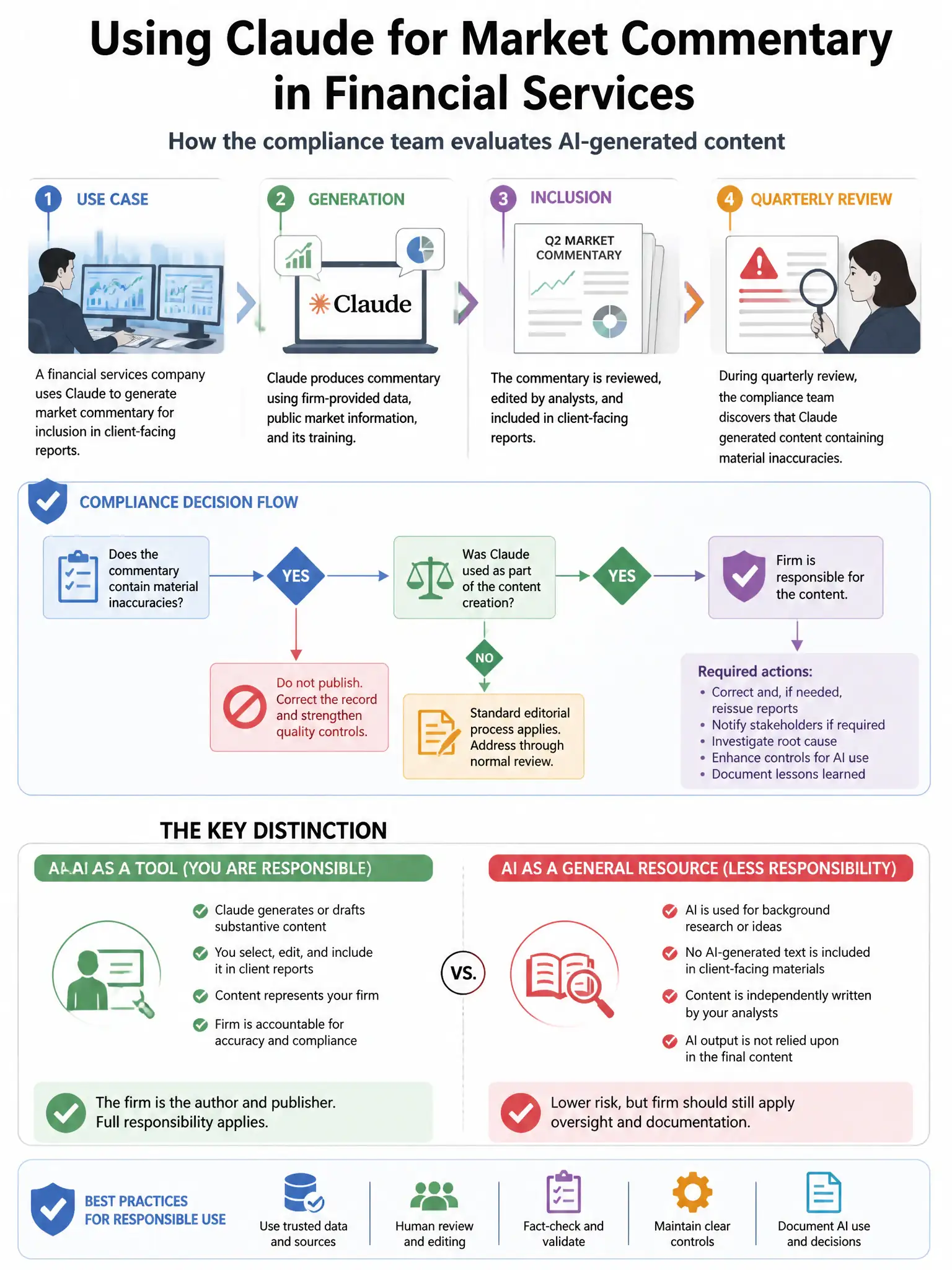
A financial services company uses Claude to generate market commentary for inclusion in client-facing reports. During a quarterly review, the compliance team discovers that Claude occasionally generates statements that could be construed as investment advice ('This stock appears undervalued and may present a buying opportunity'). The platform was designed for informational market commentary only, not investment advice. What production safety architecture addresses this regulatory risk?
Select an answer to reveal the explanation.
Short Explanation
Here's the deal — if Claude can generate statements that look like investment advice, you need defense-in-depth. Constrain the output style up front, catch violations after generation, and log flagged outputs for compliance audit.
Full Explanation
Investment advice regulations (SEC, FINRA) require that systems providing investment advice be registered and regulated — this is a legal risk, not just a content quality issue. The three-layer control provides defense-in-depth appropriate to regulatory exposure: the system prompt preemptively constrains the output style with examples of prohibited versus permitted phrasing; the post-generation classifier catches violations that slip through, including buy/sell recommendations and predictive statements about price movements; and audit logging demonstrates due diligence in compliance monitoring. The boilerplate disclaimer approach is legally insufficient — regulators evaluate substantive content, not disclaimers. Adding 'I am not a financial advisor' before investment advice doesn't make the advice legal. The fine-tuning approach can shift default behavior but cannot guarantee zero violations — fine-tuned models still produce off-distribution outputs under adversarial or unusual prompts. The human-review-every-output approach is the gold standard but is operationally untenable at production scale for market commentary generation and eliminates the efficiency benefit of automation.