
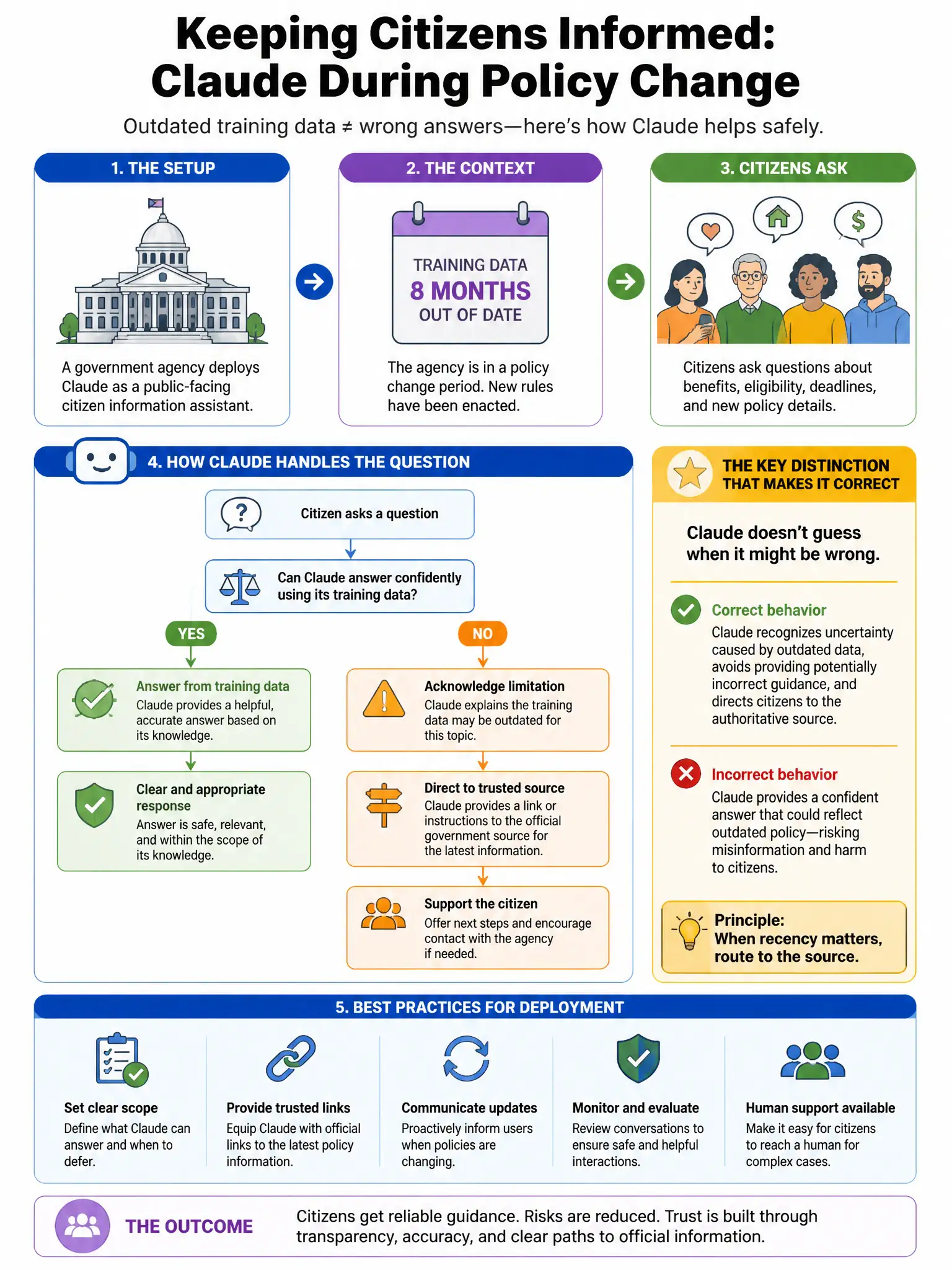
A government agency deploys Claude for a public-facing citizen information assistant. During a policy change period, Claude's training data is 8 months out of date. Citizens ask about the current eligibility criteria for a benefits program that changed 3 months ago. Claude confidently provides the old eligibility thresholds as current fact, causing citizens to incorrectly assess their eligibility. What production safety architecture prevents this knowledge currency harm?
Select an answer to reveal the explanation.
Short Explanation
Here's the deal — you don't want citizens acting on stale eligibility thresholds. RAG over daily-updated policy docs, mandatory retrieval, dated citations, and a 30-day staleness signal keep answers current and auditable.
Full Explanation
Knowledge currency is a production safety issue for high-stakes factual domains like government benefits. The correct architecture is RAG over current policy documents updated daily, mandatory retrieval instead of relying on training knowledge, dated source citations in every policy response, and a confidence signal when retrieved content is more than 30 days old. This keeps answers aligned with latest official information, lets citizens verify currency, and creates an audit trail. Monthly fine-tuning on updated policy documents is expensive, slow because cycles take weeks, and still leaves the model potentially outdated; RAG can reflect same-day updates. Telling uncertain users to visit the official government website is a safe fallback but gives no value when the citizen asked the assistant for answers. Routing policy questions to a manually maintained rule-based FAQ sidesteps the problem, creates a second system, and still depends on manual updates that can lag behind policy changes.