
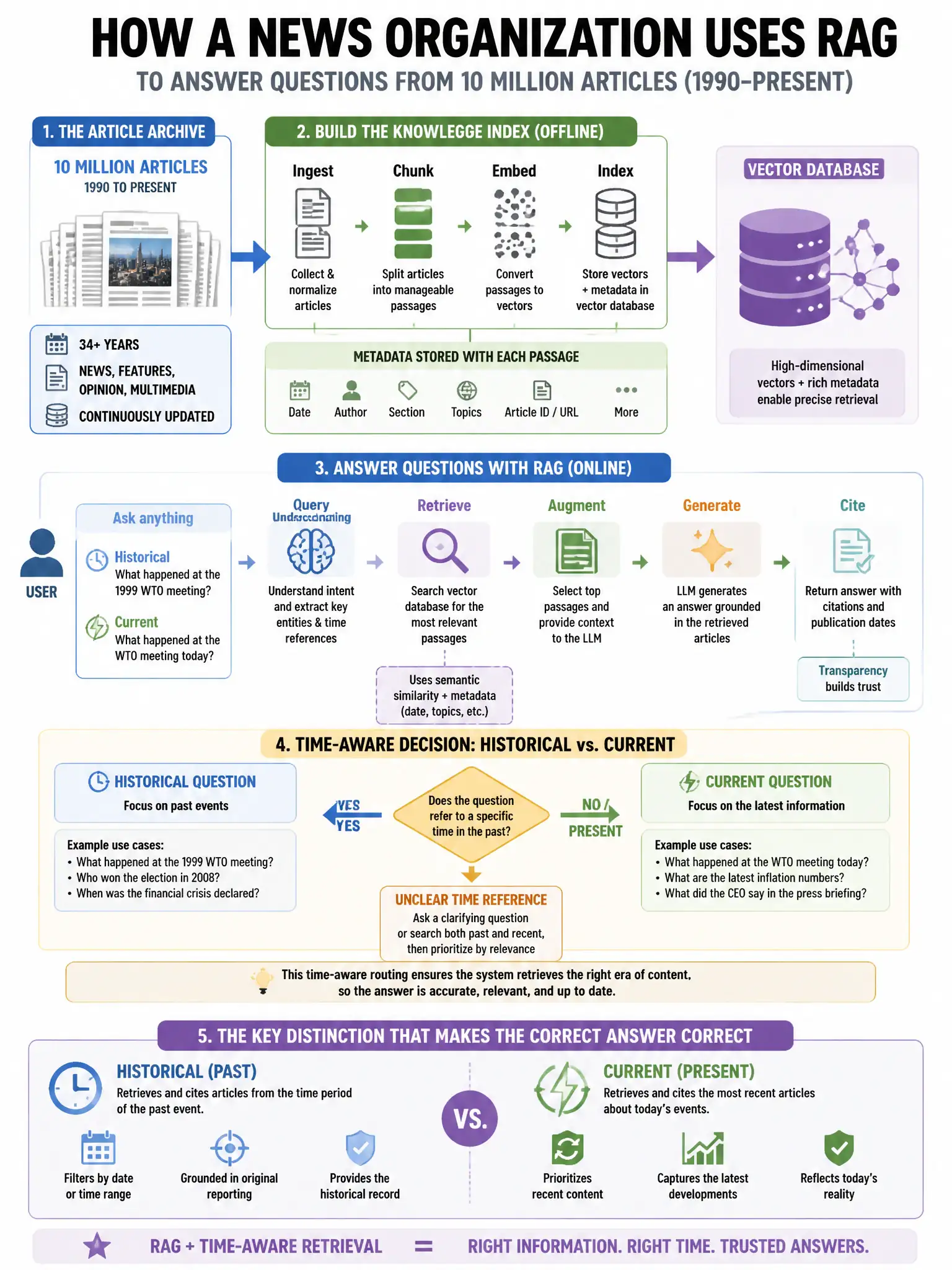
A news organization builds a RAG system over their article archive (10 million articles from 1990 to present). Users ask both historical questions ('What happened at the 1999 WTO protests?') and current questions ('What are the latest developments in the trade war?'). They use a single embedding index with no temporal metadata. Current events questions return outdated articles because older content on the same topic has higher embedding similarity from more training data. What retrieval architecture best handles temporal relevance?
Select an answer to reveal the explanation.
Short Explanation
Here's the deal — you need metadata-filtered retrieval because it applies a date filter only when the query asks for recency, while historical questions still search the whole archive. That keeps current-event answers fresh without burying the best historical coverage.
Full Explanation
Metadata-filtered retrieval is the cleanest solution because it applies the temporal constraint precisely where it's semantically required. Temporal intent detection, looking for signals like 'latest,' 'recent,' 'current,' or 'as of today,' triggers a date filter that constrains semantic search to recent articles, while historical questions such as the 1999 WTO protests access the full corpus without date restriction. This handles both use cases with a single index. Rebuilding the embedding index monthly doesn't solve the recency problem because semantic similarity still favors highly-referenced older articles over recent ones on the same topic. Implementing two separate indices, one for content published in the last 30 days and one for historical content, solves the routing problem but requires routing logic to determine query type and misses queries that need both historical context and recent developments. Weighting embedding similarity scores by document recency using an exponential decay function is a heuristic that degrades historical question quality because a question about WTO protests shouldn't prefer a recent article mentioning WTO over the definitive historical coverage.