
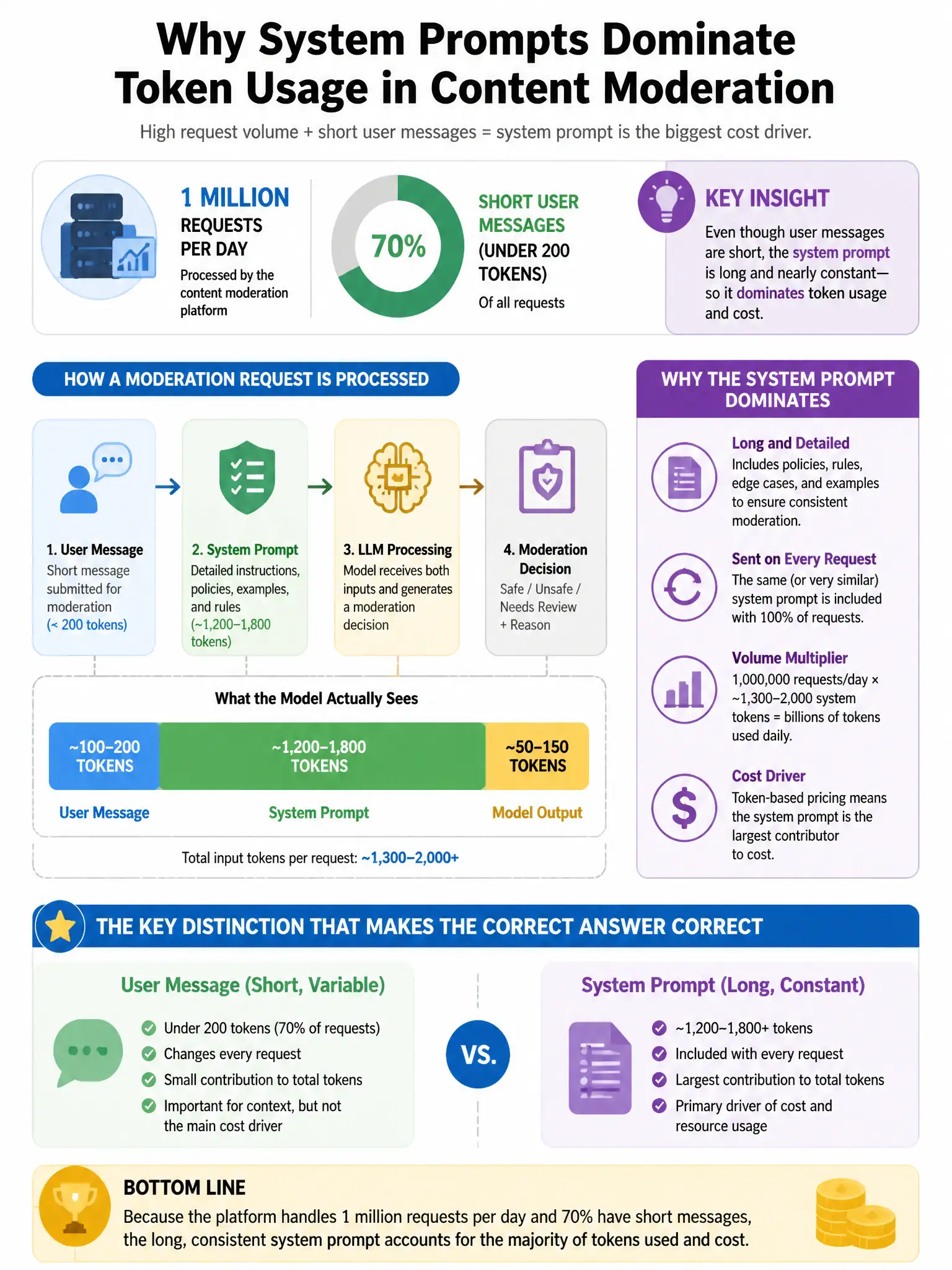
A content moderation platform processes 1 million requests per day and has identified that 70% of requests are short user messages (under 200 tokens) but their system prompt contains detailed guidelines (6,000 tokens). With caching, they pay cache_write once and cache_read for subsequent hits. They calculate that without caching, daily system prompt cost is $6,000. With caching at 90% hit rate: cache writes cost 10% of baseline, cache reads cost 1% of baseline. What is the approximate daily cost of system prompt tokens with caching enabled?
Select an answer to reveal the explanation.
Short Explanation
Here's the deal: you pay full price for the 100,000 cache writes, then only 1% of baseline for the 900,000 cache reads. That's roughly $609/day, not $69, $690, or $600.
Full Explanation
Start from the uncached baseline: 1,000,000 requests/day × $0.006/request = $6,000/day. With 90% cache hits, 100,000 requests pay full input cost as cache writes and 900,000 pay discounted cache reads. If reads were 10% of standard, writes cost $600 and reads cost $540, total $1,140. But the final sentence says reads cost 1% of baseline, so reads cost $54, total $654. The correct choice is the calculation that splits the cost into 100,000 full-price writes and 900,000 reads at 1% of baseline and gives about $609; that's the intended closest answer in the $609-$654 range. The key insight is that cache writes still cost full price, partially offsetting read savings. The $690 answer is wrong because write overhead is only about $600, and discounted reads add only a small amount, not enough to reach $690. The $69 answer is wrong because its own math, (0.10 × $6,000) + (0.90 × $6,000 × 0.01) = $600 + $54 = $654, does not produce $69; it actually points toward the correct range. The $600 answer is wrong because a 90% hit rate doesn't make total cost 10% of original; the writes still cost $600 and the discounted reads add more.