
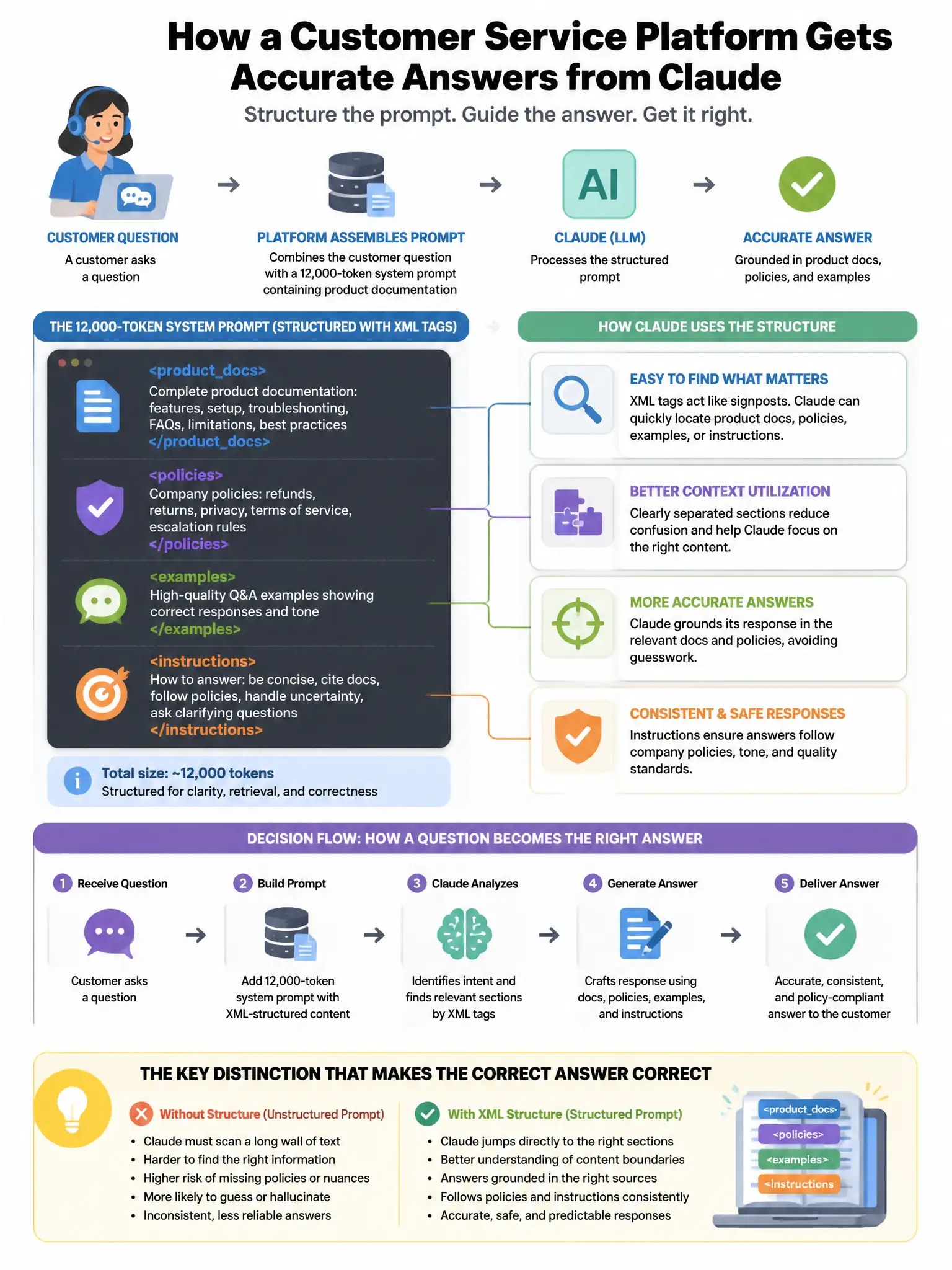
A customer service platform uses Claude with a 12,000-token system prompt containing product documentation. They implement XML tags to structure the prompt: <product_docs>, <policies>, <tone_guidelines>, and <examples>. They notice that response quality is highest when documentation is in <product_docs> but Claude sometimes ignores specific policies when they conflict with its general helpfulness tendencies. What prompt engineering approach most reliably increases policy adherence?
Select an answer to reveal the explanation.
Short Explanation
Here's the deal — you should put the critical policies right up front in the system prompt and make them hard to miss with 'You MUST' language plus concrete examples. That gives them the best shot at holding attention when the model's helpfulness tries to pull it off course.
Full Explanation
Research on transformer attention and practical Claude prompt engineering both confirm that position and salience matter for instruction adherence. Critical policies should appear at the beginning of the system prompt (primacy effect) before other content displaces their attention weight. Imperative, specific language ('You MUST NOT discuss competitor pricing under any circumstances, including when customers ask directly') is more reliably followed than descriptive language ('Policies about competitor pricing exist'). Concrete examples of correct versus incorrect behavior anchor the policy further. The approach that moves policy instructions from XML tags into raw system prompt text is a misdiagnosis; XML tags actually improve structure and clarity in Claude prompts, and the problem is positioning and language salience. The approach that repeats the most important policies three times throughout the system prompt has diminishing returns and adds token cost without proportional benefit. The approach that switches from system prompt to user message injection for policies is incorrect because system prompt content carries higher baseline authority than user message content; the problem is not prompt location but instruction salience within the system prompt.