
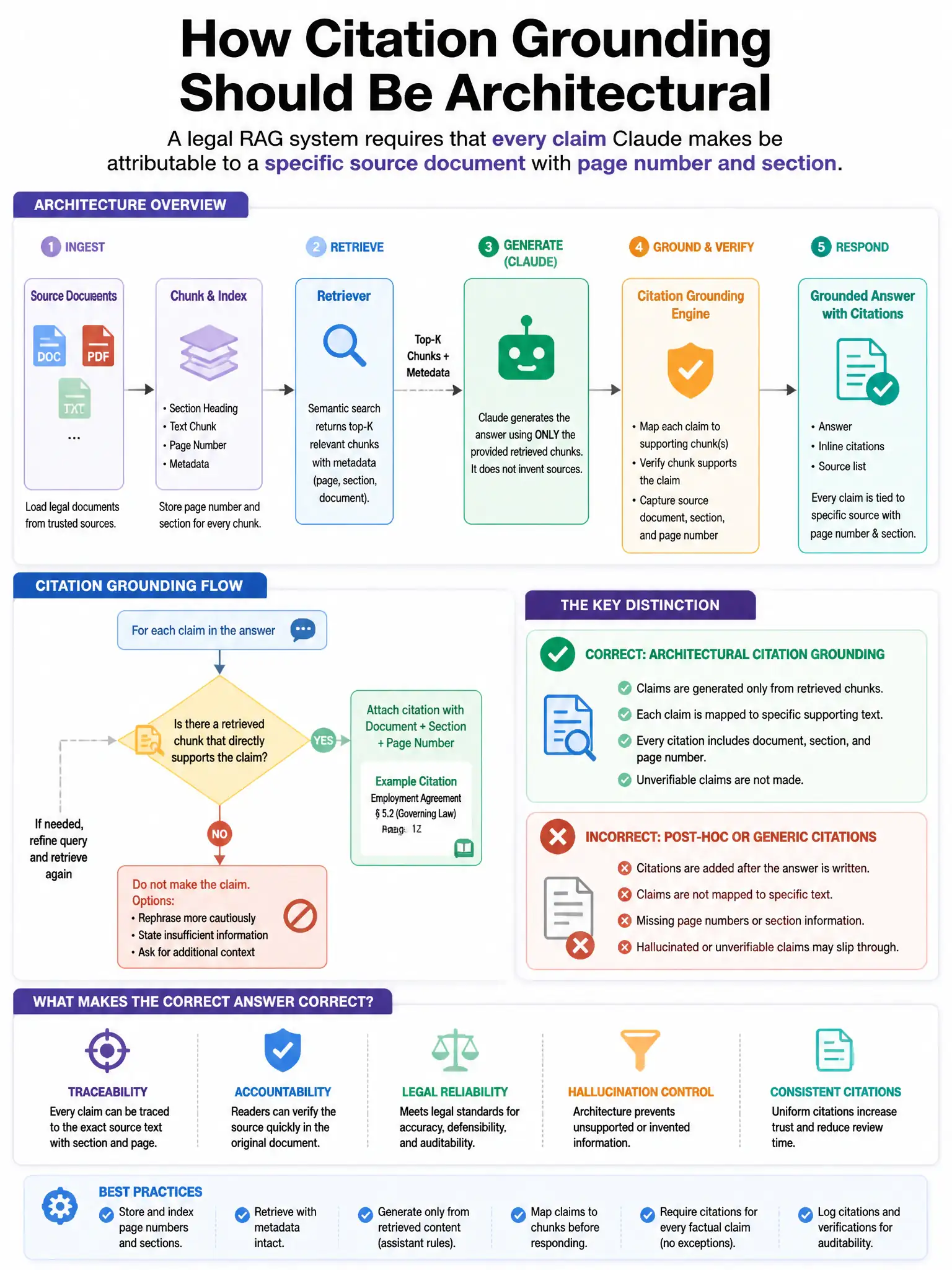
A legal RAG system requires that every claim Claude makes be attributable to a specific source document with page number and section. How should citation grounding be architecturally implemented?
Select an answer to reveal the explanation.
Short Explanation
Here's the deal — you need document title, page, and section metadata stored with each chunk, passed to Claude in a structured format, and cited in a verifiable output format. That gives you an auditable chain from claim to source. Trusting prompt-only instructions, web search, or a follow-up citation pass won't guarantee legal-grade attribution.
Full Explanation
Robust citation grounding requires that metadata (document title, page number, section) be embedded alongside each chunk in the retrieval system, passed to Claude in a structured format (e.g., <source id='1' title='Contract One' page='12' section='3.2'>text...</source>), and that Claude be instructed to cite using the source IDs in a verifiable output format (e.g., [SOURCE:1] inline). This creates an auditable chain from claim to source. Relying only on a system-prompt instruction to always cite sources produces citations but doesn't guarantee they reference actual retrieved chunks — Claude may fabricate plausible-sounding but incorrect citations from its training knowledge. Using Claude's web search tool to retrieve documents in real time is for live web retrieval; the scenario specifies a pre-indexed legal corpus. Implementing post-processing with a follow-up Claude call to add citations by cross-referencing the response against retrieved chunks adds latency and cost while still depending on Claude correctly mapping generated text to source chunks in a later pass, which has the same hallucination risk as the initial generation.