
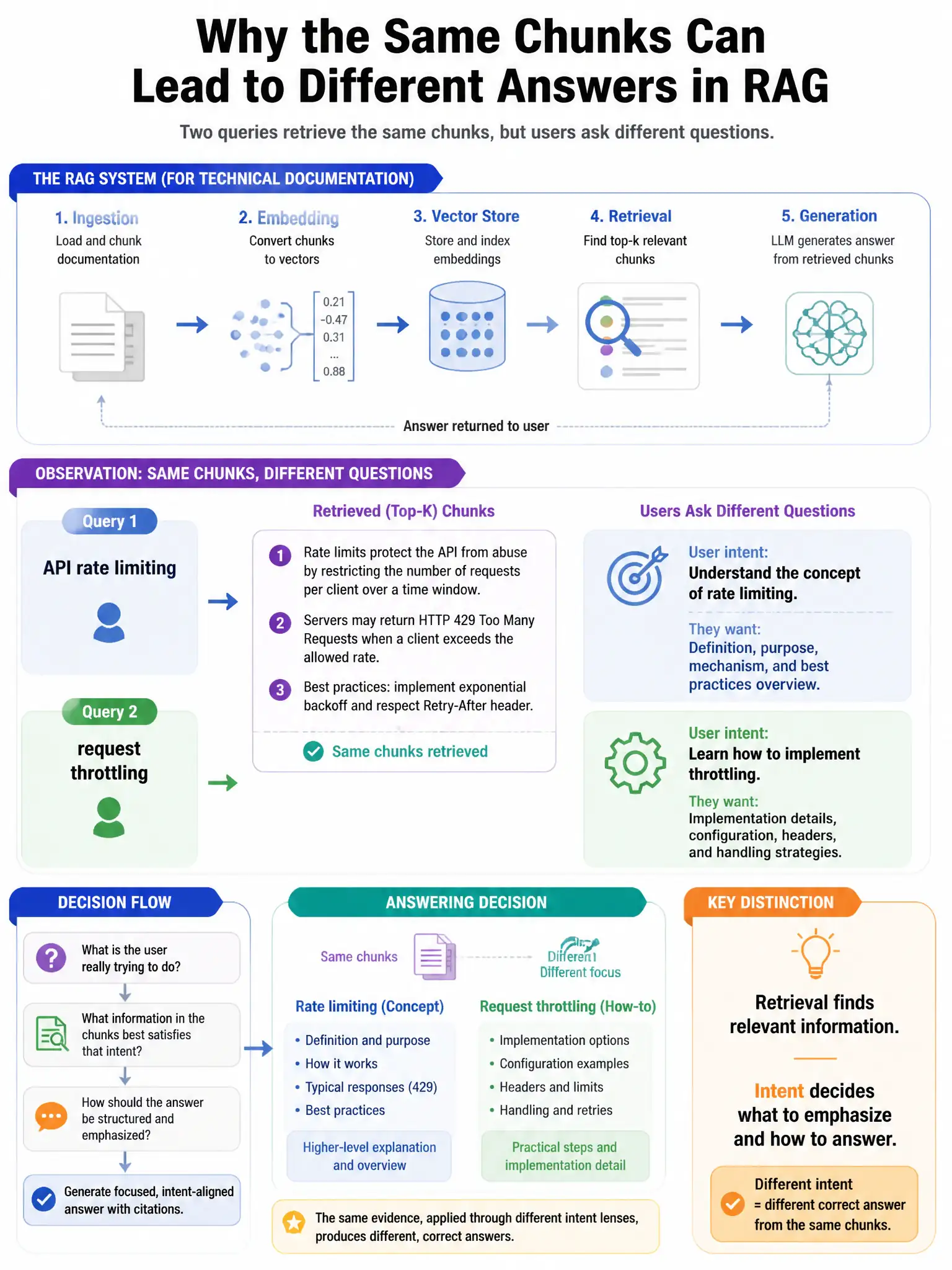
A team is building a RAG system for technical documentation and observes that 'API rate limiting' and 'request throttling' retrieve the same chunks for either query, but users asking about rate limits want policy numbers while users asking about throttling want retry strategies. How should the retrieval architecture handle this semantic overlap?
Select an answer to reveal the explanation.
Short Explanation
Here's the deal — when similar topics mean different things to users, route the query by intent before retrieval. You tag chunks with domain metadata, classify the query as policy lookup or implementation guidance, and filter retrieval so Claude gets the right chunks.
Full Explanation
When semantically similar topics serve different user intents, intent-aware routing at the retrieval layer is more robust than post-hoc in-context filtering. An intent classifier, even a simple rule-based or lightweight model, categorizes the query as policy lookup versus implementation guidance and applies corresponding metadata filters at retrieval time, ensuring Claude receives the right type of chunks. Training separate embedding models for each topic is operationally complex and expensive; the solution should be at the metadata and routing layer, not the embedding layer. Query expansion worsens the problem because expanding 'rate limiting' with 'throttle' makes retrieval even more ambiguous between the two intents, retrieving more of both types indiscriminately. Accepting the semantic overlap and relying on Claude's in-context reasoning to distinguish relevant chunks after retrieval works at small scale but is inefficient, because the compute spent discarding irrelevant chunks is wasted; filtering should happen at retrieval time.