
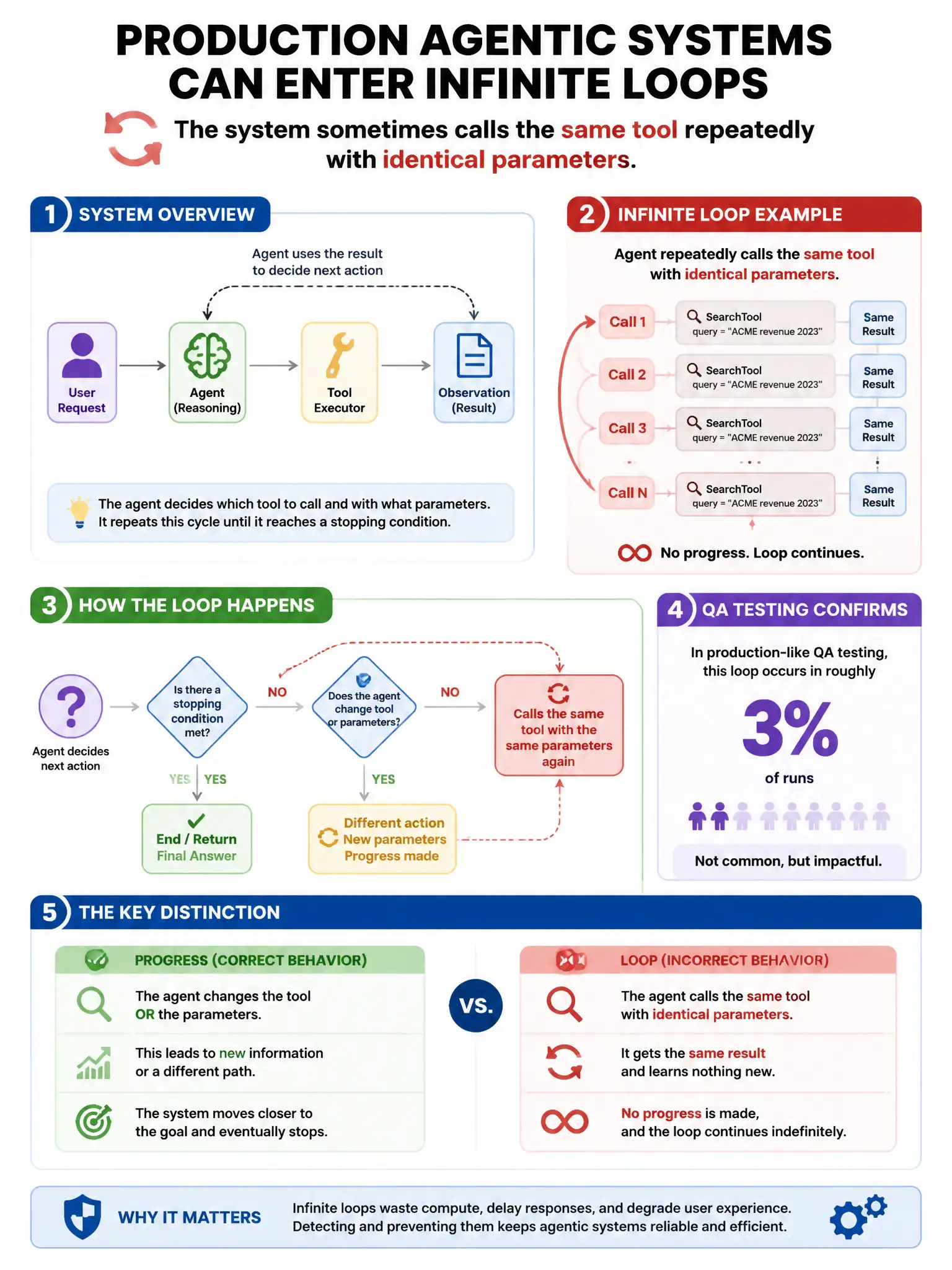
A production agentic system sometimes enters infinite loops, calling the same tool repeatedly with identical parameters. QA testing confirms this happens in roughly 3% of runs. What architectural safeguard should be implemented?
Select an answer to reveal the explanation.
Short Explanation
You can't trust Claude alone to break out of an agent loop. Put loop detection in the orchestration layer: track tool calls and parameters, catch identical repeats, inject a guidance message, and enforce a hard max iteration count.
Full Explanation
Infinite loop detection and prevention must be implemented in the orchestration layer (code), not trusted to Claude's instruction-following alone. The safeguard has two components: active loop detection — compare each tool call against recent call history and detect identical tool-and-parameter pairs; and maximum iteration count — enforce a hard cap, such as 50 steps, with human escalation or graceful failure when reached. When a loop is detected, inject a guidance message such as: 'You have called this tool with these parameters 3 times without progress. Consider an alternative approach.' The larger-context approach is irrelevant because Claude can already see its call history in context and still loops; the issue is a reasoning failure, not context blindness. The temperature-zero approach makes loops more likely, not less, because a deterministic model will repeat the same mistake every time with zero variation. The instruction-only approach is insufficient because agentic loops occur when the model genuinely believes each next call will differ.