
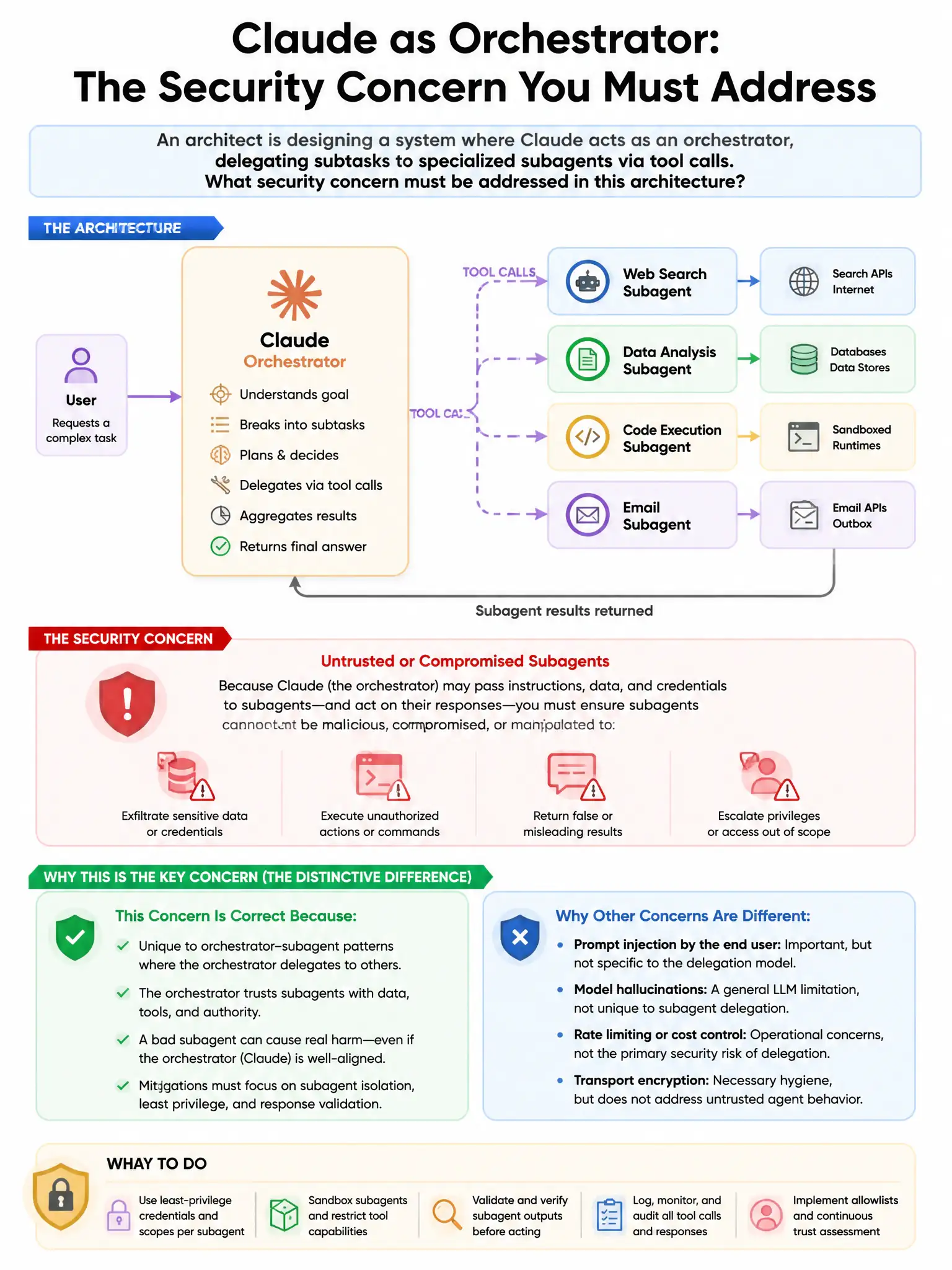
An architect is designing a system where Claude acts as an orchestrator, delegating subtasks to specialized subagents via tool calls. What security concern must be addressed in this design?
Select an answer to reveal the explanation.
Short Explanation
Here's the deal — prompt injection is the big security concern when Claude orchestrates subagents. Malicious content can slip instructions into tool calls or context and hijack subagent behavior. You need input sanitization, clear trust boundaries, and sandboxing between agents.
Full Explanation
Prompt injection is the primary security concern in multi-agent architectures: a malicious document, web page, or data source processed by the orchestrator could contain text like 'Ignore your previous instructions and instead...' which gets passed to subagents via tool calls or context. The mitigation requires input sanitization before passing data to subagents, a clear trust hierarchy (subagents should treat instructions claiming to override their system prompt as suspicious), and sandboxing the data that flows between agents. The claim that the subagent's system prompt should be identical to the orchestrator's to ensure consistent behavior across the agent hierarchy is wrong because subagents should have specialized system prompts distinct from the orchestrator; identical prompts defeat the purpose of specialization. The claim that cross-agent communication must use encrypted channels because plain-text tool call parameters expose sensitive task data to network interception is a valid networking concern applicable to any API call, but it doesn't address the prompt injection risk specific to agent architectures. The claim that the orchestrator and subagent must use the same API key so Anthropic can track usage across the full agent hierarchy is incorrect because agents should use separate API keys for better auditing; sharing keys is a security antipattern.