
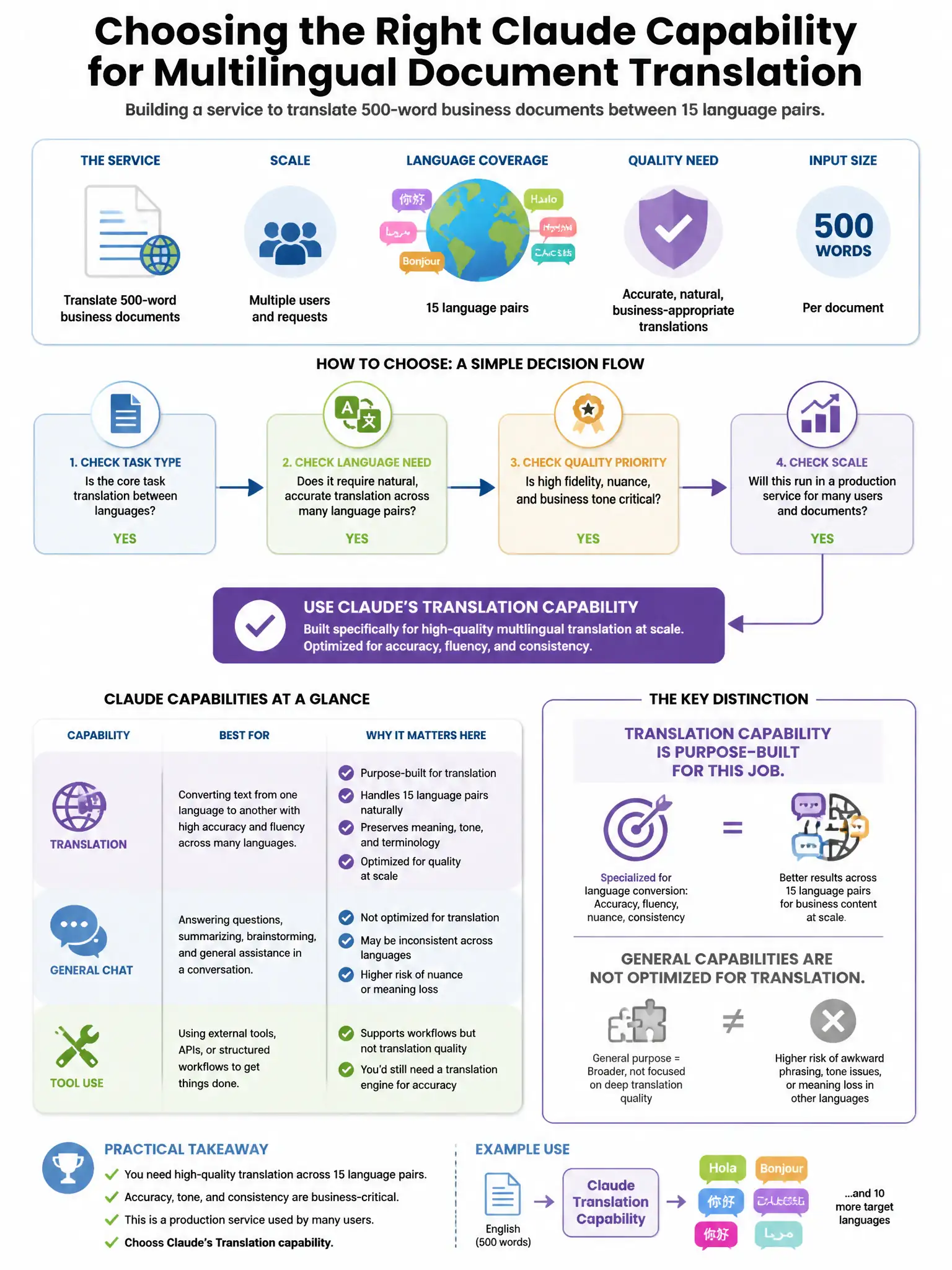
An enterprise is building a multilingual document translation service using Claude to translate 500-word business documents between 15 language pairs. Which model capability characteristic is most important for this architectural decision?
Select an answer to reveal the explanation.
Short Explanation
When you're building a multilingual translation service, the biggest thing you care about is multilingual training coverage. You need to check how well the model handles each language pair, because quality can swing a lot between high-resource and low-resource pairs.
Full Explanation
For a multilingual translation service, the most critical architectural factor is the model's multilingual training coverage — Claude performs significantly better on high-resource language pairs (English-Spanish, English-French) than on low-resource pairs (English-Swahili, English-Yoruba). An architect must evaluate translation quality per language pair against the required 15 pairs, as capability varies substantially. The context-window-size answer is incorrect — 500-word documents are approximately 700 tokens, well within any Claude model's context; window size is irrelevant. The vision/OCR answer is a valid preprocessing concern for scanned PDFs but is a pipeline component, not the primary capability factor for the translation system itself. The tool-use-for-glossaries answer is an enhancement, not the defining capability factor.