
A multi-agent document processing system has a planner, an extraction agent, a validation agent, and a formatting agent. In production, the planner sometimes issues malformed tool calls to the extraction agent (missing required parameters). These errors cascade: the extraction agent fails, the validation agent receives empty input, and the formatting agent produces a malformed report. Where is the most leverage to prevent this cascade?
Select an answer to reveal the explanation.
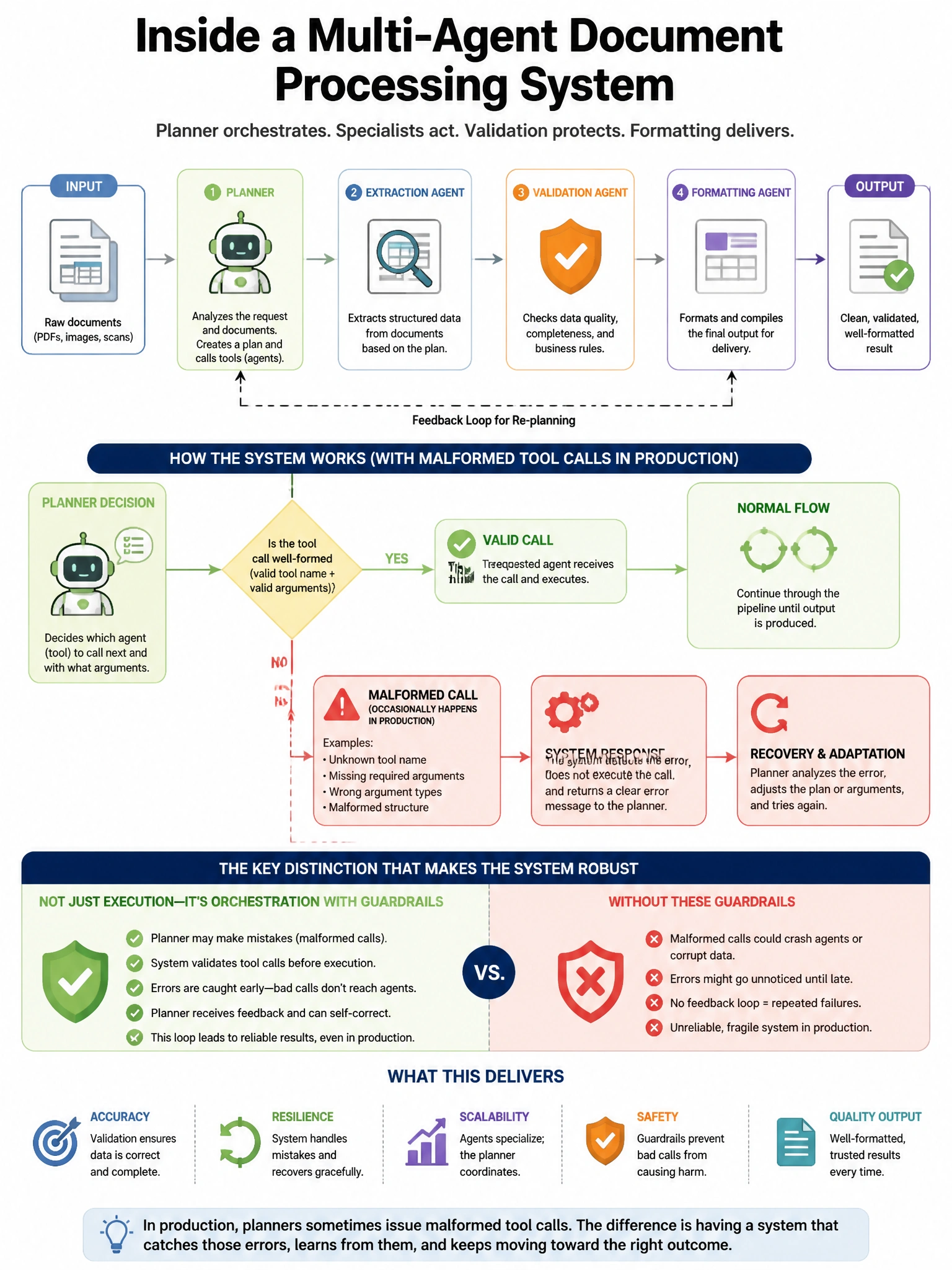
Short Explanation and Infographic
Here's the deal — b is correct because parameter validation at the tool-call intake layer provides the best leverage for two reasons: (1) it prevents cascade by catching errors at their entry point before they propagate downstream, and (2) it creates a structured feedback loop where the planner receives a precise error description and can self-correct with a retry, rather than requiring human intervention. This is the 'fail fast and inform' pattern for multi-agent systems.
Full explanation below image
Full Explanation
B is correct because parameter validation at the tool-call intake layer provides the best leverage for two reasons: (1) it prevents cascade by catching errors at their entry point before they propagate downstream, and (2) it creates a structured feedback loop where the planner receives a precise error description and can self-correct with a retry, rather than requiring human intervention. This is the 'fail fast and inform' pattern for multi-agent systems. A is wrong because adding error handling to the last stage (formatting agent) only detects failures after they have fully cascaded through the pipeline — it cannot prevent the cascade or enable self-correction. C is wrong because prompt improvement reduces the frequency of malformed calls but does not eliminate them; LLM outputs are probabilistic and prompt-level prevention alone is insufficient for production reliability. D is wrong because full pipeline restarts are expensive, destroy any intermediate valid results, and do not address the root cause — a restarted pipeline will fail again if the planner generates the same malformed call.