
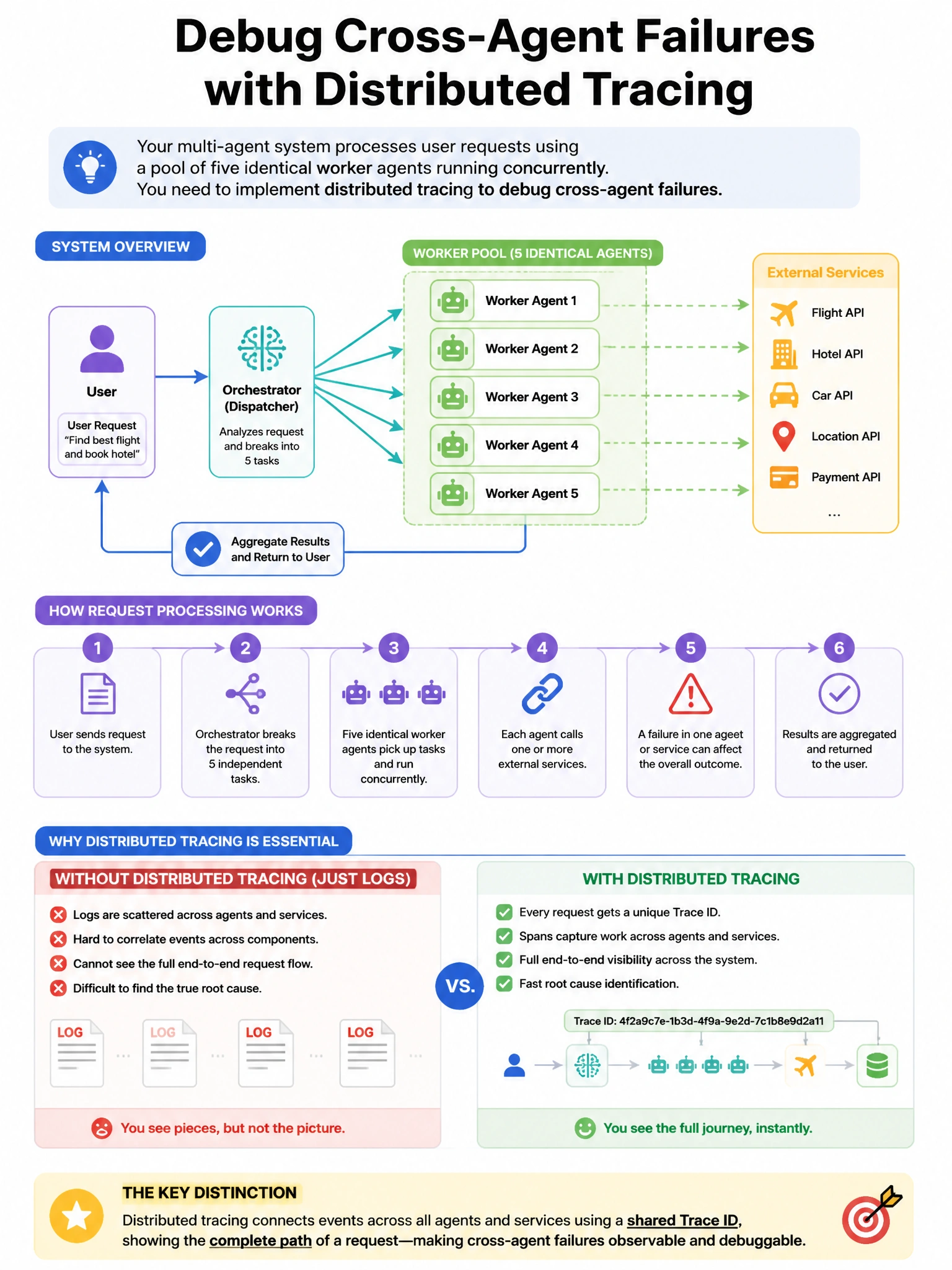
Your multi-agent system processes user requests using a pool of five identical worker agents running concurrently. You need to implement distributed tracing to debug cross-agent failures. A request for a complex analysis spawns three workers simultaneously. When the final response is wrong, you need to identify which worker introduced the error. What tracing design is necessary?
Select an answer to reveal the explanation.
Short Explanation and Infographic
Here's the deal — a is correct because distributed tracing with hierarchical trace/span IDs is the standard solution for attribution in concurrent multi-agent systems. The root trace ID correlates all activity for a single user request.
Full explanation below image
Full Explanation
A is correct because distributed tracing with hierarchical trace/span IDs is the standard solution for attribution in concurrent multi-agent systems. The root trace ID correlates all activity for a single user request. Individual span IDs for each worker allow independent logging of inputs, tool calls, and outputs without collision. When the final response is wrong, the orchestrator's log of which worker outputs were used in synthesis provides the causal chain, and the worker's span log reveals what context and tool calls produced that output. B is wrong because timestamp comparison only establishes ordering, not causality — it cannot identify which worker's output was used in the final synthesis or what inputs that worker received. C is wrong because running each worker three times triples cost and latency and provides consistency measurement, not error attribution — a worker that consistently produces wrong outputs will be consistently wrong in three runs. D is wrong because self-reported confidence scores are not reliable indicators of error — workers may be confidently wrong, and there is no standard for how different Claude instances calibrate confidence in structured outputs.