
A developer is implementing a Claude-based coding assistant that generates Python code. The system should ensure all generated code can be executed without syntax errors. Testing shows 94% of generated code is syntactically valid but 6% has errors. What is the most architecturally robust quality assurance design?
Select an answer to reveal the explanation.
Short Explanation and Infographic
Here's the deal — b is correct because a parse-validate-retry loop converts a probabilistic output quality problem into a deterministic quality guarantee. Python's ast.parse() is a fast, reliable syntax validator.
Full explanation below image
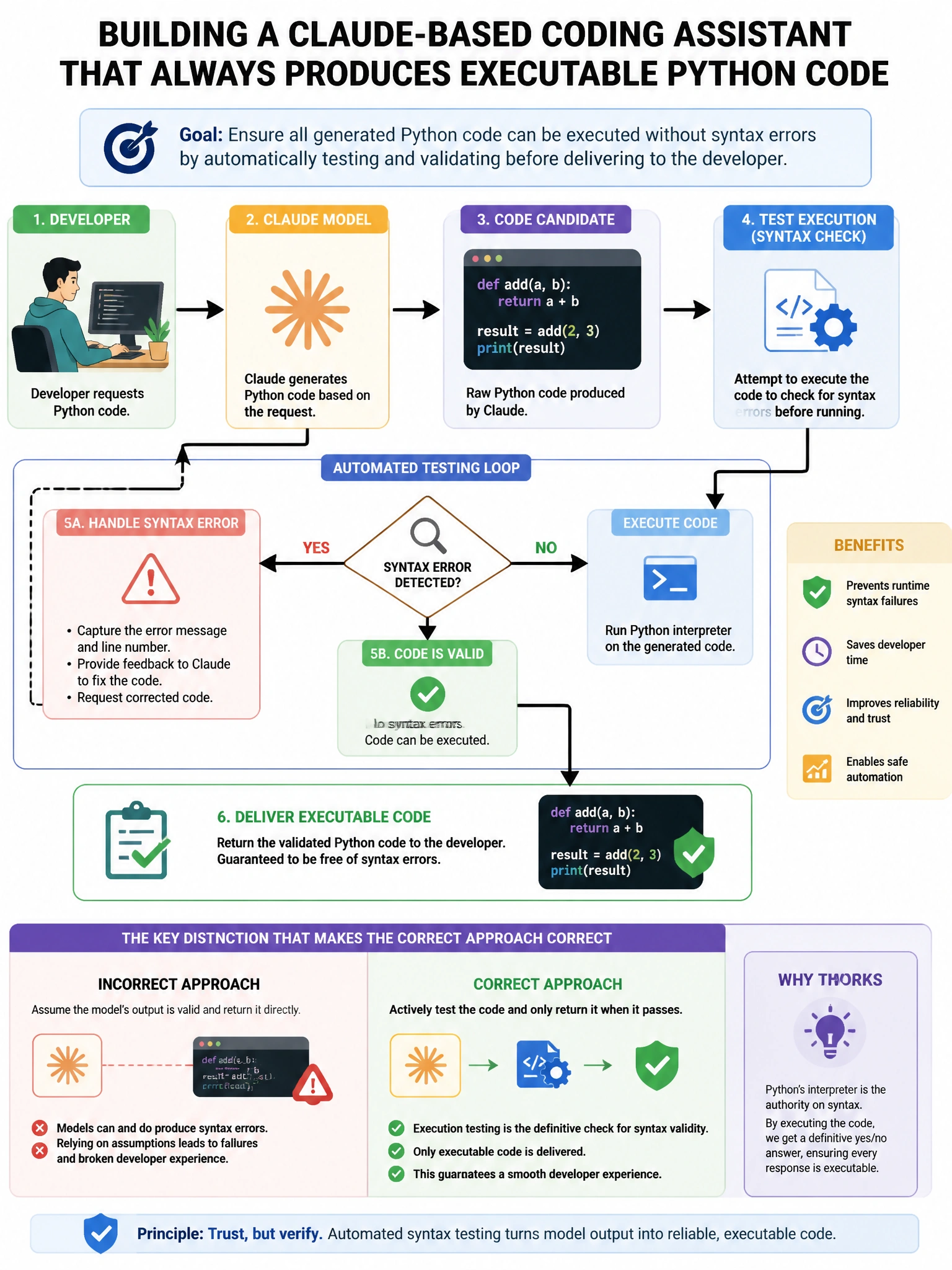
Full Explanation
B is correct because a parse-validate-retry loop converts a probabilistic output quality problem into a deterministic quality guarantee. Python's ast.parse() is a fast, reliable syntax validator. When syntax errors are found, providing Claude with the specific error message enables targeted correction — Claude is effective at fixing its own errors when given clear feedback. Logging fix attempts provides signal for prompt improvement over time, reducing the base 6% error rate. A is wrong because increasing instruction prominence for an LLM has diminishing returns — the 6% failure rate is an inherent statistical property of the model on this task, and repetition of instructions does not drive it to zero. Engineering validation is more reliable. C is wrong because even code-specialized models produce syntax errors, and the 'near-zero error rate' claim overstates the reliability of any probabilistic model; the validation loop is still necessary for production-grade guarantees. D is wrong because Black is a code formatter, not a syntax fixer — it rejects code that fails to parse rather than correcting syntax errors, and running Black on a syntax-invalid file raises an exception.