
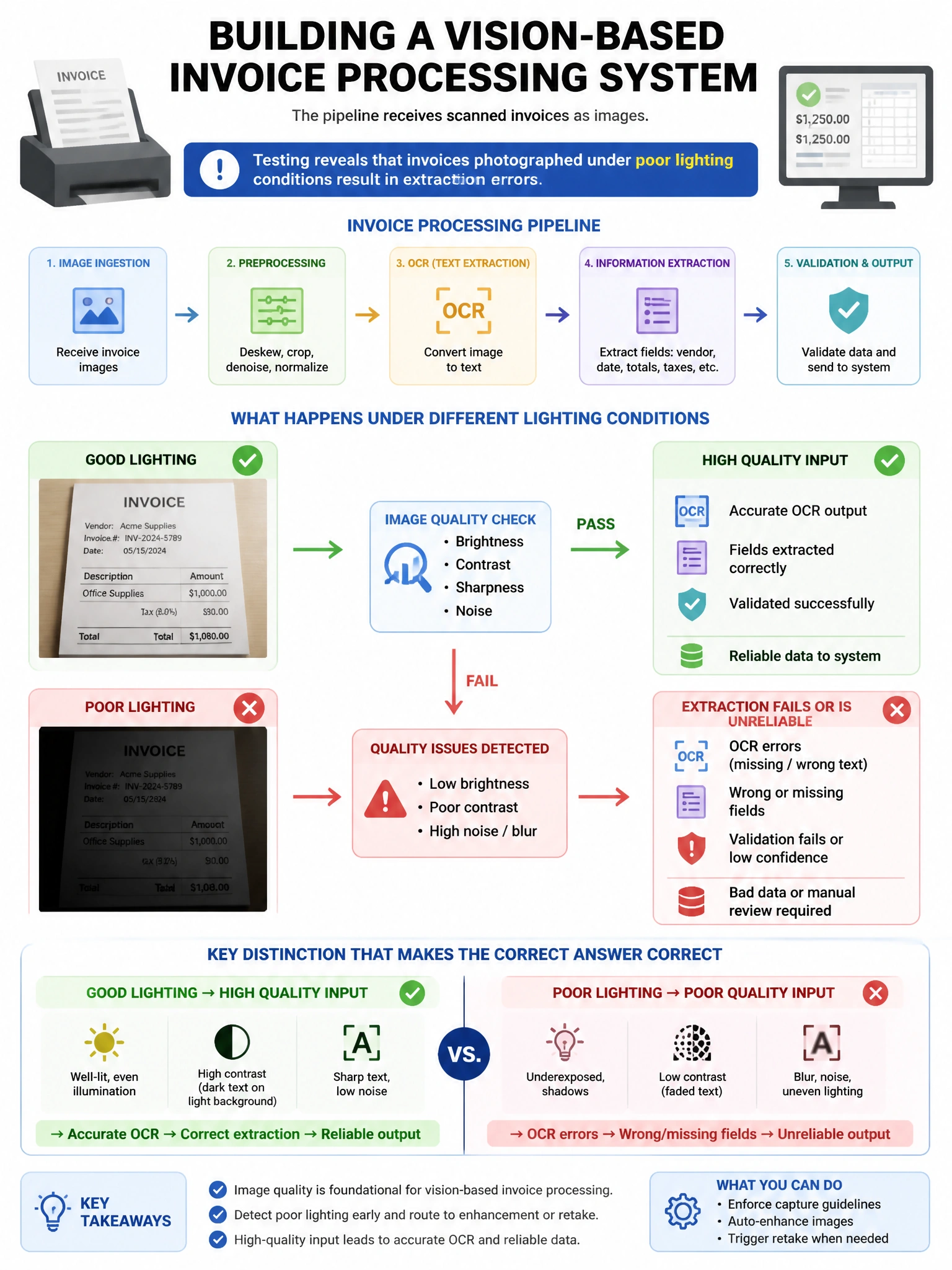
You are building a vision-based invoice processing system. The pipeline receives scanned invoices as images. Testing reveals that invoices photographed under poor lighting conditions (high contrast shadows, overexposed regions) result in significantly lower extraction accuracy. Before sending images to Claude's vision API, what preprocessing should the architect implement?
Select an answer to reveal the explanation.
Short Explanation and Infographic
Here's the deal — c is correct because the described failures (high contrast shadows, overexposed regions) are image quality problems that preprocessing can directly mitigate. CLAHE normalizes local contrast without globally washing out the image.
Full explanation below image
Full Explanation
C is correct because the described failures (high contrast shadows, overexposed regions) are image quality problems that preprocessing can directly mitigate. CLAHE normalizes local contrast without globally washing out the image. Skew correction ensures text orientation is consistent. Minimum resolution (150+ DPI for text) ensures characters are legible at the pixel level. These are standard document image preprocessing steps that have a direct, measurable impact on OCR and vision model accuracy. A is wrong because converting to grayscale eliminates color information that can be useful for distinguishing printed text from stamps, logos, or highlighted fields on colored invoice templates — and it does not address the lighting normalization problem. B is wrong because sending multiple exposures requires multiple API calls per invoice (multiplying cost and latency) and averaging extractions from a poorly exposed original with other poorly exposed variants does not correct the root problem. D is wrong because temperature controls output sampling randomness and has no effect on how the model perceives visual content — increasing temperature would make extractions less consistent, not more accurate.